
The FDA doesn’t guess when a foodborne illness outbreak happens. It doesn’t wait weeks to track down contaminated food. Instead, it uses a single, powerful tool: the traceability lot code. This isn’t just a label on a box. It’s the key that unlocks the entire supply chain - from farm to store - and lets regulators find the exact source of contamination in hours, not days.
Why Lot Numbers Matter More Than Ever
Before 2022, tracing a contaminated bag of spinach or a batch of contaminated cheese could take weeks. Investigators had to call dozens of suppliers, sift through paper records, and piece together shipments like a puzzle with missing pieces. That delay meant more people got sick. In 2018, an E. coli outbreak linked to romaine lettuce took nearly three months to trace. Over 200 people were infected. Five died. The FDA’s Food Traceability Rule, finalized in November 2022, changed all that. It didn’t just improve tracking - it forced the entire food industry to rethink how they label and track products. The rule applies to foods on the Food Traceability List (FTL), which includes high-risk items like leafy greens, tomatoes, onions, fresh-cut fruits and vegetables, nut butters, cheeses, and certain seafood. These foods make up about 15% of the U.S. food supply, but they’re responsible for a disproportionate share of outbreaks.What Is a Traceability Lot Code (TLC)?
A traceability lot code (TLC) is an alphanumeric identifier assigned to a specific group of food products at key points in the supply chain. It’s not your company’s internal lot number - unless it meets the FDA’s rules. The TLC must be unique across the entire system, not just within one company. That means if a farm assigns TLC #2024-05-12-LG001 to a pallet of lettuce, that same code must be passed along unchanged when it’s shipped to a distributor, then to a retailer. No renumbering. No confusion. The TLC is the anchor point. Every time the food changes hands - whether it’s packed, received, or transformed - the TLC stays with it. And it’s linked to seven other critical pieces of information, called Key Data Elements (KDEs): where the code was assigned, what the product is, how much there is, the unit of measure, who received it, when it was received, and the transaction details. Without all seven, the trace is broken.When and Where the Code Is Assigned
The FDA doesn’t let companies assign TLCs whenever they want. There are only three legal points in the supply chain where a TLC can be created:- When raw agricultural commodities (like lettuce or tomatoes) are first packed - unless they come from a fishing vessel
- When seafood from a fishing vessel is first received on land
- When food is transformed - like when tomatoes are turned into salsa, or spinach is washed and packaged as a salad mix

How the FDA Uses the Code During an Outbreak
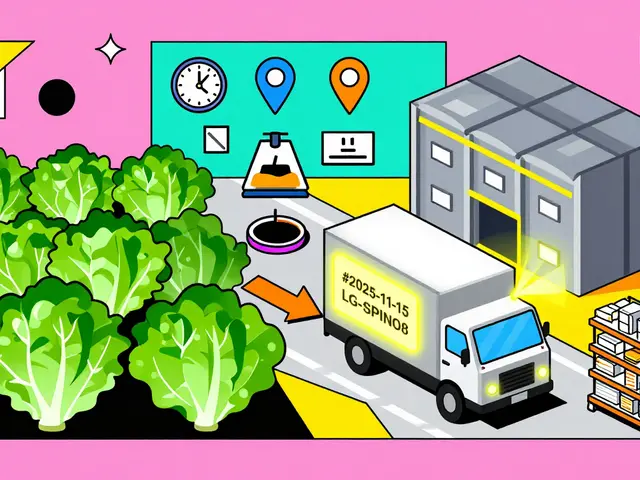
Imagine a cluster of Salmonella cases pops up in Ohio, Illinois, and Texas. The CDC flags it as a possible foodborne outbreak. The FDA gets the alert. They start asking: What did all the patients eat? A common food is identified - say, pre-packaged spinach. The FDA calls the retailer who sold the spinach and asks for the TLC on the affected packages. Within minutes, the retailer pulls up the electronic record. The TLC is #2025-11-15-LG-SPIN08. The FDA sends that code to the distributor. The distributor responds: “We received this from Farm X on November 12.” The FDA contacts Farm X. The farm’s records show: “We harvested this batch from Field 7 on November 10. We packed it on November 11.” That’s it. In less than 24 hours - the legal deadline for responding to an FDA request - they’ve traced the contamination back to a single field. The FDA can issue a targeted recall. They can warn consumers who bought that specific batch. They can test soil samples from Field 7. And they can stop the outbreak before it spreads further.What Happens If You Don’t Comply?
The rule isn’t optional. It’s enforceable. Companies handling FTL foods must keep electronic records of all KDEs linked to each TLC. These records must be sortable and exportable - in formats like CSV or XML - so the FDA can quickly pull data during an investigation. Paper records are allowed, but they’re slow. And slow means more people get sick. If a company fails to provide records within 24 hours of an FDA request, the agency can take action. That could mean holding shipments, issuing warning letters, or even initiating a seizure of product. For small businesses, the cost of non-compliance isn’t just financial - it’s reputational. A single outbreak tied to poor traceability can destroy a brand.
Industry Challenges and Real-World Fixes
Not everyone was ready. A 2023 survey found that 71% of companies struggled to get their supply chain partners to use TLCs consistently. Some small farms didn’t have the software. Some distributors used different systems. Many companies ended up running two systems - their old internal lot codes and the new TLCs - just to be safe. The FDA heard these concerns. In response, they clarified: your existing lot code can be your TLC - as long as it’s unique, passed along correctly, and linked to all seven KDEs. That’s a huge relief. Many companies simply updated their ERP systems to include the required fields. Others turned to traceability software like IBM Food Trust or SAP’s supply chain tools. A few small operators still use spreadsheets - but they’re being helped by the FDA’s Traceability Assistance Program, launched in January 2023.The Bigger Picture: Technology and the Future
The TLC system is just the beginning. The FDA is already working on standardized electronic formats for KDEs, with a draft expected in mid-2024. They’re testing blockchain and IoT sensors to automatically log temperature, location, and handling conditions in real time. Walmart’s been using blockchain for leafy greens since 2019 - and now, the FDA’s rules are catching up. But the biggest question is: will the list grow? Right now, melons, sprouts, and ready-to-eat meals aren’t on the FTL - even though they’ve been linked to outbreaks. FDA Commissioner Robert Califf has said these foods are under active review. If they’re added, the system’s impact will multiply.What This Means for You
If you buy food - especially leafy greens, tomatoes, or fresh-cut produce - you’re benefiting from this system. It means fewer outbreaks. Fewer hospitalizations. Fewer deaths. It means when something goes wrong, the system doesn’t just react - it responds fast, precisely, and effectively. For businesses, it’s a cost. For consumers, it’s safety. And for the FDA, it’s the most powerful tool they’ve had since the Bioterrorism Act of 2002. The traceability lot code isn’t just a label. It’s a lifeline.What is a traceability lot code (TLC)?
A traceability lot code (TLC) is a unique alphanumeric identifier assigned to a specific batch of food on the FDA’s Food Traceability List. It must be passed along unchanged through the supply chain and linked to seven key data elements, allowing the FDA to quickly trace contaminated products back to their source during foodborne illness investigations.
Which foods are covered by the FDA’s traceability rule?
The rule applies to foods on the Food Traceability List (FTL), which includes high-risk items like leafy greens, tomatoes, onions, fresh-cut fruits and vegetables, nut butters, cheeses, eggs, and certain seafood. These represent about 15% of the U.S. food supply by volume. Melons and sprouts are currently under review for possible future inclusion.
When does the FDA’s traceability rule take effect?
The rule became effective on December 13, 2022. However, the FDA proposed and is currently considering a 30-month extension of the compliance deadline to July 20, 2028, to give businesses more time to implement systems. Until then, companies are encouraged to prepare.
Can I use my existing lot code as the traceability lot code?
Yes. The FDA explicitly states that any existing lot code you use internally can serve as the traceability lot code - as long as it’s unique across the supply chain, consistently passed along, and linked to all seven required Key Data Elements. You don’t need a separate code unless your current one doesn’t meet these criteria.
How quickly must companies respond to FDA requests for traceability records?
Companies must provide all traceability records - including the TLC and all seven Key Data Elements - within 24 hours of an FDA request during an investigation. This deadline is strict and applies whether records are stored electronically or on paper.
Why doesn’t the FDA require blockchain or digital tracking?
The FDA’s rule focuses on data - not technology. It requires that traceability records be electronic, sortable, and exportable, but it doesn’t mandate any specific system like blockchain. This gives businesses flexibility. However, companies like Walmart and Kroger are already using blockchain because it makes compliance easier and improves supply chain transparency.
How does this rule help prevent foodborne illness?
By cutting trace-back time from weeks to hours, the rule allows the FDA to isolate and remove contaminated products before they spread widely. FDA estimates this could reduce foodborne illness outbreaks by 20-30%. Faster recalls mean fewer people get sick, fewer hospitals are overwhelmed, and public trust in the food supply stays stronger.

December 16, 2025 AT 08:20 AM
This is the kind of system that actually saves lives. No fluff, no delays, just clean traceability. I used to worry about my salad. Now I feel safer.
December 17, 2025 AT 08:46 AM
The fact that the FDA can now pinpoint a contaminated field in under 24 hours instead of months is a game changer. This isn’t bureaucracy - it’s public health infrastructure.
December 19, 2025 AT 08:30 AM
I work in a small farm co-op and we were terrified of this rule. Turns out we just had to update our label printer and link our existing lot codes. No new software needed. The FDA actually listened.
December 20, 2025 AT 11:07 AM
This is what happens when you stop letting ‘small businesses’ hide behind paper records! The FDA finally enforced REAL accountability. If you can’t track your product electronically, you shouldn’t be selling it. Period.
December 22, 2025 AT 01:07 AM
In India we use batch codes for spices but nothing like this. The KDEs make sense - location, time, who handled it. Simple. I wish our food safety had this. We lose too many people to bad produce.
December 23, 2025 AT 12:00 PM
The 24-hour compliance window is non-negotiable and rightly so. Delayed traceability equals preventable illness. This rule reflects a mature, science-based regulatory framework that prioritizes consumer safety over operational convenience.
December 24, 2025 AT 21:37 PM
I used to think this was just paperwork. Then my cousin got sick from a recalled batch. Turns out, without this code, they didn’t even know which store had the bad stuff. Now I’m glad it’s mandatory.
December 25, 2025 AT 03:04 AM
This is not merely a regulatory triumph - it is a paradigmatic renaissance in food safety architecture. The traceability lot code functions as a digital fingerprint for alimentary integrity, ensuring that the sanctity of the consumer’s right to safe nourishment is no longer a rhetorical aspiration, but a quantifiable, executable reality.
December 26, 2025 AT 18:38 PM
The KDEs are the real MVP. Without transaction details and unit of measure, the TLC is just a number. I’ve seen companies mess this up - they track the code but forget the ‘when’ or ‘who’. Then the whole trace breaks. Gotta nail all seven.
December 26, 2025 AT 20:54 PM
Americans think they invented food safety. Meanwhile, the EU has had blockchain traceability since 2017. This is just catching up. And it’s still optional tech. Pathetic.
December 28, 2025 AT 12:25 PM
The FDA’s decision to allow existing lot codes to serve as TLCs was pragmatic. It prevented unnecessary disruption while maintaining data integrity. This balance between regulation and operational feasibility deserves recognition.