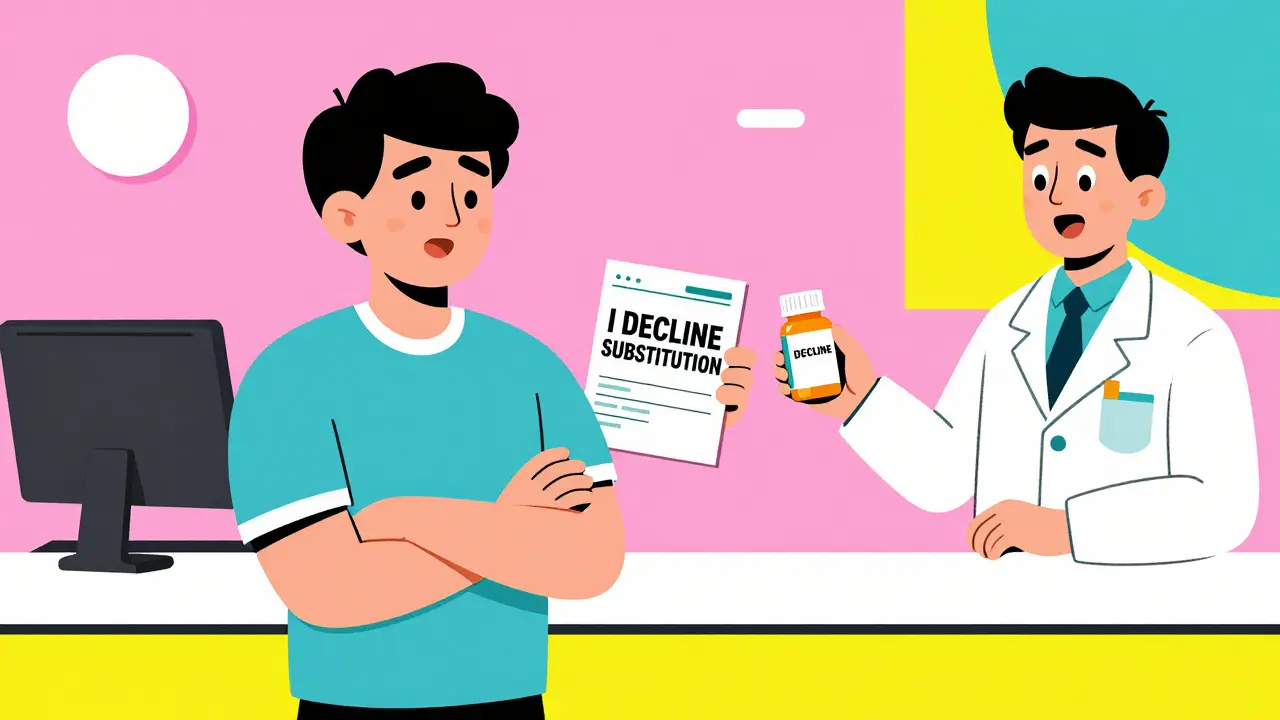
When you pick up a prescription, you might not realize you have the right to say no. Pharmacists in the U.S. can swap your brand-name drug for a cheaper generic version - but you don’t have to accept it. Many patients don’t know this. They assume the pharmacist is just doing their job. But under federal and state laws, you have clear rights to insist on the exact medication your doctor prescribed - even if it costs more.
Why Pharmacists Substitute Generic Drugs
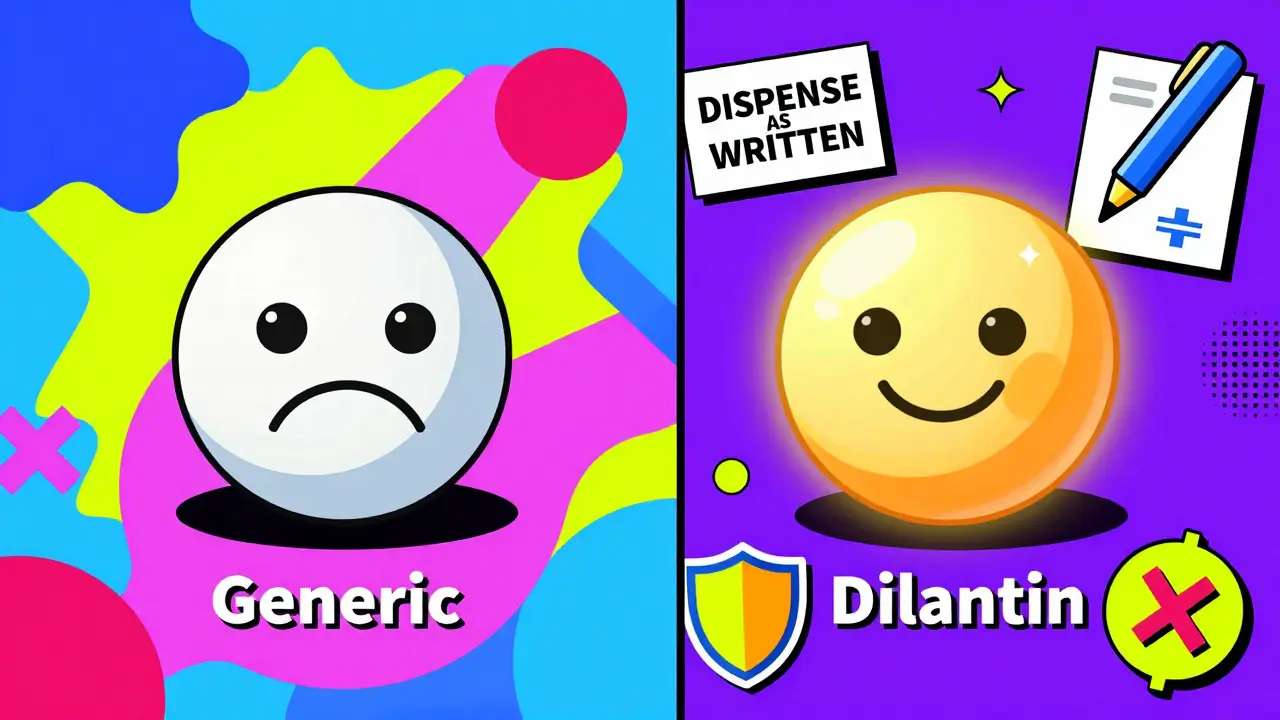
Generic drugs look and work the same as brand-name versions. They contain the same active ingredient, dose, and route of administration. The FDA requires them to be bioequivalent - meaning they deliver the same amount of medicine into your bloodstream at the same rate. That’s why most doctors and insurers encourage generics. They’re cheaper. Often 80-85% cheaper. Pharmacies make more money when they dispense generics. Pharmacy Benefit Managers (PBMs) - the middlemen that manage drug plans for insurers - push substitution hard. They get rebates from generic manufacturers. In 2023, 92% of all prescriptions filled in the U.S. were generics. But that doesn’t mean every patient should take them. Some drugs are not interchangeable. For example, levothyroxine (used for thyroid conditions) and antiepileptic drugs like phenytoin have a narrow therapeutic index. That means tiny changes in blood levels can cause serious side effects - or make the drug stop working entirely. A 2019 lawsuit in Michigan involved a patient who had seizures after an automatic switch from brand-name Dilantin to a generic. The pharmacy was found liable.Your Legal Right to Refuse
You don’t need a doctor’s note to refuse a generic. You just need to say it out loud. In 43 states, simply stating “I decline substitution” at the pharmacy counter is legally binding. The pharmacist must honor it. No questions asked. No extra paperwork. No arguing. But not all states are the same. Some require the pharmacist to get your written or verbal consent before switching. Others let them swap automatically unless the doctor writes “dispense as written” on the prescription. Here’s how it breaks down:| State Type | Number of States | What Happens |
|---|---|---|
| Automatic Substitution Allowed | 19 | Pharmacist can switch without asking - unless doctor says "dispense as written" |
| Require Patient Notification | 31 + DC | Pharmacist must tell you before switching - verbally or in writing |
| Require Patient Consent | 7 + DC | You must say yes - in person or in writing - before any substitution |
When Brand-Name Drugs Are Necessary
Not all drugs are created equal. Some patients react differently to inactive ingredients - like dyes, fillers, or preservatives - that vary between brands and generics. These are called excipients. For people with allergies, autoimmune conditions, or chronic illnesses, even small changes can cause problems. The FDA’s Orange Book lists which drugs are rated as therapeutically equivalent (AB-rated). Most are safe to swap. But some drugs - especially those with a narrow therapeutic index - are rated BX. That means they’re not considered interchangeable. Examples include:- Levothyroxine (Synthroid, Unithroid)
- Warfarin (Coumadin)
- Phenytoin (Dilantin)
- Valproic acid (Depakote)
- Cyclosporine (Neoral, Sandimmune)
What to Say at the Pharmacy
You don’t need to be confrontational. You just need to be clear. Here’s what works:- When the pharmacist says, “We have a generic today,” reply: “I decline substitution.”
- If they push back: “I’m entitled to the brand-name drug under [your state] law.”
- If they say, “It’s cheaper with the generic,” ask: “What’s the cash price for the brand?” Sometimes paying out-of-pocket for the brand is cheaper than your insurance co-pay.
- If they refuse: Ask for the manager. Say: “I’d like to file a complaint with the State Board of Pharmacy.” Most pharmacists will back down.
What If the Brand Is Too Expensive?
You can still get the brand-name drug without breaking the bank. Many manufacturers offer patient assistance programs. Pfizer, Merck, and AbbVie all have programs that give free or low-cost brand-name drugs to qualifying patients. You can apply online in minutes. Also, check GoodRx or SingleCare. These apps often show the cash price for brand-name drugs - and sometimes it’s lower than your insurance co-pay. That’s because PBMs negotiate prices behind the scenes. The pharmacy might be able to fill your script at the cash price even if you’re using insurance. The 2018 Know the Lowest Price Act banned “gag clauses” that stopped pharmacists from telling you this. So now, they’re legally required to say: “You can pay $15 cash for this brand, or $45 with your insurance.”What to Do If You’re Switched Without Consent
If you find out your medication was switched without your knowledge - and you had side effects - act fast. 1. Stop taking the new drug. Contact your doctor immediately. 2. Call the pharmacy. Ask for a copy of the dispensing record. They’re required to keep it for 10 years. 3. File a complaint. Every state has a Board of Pharmacy. They investigate these cases. You can file online - no lawyer needed. 4. Notify your doctor. Ask them to write “dispense as written” on all future prescriptions. A 2021 Consumer Reports survey found 28% of patients who tried to refuse substitution were turned away. Some pharmacists claimed they “had to” substitute. That’s false. If your state requires consent, they can’t do it without you.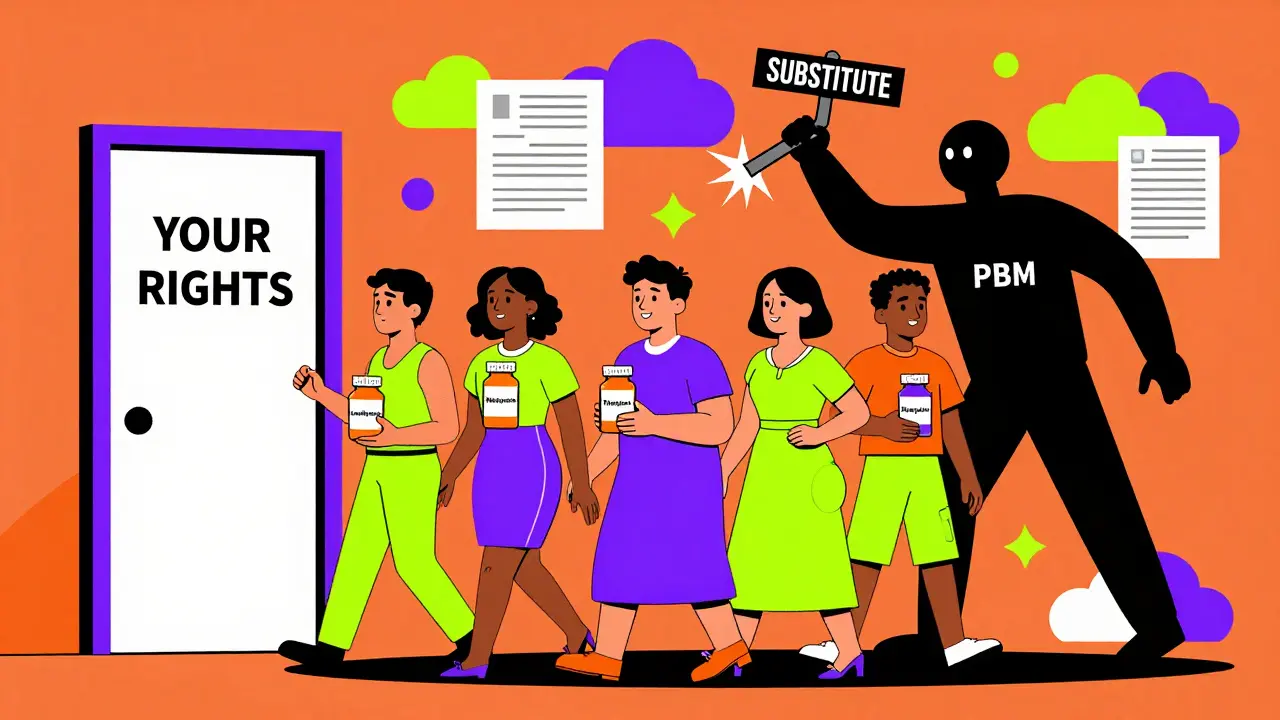
How to Protect Yourself Long-Term
- Keep a list of all your medications and whether you’ve refused substitution in the past. - Ask your doctor to write “dispense as written” on any prescription for a drug with a narrow therapeutic index. - Use the same pharmacy so your history is tracked. - Check your pill bottles every time. If the shape, color, or name changed - ask why. - Save receipts and pharmacy communication. If something goes wrong, you’ll need proof. The FDA and CDC both warn that switching medications without oversight can lead to hospitalizations. For people with epilepsy, heart disease, or thyroid disorders, even a small change can be life-changing.Frequently Asked Questions
Can a pharmacist refuse to give me the brand-name drug even if I ask for it?
No. If you say "I decline substitution," the pharmacist must honor it in 43 states. In the 7 states plus D.C. that require consent, they can’t substitute at all without your approval. If they refuse to fill your prescription, ask for the manager and file a complaint with your state’s Board of Pharmacy. This is a violation of patient rights.
Do I need a doctor’s note to get the brand-name drug?
Not always. You can refuse substitution just by saying so. But if you have a medical reason - like a reaction to a generic - your doctor can write "dispense as written" on the prescription. This legally blocks substitution in 48 states. It’s the most reliable method.
Is it true that paying cash for the brand-name drug is sometimes cheaper than using insurance?
Yes. Thanks to the 2018 Know the Lowest Price Act, pharmacists must tell you if paying cash is cheaper. Many brand-name drugs cost $15-$30 out-of-pocket, while your insurance co-pay is $40-$60. Always ask: "What’s the cash price?" You don’t need to use insurance if cash is better.
What if I’m on a biosimilar and it’s making me sick?
Biosimilars are not generics. They’re complex biologic drugs with slight variations. All 50 states and D.C. allow you to refuse substitution of biosimilars. If you were switched without your knowledge and feel worse, contact your doctor immediately. File a complaint with your state pharmacy board. The FDA tracks adverse events - your report helps protect others.
Can I switch back to the brand-name drug if I tried the generic and didn’t like it?
Yes. If you had side effects or your condition worsened, your doctor can write "dispense as written" on your next prescription. You can also refuse substitution again. Many patients find that after one bad experience with a generic, they stick with the brand - and their insurance often covers it after a prior authorization.
Next Steps
If you’re on a medication where substitution could be risky - like thyroid, epilepsy, or blood thinners - take action now:- Call your doctor and ask them to write "dispense as written" on your next prescription.
- Check your state’s pharmacy board website for substitution laws.
- Download GoodRx or SingleCare and compare cash prices for your brand-name drug.
- Keep a printed copy of your state’s law in your wallet.
- When you pick up your script, say: "I decline substitution." Then walk out with the right medicine.

February 7, 2026 AT 02:48 AM
This is the kind of info everyone needs to know. I used to just take whatever they handed me until my thyroid went haywire after a generic switch. Now I say 'I decline substitution' every time. No drama, no fuss. Just keep my life stable.
February 7, 2026 AT 04:12 AM
THEY’RE ALL LYING. Pharmacists don’t give a damn about your rights. Big Pharma and PBMs are in bed together. They’ve been swapping drugs since the 90s and covering it up. You think the FDA really checks bioequivalence? HA. I’ve seen generics that look like chalk dust. Your 'therapeutic equivalence' is a marketing lie. They’re playing you. Wake up.
February 7, 2026 AT 04:43 AM
I’ve been on levothyroxine for 12 years. Switched once. Seizure-like panic attacks for 3 days. Never again. Say 'I decline substitution' like your life depends on it. Because it does.
February 8, 2026 AT 11:30 AM
so like... the whole generic thing is just a scam? i mean, i get that some people react bad but like... 92% of prescriptions are generics? that’s like... 92% of people being fine? idk man. maybe we just need better labeling? or something? i’m just sayin’
February 8, 2026 AT 14:30 PM
This is a profoundly important public health issue. In India, where I come from, the regulatory framework for generics is far less stringent. Many patients suffer irreversible harm due to inconsistent excipients. The fact that U.S. law recognizes patient autonomy in this context is commendable. However, awareness remains critically low. We must advocate for mandatory pharmacist counseling on substitution risks - not just as a legal formality, but as a moral imperative.
February 10, 2026 AT 06:08 AM
I had no idea about any of this until my mom had a stroke after switching from Coumadin to a generic. She was stable for 8 years. Then one day, her INR went off the charts. They said 'it's the same thing.' But it wasn't. The fillers were different. She spent 3 months in rehab. Now I carry a printed copy of the state law in my wallet. I hand it to every pharmacist. I don't care if they roll their eyes. My mom's life is not a cost-cutting experiment.
February 11, 2026 AT 01:51 AM
i just say i decline substitution and they always give me the brand. no big deal. also goodrx saved me like 50 bucks last month on my zoloft. chill out people its not rocket science
February 12, 2026 AT 14:50 PM
Honestly? You’re all missing the point. The real issue isn’t substitution - it’s that our healthcare system is designed to turn human beings into data points. You think your thyroid is special? Your epilepsy? Your 'narrow therapeutic index'? Newsflash: they’ve been doing this since Nixon. The system doesn’t care if you live or die. It cares about margins. So yes - say 'I decline substitution.' But also? Burn the whole thing down. We need single-payer. We need drug price caps. We need to stop treating medicine like a vending machine. This post? It’s a bandaid on a severed artery.
February 14, 2026 AT 14:07 PM
I love how this post is so calm and factual. Meanwhile, I’ve been yelling at pharmacists since 2017. One guy said 'it’s just a pill.' I replied, 'then why is my prescription handwritten and not stamped 'generic'?'. He shut up. Sometimes you just have to be polite and unshakable. And if they still push? Ask for the manager. Always.
February 16, 2026 AT 13:33 PM
people are so dramatic about this. if you cant afford the brand name then tough. you shouldnt be on expensive meds anyway. its not like you need to live. just take the generic. and stop making everything a personal crusade. i mean come on
February 18, 2026 AT 05:35 AM
This is so important. I always say 'I decline substitution' - even if I know the generic is fine. Because I want to set the precedent. I want them to know I’m not just a patient who’ll take whatever. I’m someone who knows their rights. It’s not about money. It’s about agency.
February 18, 2026 AT 08:16 AM
just say no. simple. done. no drama. no paperwork. they have to listen. trust me
February 19, 2026 AT 07:27 AM
i had no idea about the cash price thing. i was paying $50 with insurance for my brand name seizure med. checked goodrx - it was $18 cash. i paid cash. my insurance didn’t even process it. i felt like a genius. also i now carry my state law printed out. i’m not ashamed. this is life or death
February 20, 2026 AT 07:16 AM
I’m not even mad. I’m just disappointed. You’re all treating this like some new discovery. I’ve been fighting this since 2012. I’ve filed 3 complaints. I’ve called senators. I’ve written letters to the FDA. And guess what? NOTHING CHANGES. The system is rigged. You say 'I decline substitution'? Cool. They’ll just refill your script with the generic anyway. And if you complain? They’ll say 'you didn’t say it loud enough.' So yeah. Say it. But don’t expect justice. Just expect to be tired.
February 21, 2026 AT 16:40 PM
americans think they’re special because they can say no. in other countries we dont even get to choose. so stop acting like this is some huge win. you just got basic rights. now go be grateful
February 23, 2026 AT 13:19 PM
I’m Canadian. We don’t have this problem. Our government negotiates drug prices. Brand-name drugs cost the same as generics. No switching. No drama. Just access. Maybe we should stop treating healthcare like a marketplace and start treating it like a human right.
February 25, 2026 AT 00:00 AM
I mean... I guess it’s nice that you can refuse? But honestly, do you really think it matters? Like... the drug’s the same. The active ingredient. The dosage. The science. You’re just... being extra. I don’t get the panic. It’s a pill. It’s not a bomb.
February 26, 2026 AT 14:49 PM
so like... if you're on levothyroxine and you switch generics, you might get a seizure? okay. but what if you're on, idk, ibuprofen? do you need to say no then too? because i feel like this whole thing is being blown out of proportion. not everything needs to be a battle.