Drug Side Effect Risk Calculator
How It Works
Select your medication, indicate your health history, and we'll assess your risk for predictable and unpredictable side effects.
Your Risk Assessment
Predictable Side Effects
Unpredictable Side Effects
Recommendations
When you take a medication, you expect it to help. But sometimes, it does something unexpected - and dangerous. Not all side effects are the same. Some you can see coming. Others strike out of nowhere. Understanding the difference between predictable and unpredictable side effects isn’t just academic - it’s the difference between a minor inconvenience and a life-threatening emergency.
What Are Predictable Side Effects?
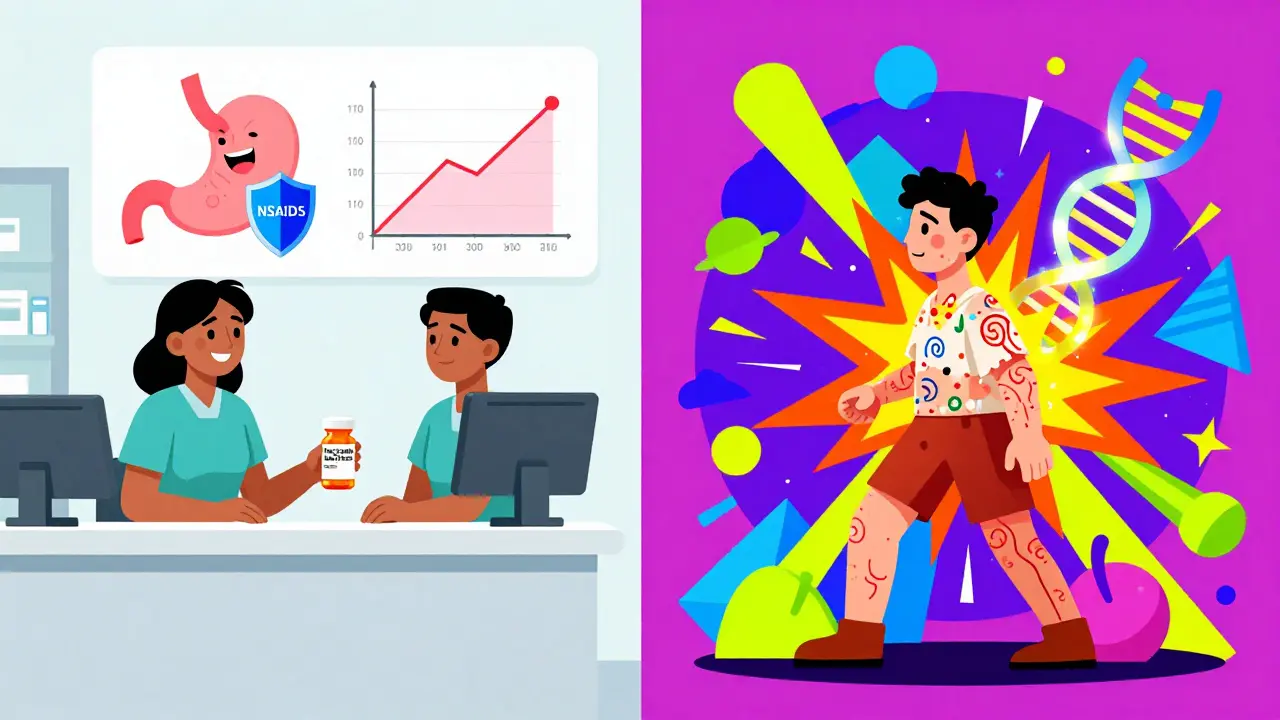
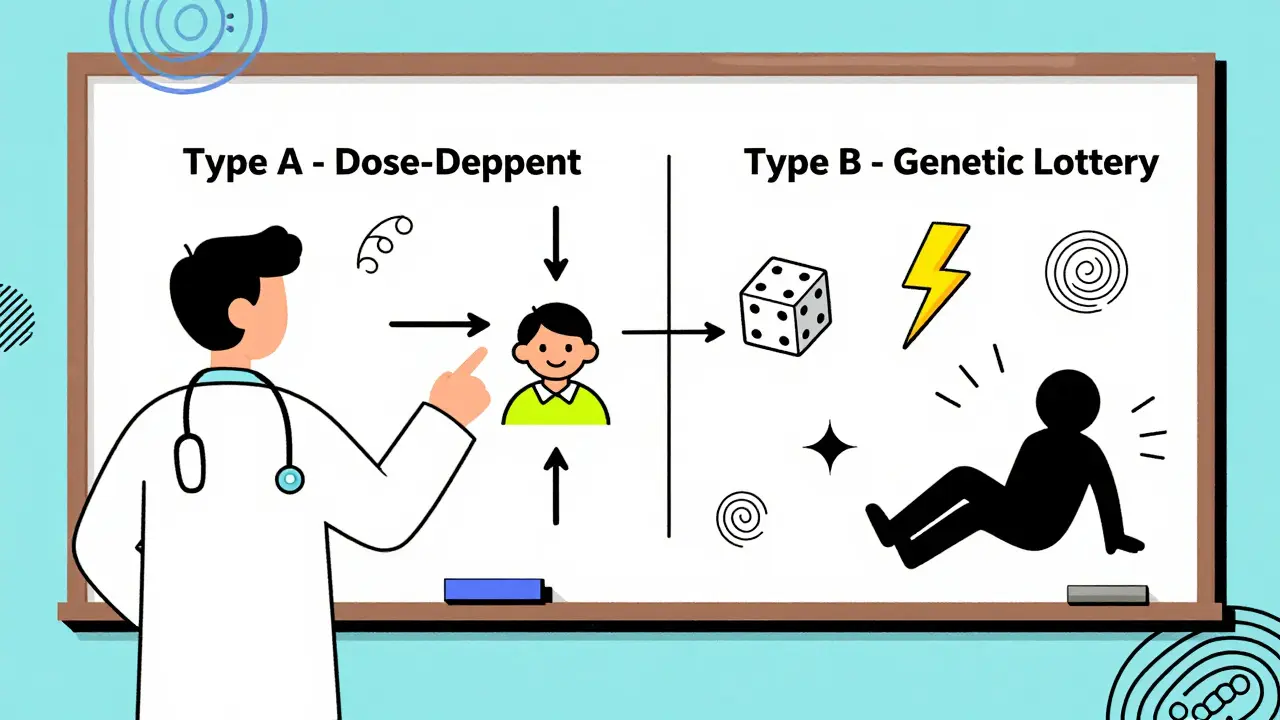
Predictable side effects, known as Type A reactions, make up about 75-80% of all adverse drug reactions. These aren’t surprises. They happen because the drug does exactly what it’s supposed to do - just too much, or in the wrong place. Think of them as the side effects you read about in the pamphlet inside the pill bottle.Take NSAIDs, like ibuprofen or naproxen. They reduce inflammation and pain by blocking enzymes that cause swelling. But those same enzymes also protect your stomach lining. So when you take them, you’re not just fighting arthritis - you’re quietly thinning your stomach’s natural defense. That’s why long-term use can lead to ulcers or bleeding. It’s not a glitch. It’s a direct result of the drug’s chemistry.
Same with blood pressure meds. If you take too much, your blood pressure drops too low. Too much insulin? Your blood sugar crashes. Opioids? You get drowsy. These aren’t rare. They’re common. And they’re usually dose-dependent. Double the dose? Double the risk. Cut the dose? The side effect often fades.
The good news? These reactions are usually reversible. Stop the drug, lower the dose, or tweak the timing - and things go back to normal. That’s why doctors monitor kidney function when prescribing NSAIDs, or check blood sugar in diabetics on metformin. They’re not being cautious for no reason. They’re preventing the predictable.
What Makes a Side Effect Unpredictable?
Now, imagine taking a drug you’ve used before - no changes in dose, no new health issues - and suddenly, your skin starts peeling off. Or you break out in hives, your throat swells, and you can’t breathe. This isn’t an overdose. It’s not even a common reaction. It’s unpredictable. And it’s terrifying.These are Type B reactions. They make up only 20-25% of all adverse reactions, but they’re responsible for nearly half of all serious drug-related hospitalizations and deaths. Why? Because they have nothing to do with the drug’s intended action. Instead, they’re triggered by your body’s unique biology.
Take carbamazepine, a drug used for seizures and nerve pain. In most people, it works fine. But in someone with the HLA-B*1502 gene variant - common in Han Chinese, Thai, and other Southeast Asian populations - it can trigger Stevens-Johnson syndrome. This rare, deadly condition destroys the skin and mucous membranes. The dose? Doesn’t matter. One pill can be enough. And there’s no way to know unless you get tested.
Another example: penicillin. For most, it’s safe. For others, it causes anaphylaxis - a full-body allergic reaction that can kill in minutes. No prior history? Doesn’t matter. No overdose? Irrelevant. It’s a genetic lottery you didn’t know you were playing.
These reactions aren’t just allergies. Some are idiosyncratic - meaning your body reacts in a way no one else’s does. Others are pseudoallergic, where the drug directly triggers mast cells to release histamine, even without an immune response. Think vancomycin causing "red man syndrome" - flushing and itching - not because you’re allergic, but because the drug irritates your cells.
Why This Distinction Matters
The difference between predictable and unpredictable side effects changes how doctors treat you.Predictable reactions? You can plan for them. A doctor might avoid NSAIDs in someone with a history of ulcers. Or prescribe a stomach-protecting drug alongside. Or adjust the dose based on kidney function. These are standard precautions. Easy to track. Easy to prevent.
Unpredictable reactions? Not so much. You can’t screen everyone for every possible genetic risk. HLA-B*1502 testing before carbamazepine? That’s done in some places - but not everywhere. And even then, it only covers a few known triggers. There are hundreds of other gene-drug pairs we don’t yet understand. A 2023 study found that current genetic tests can predict only about 30% of severe unpredictable reactions. That leaves 70% - invisible.
That’s why doctors still rely on vigilance. They ask: "Have you ever had a rash after a drug?" "Did your family member have a bad reaction?" "Have you ever had a strange response to antibiotics?" These aren’t just small talk. They’re lifesaving clues.
And when something unexpected happens? The first question isn’t "Did you take too much?" It’s "Is this a Type B?" Because if it is, the drug has to go - permanently. No second chances.
Real-World Examples You Can’t Ignore
A 68-year-old man in Minnesota started metformin for type 2 diabetes. Within two days, his blood sugar dropped to 48 mg/dL - dangerously low. He was hospitalized. His doctor didn’t panic. He knew metformin can cause hypoglycemia in people with kidney problems. It was predictable. The dose was adjusted. He went home.
Meanwhile, a healthy 24-year-old woman in California took a single dose of sulfamethoxazole for a urinary infection. Two days later, she was admitted with toxic epidermal necrolysis - over 30% of her skin had detached. She didn’t have a known allergy. No family history. No genetic marker. She didn’t overdose. She just… reacted. She survived, but barely. This wasn’t a mistake. It was a biological accident.
These stories aren’t rare. A 2023 survey of 427 physicians found that 78% saw NSAID-induced bleeding as their most common predictable reaction. But 63% said penicillin allergy was their most feared unpredictable one - because you never know who’s going to react.
What’s Being Done About It?
Medicine is catching up. The FDA now requires special safety programs - called REMS - for drugs with high-risk unpredictable reactions. For example, abacavir (an HIV drug) can’t be prescribed unless you test for HLA-B*5701 first. If you have it? You don’t get the drug. Period.
Pharmacogenetic testing is growing. In 2015, only 5% of U.S. hospitals did routine genetic screening for drug reactions. By 2023, that number jumped to 38%. It’s still uneven. Cardiologists test for genes that affect blood thinners. Oncologists screen for reactions to chemo. But most primary care doctors? They don’t.
AI is trying to help. Google Health trained a model on 10 million electronic health records. It could predict predictable reactions with 89% accuracy. But for unpredictable ones? Only 47%. Why? Because they’re random. They’re personal. They’re shaped by genes, environment, diet, infections - a thousand tiny factors we can’t yet measure.
Still, progress is real. In 2023, the NIH added 17 new gene-drug links to its database. One of them? HLA-B*15:02 and phenytoin - a seizure drug - even in people without Asian ancestry. That’s new knowledge. That’s a chance to prevent death.
What You Can Do
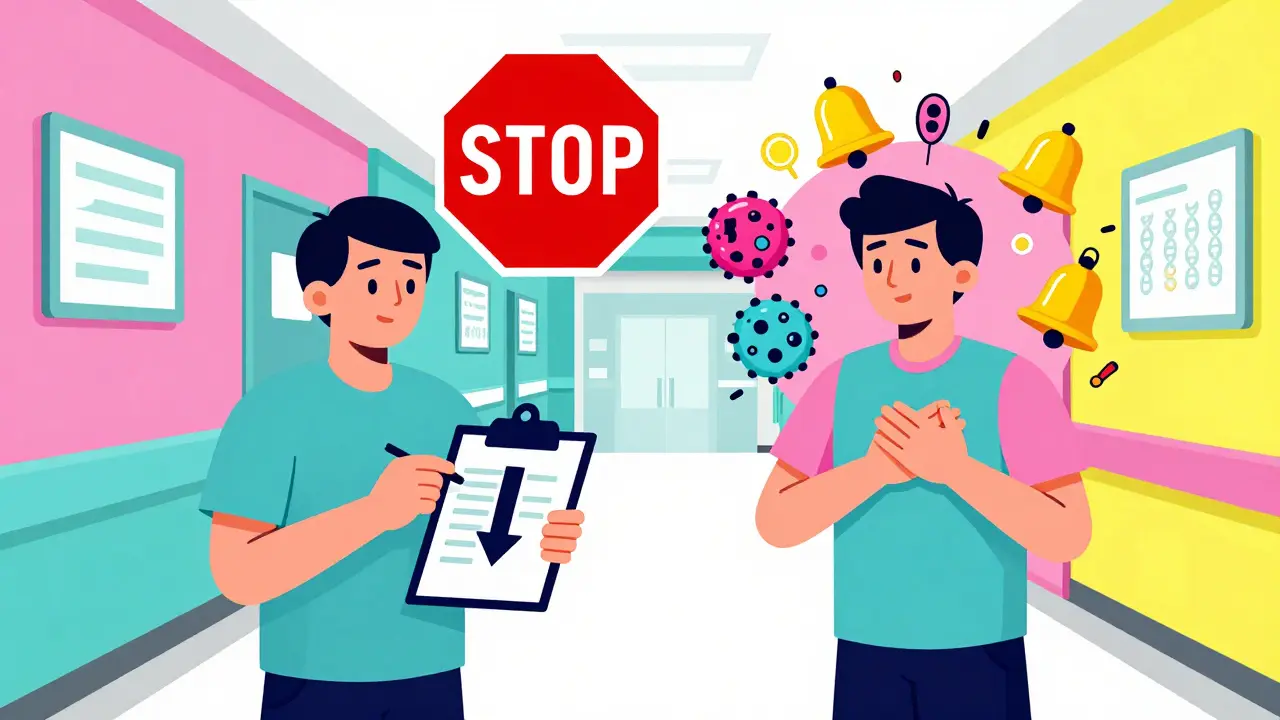
You don’t need to be a doctor to stay safe. Here’s what works:
- Know your history. Have you ever had a rash, swelling, or trouble breathing after a drug? Tell your doctor - even if it was years ago.
- Ask about testing. If you’re prescribed a drug with known genetic risks (like carbamazepine, abacavir, or allopurinol), ask if a blood test is available.
- Track your reactions. Keep a list of drugs you’ve taken and how you felt. Even "I got dizzy after that one pill" matters.
- Don’t ignore early signs. A mild rash, fever, or sore throat after starting a new drug? Don’t wait. Call your doctor. It could be the first sign of something serious.
The goal isn’t to scare you off medicine. It’s to make you a smarter partner in your care. Most side effects are harmless. But the ones that aren’t? They don’t announce themselves. They strike quietly. And if you know the difference between predictable and unpredictable - you might just catch it in time.
What’s Next?
The future of drug safety lies in personalization. Not just "this drug works for most people," but "this drug works for you - and won’t hurt you." That means more genetic testing. Better data sharing. And smarter tools that flag risks before a pill is even dispensed.
But until then, awareness is your best defense. Understand the drugs you take. Know the difference between a common side effect and a silent danger. And never assume that because it’s been safe before, it always will be.
Are all side effects dangerous?
No. Many side effects - like mild nausea, drowsiness, or dry mouth - are uncomfortable but not dangerous. They’re often predictable and go away as your body adjusts. The real concern is when side effects are severe, unexpected, or life-threatening - these are the ones that need immediate attention.
Can you predict if you’ll have an unpredictable side effect?
Sometimes, but not always. For a few drugs - like carbamazepine or abacavir - genetic testing can identify high-risk individuals. But for most unpredictable reactions, there’s no test. That’s why doctors rely on your medical history, family history, and early warning signs. If you’ve never had a bad reaction before, it doesn’t mean you never will.
Why do some people react badly to drugs others take safely?
It comes down to genetics, immune system differences, metabolism, and even gut bacteria. Two people can take the same dose of the same drug, but one person’s body may treat it like a toxin. For example, a person with G6PD deficiency can have severe anemia after taking certain antibiotics, while someone without the deficiency stays fine. These differences are unique to each individual.
Do side effects get worse with long-term use?
For predictable side effects - yes. Long-term use of NSAIDs increases stomach bleeding risk. Chronic steroid use can lead to bone loss or diabetes. But for unpredictable reactions, timing doesn’t matter. A deadly reaction can happen on the first dose. That’s why you can’t assume safety just because you’ve taken a drug for months.
If I have a side effect, should I stop the drug?
Don’t stop on your own. Call your doctor. Some side effects are normal and temporary. Others - like rash, swelling, breathing trouble, or unexplained fever - need immediate evaluation. Stopping suddenly can be dangerous for some medications, like antidepressants or blood pressure drugs. Always consult a professional.

March 6, 2026 AT 23:11 PM
Okay but let’s be real - the real danger isn’t the drug, it’s the fact that half the docs still don’t check for HLA variants unless you beg them. I had a cousin nearly die on carbamazepine because her PCP just ‘assumed’ she was fine. No test. No warning. Just ‘take it and see.’
Turns out she’s HLA-B*1502 positive. She’s lucky she didn’t lose 60% of her skin. Now she’s on a different med and alive. Why is this still not standard?
March 8, 2026 AT 17:17 PM
Predictable = dose related
Unpredictable = your DNA flipped a coin
Stop pretending it’s complicated. It’s not. We’re just bad at testing.
Test people. Save lives. Done.
March 10, 2026 AT 11:54 AM
So we’re just supposed to trust that some random guy in a lab coat knows what your body will do to a pill? Lol
Meanwhile, Big Pharma’s still pushing new drugs with zero pre-market genetic screening. They don’t care. They’ll just slap a black box warning on it after 3 people die. Classic.
March 11, 2026 AT 19:11 PM
Pharmacogenomics is not optional anymore. In India, we have high prevalence of HLA-B*1502 and G6PD deficiency. Yet, many primary care providers still prescribe carbamazepine and sulfonamides without screening. This is not negligence - it is systemic failure. We need policy change, not just awareness.
Training. Funding. Infrastructure. Now.
March 12, 2026 AT 08:40 AM
i just took like 3 different meds last week and im fine but like… what if i die tomorrow? like what if i just… suddenly… my skin just falls off? like no warning? no warning at all? that’s wild. i mean… i’m fine right now. right? right??
idk. i’m scared now. lol
March 13, 2026 AT 17:24 PM
Oh honey, you’re telling me this like it’s news? I’ve been saying for years that your body is a minefield and the pharmacy is just handing out grenades labeled ‘safe.’
And don’t even get me started on how they still don’t test for HLA variants in 90% of rural clinics. It’s not science. It’s Russian roulette with a prescription pad.
March 13, 2026 AT 20:52 PM
Big thanks for this breakdown. Seriously. I’m a nurse and I see this every day - people think ‘I’ve taken it before’ means ‘it’s safe forever.’
It’s not. I had a patient last month get Stevens-Johnson after 3 years of carbamazepine. No history. No warning. Just… poof.
Thanks for the clarity. 👍
March 14, 2026 AT 21:45 PM
Here’s the thing - we’re not failing because we don’t know. We’re failing because it’s cheaper to treat the reaction than prevent it.
Testing costs money. Liability scares hospitals. Doctors get 8 minutes per patient.
We know how to fix this. We just choose not to.
And that’s the real tragedy.
March 15, 2026 AT 19:34 PM
Interesting. In the UK, we’ve had HLA-B*5701 testing for abacavir since 2008. It’s standard. No exceptions. Result? Zero abacavir-related deaths in our NHS in the last 10 years.
Why can’t the US do the same?
It’s not a tech problem. It’s a will problem.
March 16, 2026 AT 01:47 AM
What if unpredictability isn’t a flaw in medicine… but a feature of biology?
We want control. We want predictability. But life doesn’t work that way.
Maybe the real lesson isn’t ‘test everyone’… but ‘trust nothing completely.’
Even if you’ve taken it for 10 years. Even if your doctor says it’s fine.
There’s always a silent variable.
And that’s terrifying. And beautiful.
March 16, 2026 AT 09:28 AM
Wait wait wait - so you’re saying I could take a single pill and my skin just… melts off? Like… in a movie? That’s not science. That’s horror fiction.
Next you’ll tell me my coffee could cause a stroke. I’m not buying this. It’s fearmongering.
March 17, 2026 AT 17:50 PM
This was so helpful. I’ve been on metformin for 8 years and never thought about kidney function. My doctor never mentioned it.
I’m going to ask for a GFR test this week. Thank you for making me feel like I’m not overreacting.
You’re right - it’s not about fear. It’s about partnership.
❤️
March 18, 2026 AT 14:04 PM
Let’s be clear: this entire system is a corporate farce. The FDA approves drugs based on 6-month trials with 3000 people. But side effects? They emerge in populations of millions. And when they do? They blame ‘idiosyncratic reactions.’
It’s not idiosyncratic. It’s statistical inevitability. And the pharmaceutical industry knows this. They just don’t care.
Until the lawsuits pile up.
Then they ‘reassess.’
Meanwhile, your cousin is dead.
March 18, 2026 AT 16:05 PM
Have you ever considered… that this is all a distraction? What if the real danger isn’t the drugs… but the vaccines? Or the water? Or the 5G towers? I mean… think about it. Why are they pushing genetic testing now? To normalize surveillance? To collect your DNA? This is a Trojan horse. They want your genome. And once they have it… they own you.
Just saying.
March 18, 2026 AT 23:24 PM
Oh my god I just realized - I took sulfamethoxazole last year. And I got a rash. I thought it was heat. But now I’m thinking… was that it? Was that the start? Should I be dead? Am I just… lucky? Oh my god I’m going to Google ‘toxic epidermal necrolysis’ right now.
Someone please tell me I’m not going to die in my sleep.
March 20, 2026 AT 19:25 PM
Thank you for writing this. I’m a diabetic and I’ve been on metformin for 12 years. I never knew about the kidney connection. My doctor never mentioned it. I’m scheduling a blood test tomorrow.
You’ve given me peace of mind. Not fear. Peace.
That’s the difference between information and wisdom.