
Gas Reduction Timeline Calculator
Predict Your Gas Improvement Timeline
Enter your medication and current symptom severity to see an estimated timeline for improvement.
When you're managing type 2 diabetes, every pill matters. But if you're taking acarbose or miglitol, you might be dealing with something no one warns you about: gas. Not just a little burp after lunch-real, embarrassing, all-day flatulence that makes you avoid social plans, skip meals, or even consider quitting the medication. You're not alone. Nearly 6 out of 10 people on these drugs report gas as their biggest problem. The good news? It gets better. And there are real, science-backed ways to make it manageable.
Why Do These Drugs Cause So Much Gas?
Acarbose and miglitol don’t work like most diabetes pills. Instead of pushing insulin out or making cells more sensitive, they slow down how fast your body breaks down carbs in the small intestine. That’s great for blood sugar-it stops spikes after meals. But here’s the trade-off: the undigested carbs don’t disappear. They travel down to your colon, where your gut bacteria feast on them. And when bacteria digest carbs, they produce gas. Lots of it.
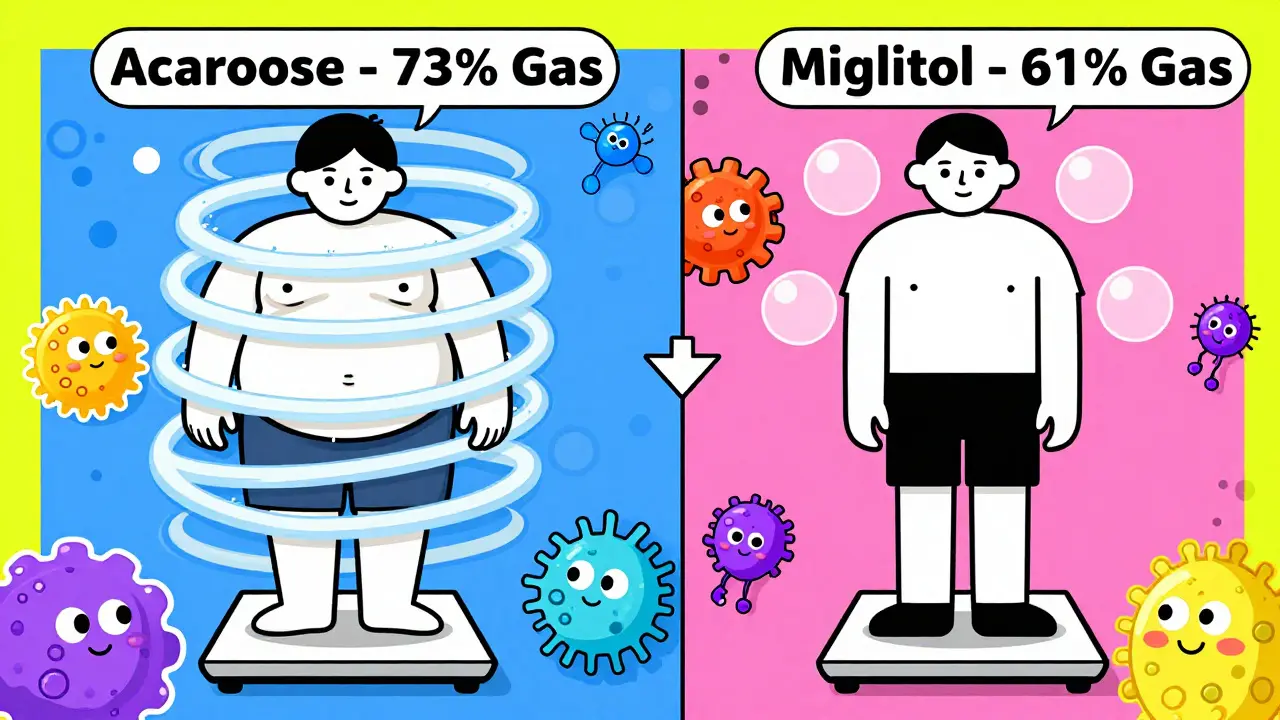
That’s why flatulence is so common. In fact, studies show up to 30% of people stop taking these drugs within the first three months because the gas becomes unbearable. Acarbose is worse than miglitol. One study found acarbose users had 47% more gas than those on miglitol. Why? Acarbose stays in the gut almost entirely, while miglitol gets absorbed into the bloodstream a bit more. That means less undigested starch reaches the colon with miglitol, leading to fewer bacteria-fueled explosions.
The Real Difference Between Acarbose and Miglitol
It’s not just about how much gas they cause-it’s about how they behave in your body.
Acarbose is a complex sugar-like molecule that doesn’t get absorbed at all. Less than 2% of it enters your bloodstream. That means it sticks around in your upper intestine, blocking enzymes that break down starch and table sugar. The result? More undigested carbs hit your colon. That’s why it’s more effective at lowering HbA1c-about 0.8% over 24 weeks-but also why it’s harder on your gut.
Miglitol is a synthetic sugar that’s absorbed about half as much as acarbose. It still blocks those enzymes, but because some of it gets pulled into your blood, less carbohydrate reaches your colon. That’s why it’s gentler. Studies show miglitol users report less bloating and fewer embarrassing moments. It’s also the only one linked to slight weight loss-about 1.2 kg over 12 weeks-while still controlling blood sugar.
Here’s how they stack up:
| Feature | Acarbose | Miglitol |
|---|---|---|
| Systemic Absorption | <2% | 50-100% |
| Typical Starting Dose | 25 mg three times daily | 25 mg three times daily |
| Max Dose | 100 mg three times daily | 100 mg three times daily |
| HbA1c Reduction (24 weeks) | 0.8% | 0.6% |
| Gas Severity (User Reports) | High (73% of negative reviews) | Moderate (61% of negative reviews) |
| Weight Change | Neutral | Weight loss (avg. 1.2 kg) |
| Cost (30-day supply, US) | $15-25 | $20-35 |
How to Cut the Gas Without Quitting the Drug
The biggest mistake? Starting too fast. Most people jump right into 100 mg three times a day. That’s like throwing a party in your colon and inviting every gas-producing bacteria. The fix? Go slow.
Start with 25 mg once a day-with your largest meal. After two weeks, if you’re not having major issues, add a second dose. Then, after another two weeks, try the third. This step-by-step approach cuts discontinuation rates in half. In one study, people who titrated slowly had only a 12% dropout rate instead of 30%.
And timing matters. Take the pill with the first bite of food. Not after. Not before. Right when you start eating. That’s when the enzymes are most active, and the drug needs to be there to block them.
Diet Tweaks That Actually Work
It’s not just about the drug-it’s about what you eat with it.
Simple sugars like candy, soda, and fruit juice? They’re the worst. They pass through the upper intestine too fast and land in the colon in large amounts, fueling bacterial gas production. Stick to complex carbs: whole grains, legumes, vegetables. They break down slower, so less ends up in your colon.
Also, avoid high-fiber foods during the first month. Yes, fiber is healthy. But right now, your gut isn’t ready. Save the lentils, broccoli, and bran cereal for after you’ve adapted. Once your microbiome adjusts (usually by week 4), you can slowly reintroduce them.
One Reddit user, u/DiabeticDave1982, said he went from gas every 15 minutes to almost none by switching from white rice to brown rice and cutting out sugary snacks. He didn’t change his meds-he changed his plate.
What to Take Alongside the Pill
Some supplements can help. Not magic, but science-backed help.
- Activated charcoal: Take 2-3 capsules 30 minutes before meals. One study found it cut flatus volume by 32%. It soaks up gas before it leaves your system.
- Simethicone: This is the same ingredient in Gas-X. A 2019 study showed 120 mg three times daily reduced bloating by 40%. It doesn’t stop gas, but it breaks up bubbles so you feel less pressure.
- Probiotics: Lactobacillus GG and Bifidobacterium longum BB536 have been tested. One trial found B. longum reduced flatulence frequency by 42% in miglitol users. Look for products with at least 10 billion CFUs.
Don’t expect overnight results. These help over time. Use them for 4-8 weeks while your gut adjusts.
When the Gas Doesn’t Go Away
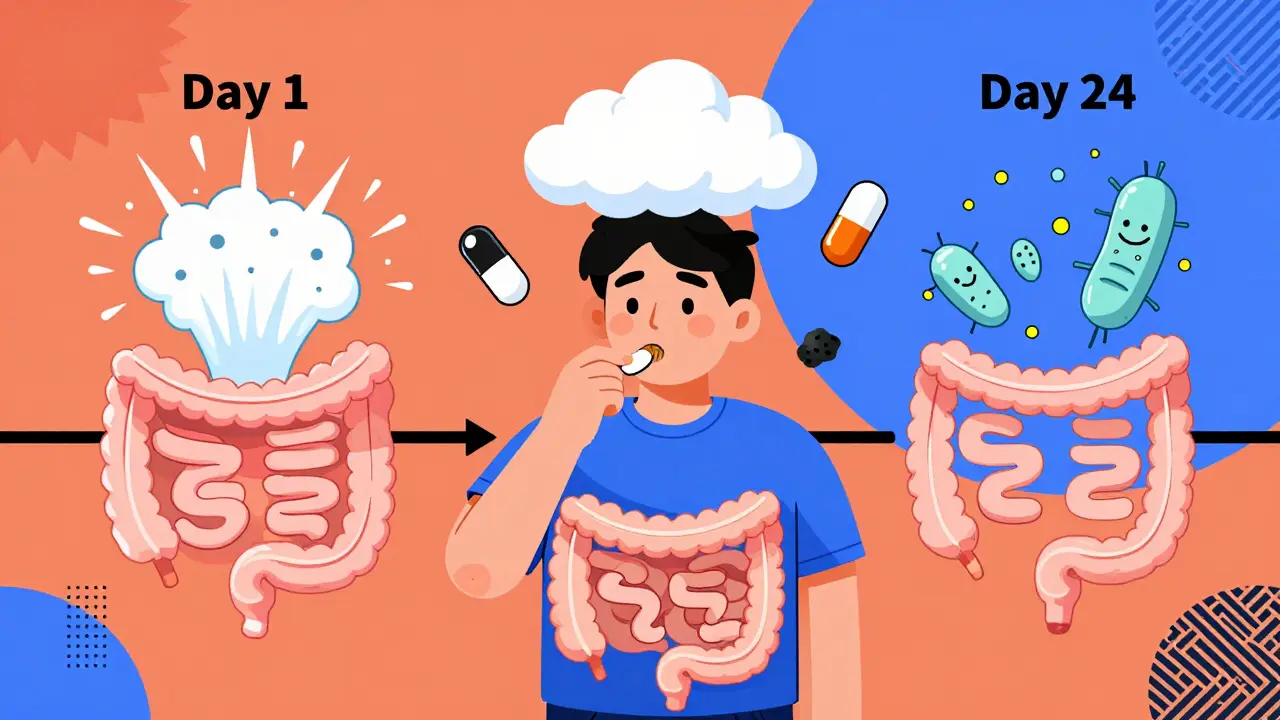
Most people see improvement within 2-4 weeks. But if you’re still struggling after 8 weeks, it’s time to talk to your doctor.
Maybe you’re on too high a dose. Maybe you’re eating too many simple carbs. Or maybe miglitol is a better fit for you. If you’re on acarbose and can’t tolerate it, switching to miglitol could cut your gas by nearly half.
There’s also a new option: a combination pill called Acbeta-M, approved in 2023. It blends acarbose with metformin in a slow-release form. Early data shows 28% less gas than regular acarbose. It’s not everywhere yet, but it’s coming.
Why This Still Matters
You might think, “If it causes so much gas, why even use it?” But for some people, it’s the only option. If you can’t take metformin because of stomach pain, or if you’re trying to lose weight and other drugs make you gain, acarbose and miglitol are valuable tools. They don’t cause low blood sugar. They don’t make you gain weight. And they work well with other diabetes meds.
That’s why they’re still used in Japan, where 4 out of 10 people with type 2 diabetes take them. Their diet is high in carbs-rice, noodles, bread. These drugs help control the spikes without insulin or weight gain. In the U.S., they’re underused because we focus too much on side effects and not enough on how to manage them.
There’s a reason these drugs exist. They’re not perfect. But with the right approach, they can be a lifeline.
Why does acarbose cause more gas than miglitol?
Acarbose stays almost entirely in the gut, blocking enzymes that break down carbs. This leaves more undigested starch to reach the colon, where bacteria ferment it into gas. Miglitol is partially absorbed into the bloodstream, so less carbohydrate reaches the colon, leading to less fermentation and fewer gas symptoms.
How long does it take for gas to improve on acarbose or miglitol?
Most people notice the worst gas during days 3-7. After that, symptoms usually start to improve. By week 2-4, many report significant relief. Full adaptation of gut bacteria can take up to 8 weeks. Consistency is key-stopping and restarting makes symptoms worse.
Can I take simethicone or charcoal with acarbose or miglitol?
Yes. Simethicone and activated charcoal are safe to use alongside these medications. Take simethicone 120 mg three times a day after meals. Take activated charcoal 30 minutes before meals. Both help reduce bloating and flatus without interfering with the drug’s blood sugar-lowering effect.
Is miglitol better than acarbose for reducing gas?
Yes, based on clinical studies and user reports. Miglitol causes less flatulence and bloating because more of it is absorbed into the bloodstream, leaving fewer undigested carbs for gut bacteria to ferment. It’s also the only one linked to slight weight loss, making it preferable for patients concerned about both blood sugar and weight.
Should I stop taking acarbose or miglitol if the gas is too bad?
Don’t quit without talking to your doctor first. Many people give up too early. With proper dosing, diet changes, and support like probiotics or simethicone, most side effects improve significantly within 4-8 weeks. If symptoms persist beyond that, switching to miglitol or trying the new combination pill may be better options than stopping entirely.
What’s Next?
These drugs aren’t going away. With diabetes rates rising globally, especially in Asia, they’ll keep being used. New formulations, like slow-release combos and targeted probiotics, are making them easier to tolerate. The future isn’t about avoiding them-it’s about using them smarter.
If you’re on one of these, remember: the gas isn’t a sign it’s not working. It’s a sign your gut is adapting. Be patient. Be consistent. And don’t let embarrassment stop you from getting the benefits.

March 17, 2026 AT 23:55 PM
lol i thought i was the only one. this post is literally my life. 🤡 gas so bad i had to leave a family dinner. now i take miglitol + simethicone and it’s manageable. thank u for explaining why 😊
March 19, 2026 AT 19:17 PM
This is the kind of info that actually helps. Start low, go slow, tweak your carbs. No magic, just smart habits. You got this.
March 20, 2026 AT 15:46 PM
I find it curious that pharmaceutical companies market these drugs without adequately warning patients about the gastrointestinal consequences. One must wonder if this is intentional-perhaps to ensure continued reliance on ancillary products like simethicone and activated charcoal. The profit motive is never far beneath the surface.
March 22, 2026 AT 07:50 AM
Bro i was on acarbose for 6 months and nearly quit. Then i switched to miglitol + brown rice + probiotics. Game changer. You’re not broken, your gut just needs time. 🙌
March 24, 2026 AT 06:42 AM
The science here is solid. Slow titration + diet tweaks + simethicone is the trifecta. Most people quit because they don’t know how to ride the initial wave. Patience and consistency win.
March 24, 2026 AT 14:07 PM
The body adapts. It always does. We fear discomfort because we confuse it with danger. But digestion is not a battle to be won. It is a conversation to be had. Listen. Adjust. Wait. The colon does not hate you. It is simply hungry for fiber, and you have been feeding it chaos.
March 25, 2026 AT 03:57 AM
The data presented here is methodologically sound and clinically relevant. The distinction between systemic absorption profiles of acarbose and miglitol is well-documented in pharmacokinetic literature. It is regrettable that patient education lags behind clinical evidence.
March 25, 2026 AT 08:41 AM
I appreciate the nuance in this analysis. Cultural dietary patterns-particularly in Asia-render these agents more viable than commonly assumed in Western contexts. A one-size-fits-all approach to diabetes management is both reductive and inequitable.
March 25, 2026 AT 10:58 AM
I suppose this is what happens when you trust a drug that was designed by chemists who’ve never eaten a bowl of rice. The real problem? We’ve normalized metabolic dysfunction as a lifestyle. These drugs are a Band-Aid on a severed artery.
March 27, 2026 AT 04:50 AM
I’ve been saying this for years: BIG PHARMA doesn’t want you to heal-they want you to buy gas pills forever. They know if you switch to miglitol and eat brown rice, you’ll save money and stop being a customer. That’s why they push acarbose. It’s all a scheme. Check the patents. The same investors own the simethicone companies too.
March 27, 2026 AT 18:14 PM
Wait-so you’re telling me that the government is letting corporations poison our guts with these drugs? And they’re not even telling us? This is a bio-weapon. I’ve been getting these symptoms since 2018. I knew it. I KNEW IT. The CDC is hiding the data. Call your senator.
March 28, 2026 AT 21:47 PM
I must point out that your assertion regarding miglitol's weight loss effect is misleading. The 1.2 kg loss observed in trials is statistically insignificant and likely due to caloric restriction from dietary avoidance-not the drug itself. Furthermore, the cost differential is negligible in countries with universal healthcare. You're overstating the clinical advantage.
March 30, 2026 AT 13:46 PM
I went from 15 gas episodes a day to 2. Just started with 25mg once a day. Took 3 weeks. Now I eat curry and don’t feel like a walking wind tunnel. You’re not alone. It gets better.
April 1, 2026 AT 05:51 AM
I find it deeply troubling that this article presents the use of activated charcoal as a legitimate solution. Charcoal is not a medicine-it is a toxin sponge. It binds nutrients, alters gut flora, and may interfere with other medications. This is not advice. It is negligence.
April 1, 2026 AT 18:09 PM
I’ve been on this for 2 years. Gas. Bloating. Shame. I’ve cried in public bathrooms. I don’t even go to weddings anymore. And now you’re telling me to take charcoal? Like I’m a dog with an upset stomach? I need help, not a band-aid.
April 2, 2026 AT 09:57 AM
In India, we’ve been using these drugs for decades. Our diet is high in complex carbs-dal, roti, rice. We don’t panic when the body adjusts. We eat slowly. We drink warm water. We trust the process. Western medicine overcomplicates what is, at its core, a simple adaptation.
April 2, 2026 AT 14:16 PM
This is solid. I started miglitol 3 months ago. Week 1 was hell. Week 2: better. Week 4: I ate lentils again. Now I’m at 100mg three times and I feel great. The key? Don’t rush. Let your gut breathe.
April 2, 2026 AT 18:14 PM
I just want to say, as someone who’s been on acarbose since 2021, that the idea that ‘it gets better’ is both true and terrifying. I’ve gone from thinking I was the only one to realizing I’m part of a silent epidemic. I’ve stopped going to brunch. I’ve declined invitations. I’ve cried over a burrito. But now? I take simethicone. I eat brown rice. I breathe. And I’m still here. We’re all still here.