GI Medication Absorption Calculator
Most people think taking a pill is simple. You swallow it, and it works. But if you’ve ever taken a medication for a gut condition and wondered why it didn’t seem to help-even when you took it exactly as directed-you’re not alone. The truth is, gastrointestinal medications often fail not because they’re weak, but because your body won’t absorb them properly.
Why Your Stomach and Intestines Block Medicines
Your digestive system isn’t designed to let drugs slip through easily. It’s built to protect you. The stomach’s acid breaks down foreign substances. The intestinal lining has tight junctions that keep toxins out. Enzymes chew up molecules they don’t recognize. And then there’s the mucus layer-up to half a millimeter thick in places-that slows everything down. For a drug to work, it has to survive all of this, then cross into your bloodstream before your liver destroys it.Most oral drugs are absorbed in the small intestine, not the stomach. That’s because the small intestine has a massive surface area-about the size of a tennis court-thanks to tiny finger-like projections called villi and microvilli. But even there, absorption isn’t guaranteed. Lipophilic drugs (those that dissolve in fat) like atorvastatin or diazepam slip through easily. But anything water-soluble, large, or charged? It’s stuck.
Take insulin, for example. It’s a protein with a molecular weight over 5,800 Da. Without special delivery systems, less than 1% of an oral dose ever reaches your blood. Same goes for many antibiotics, thyroid meds, and even some pain relievers. If your drug doesn’t dissolve fast enough or can’t cross the membrane, it just passes through-untouched-and ends up in your stool.
Food, pH, and Transit Time: The Hidden Variables
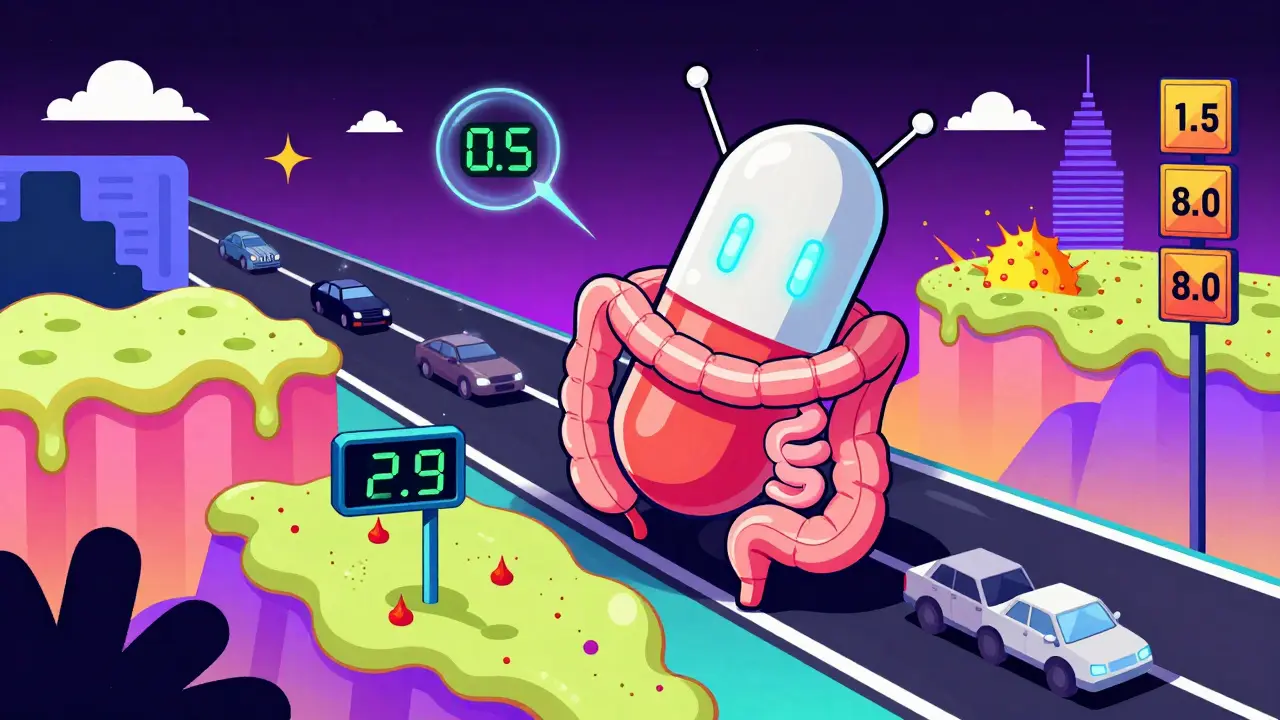
What you eat matters more than you think. A fatty meal can delay gastric emptying by 2 to 4 hours. That means a drug like levothyroxine, which needs to be absorbed on an empty stomach, might never reach peak levels if taken with breakfast. The result? Fatigue, weight gain, and a doctor who thinks you’re non-compliant.The pH of your gut changes along its length. It’s acidic near the stomach (pH 1.5-3.5), then rises to around 6-7 in the duodenum, and climbs to nearly 8 in the lower ileum. This matters because many drugs only absorb in their uncharged form. If your stomach acid is low-common in older adults or people on long-term proton pump inhibitors-drugs like ketoconazole or itraconazole won’t dissolve. They just sit there.
Then there’s transit time. In a healthy person, food moves through the small intestine in 2-6 hours. In someone with irritable bowel syndrome (IBS), it can drag on for 10+ hours. For drugs that need quick absorption-like immediate-release metoprolol or gabapentin-that delay means lower peak levels and reduced effect. On the flip side, if you have Crohn’s disease with strictures or short bowel syndrome, your gut might move too fast. Drugs don’t have time to be absorbed at all.
When Disease Breaks Absorption
Inflammatory bowel diseases like Crohn’s and ulcerative colitis don’t just cause pain-they wreck drug absorption. Studies show patients with active ulcerative colitis absorb 25-40% less mesalamine than healthy people. That’s not a small drop. It’s the difference between remission and a flare-up.One patient on a Crohn’s & Colitis Foundation forum wrote: “My Remicade levels fluctuate wildly-sometimes therapeutic, sometimes undetectable-even with consistent dosing.” That’s not poor compliance. That’s malabsorption. Inflammation damages the lining, changes pH, alters blood flow, and thickens mucus. All of it blocks drugs.
Patients with short bowel syndrome face another nightmare. If you’ve lost half your small intestine, you’ve lost most of your absorption surface. Antibiotics, vitamins, even calcium supplements might need 2-3 times the normal dose just to get a response. Pharmacists report INR levels swinging from 1.5 to 4.5 in IBD patients on warfarin-even with stable doses-because vitamin K absorption is all over the place.
Drug Interactions You Can’t See
Newer drugs like semaglutide (Ozempic, Wegovy) slow down gut motility. That sounds good for weight loss, but it’s a problem if you’re also taking a blood thinner, an antibiotic, or a seizure med. Slower movement means more time for drugs to sit in the gut-but it also means unpredictable absorption. Studies show these GLP-1 agonists can reduce absorption of other medications by 15-30%. For drugs with narrow therapeutic windows-like digoxin or phenytoin-that’s dangerous.Even something as simple as antacids or proton pump inhibitors can interfere. Omeprazole raises stomach pH, which prevents absorption of drugs that need acid to dissolve. Iron supplements? They become useless. Thyroid meds? Less effective. The interaction isn’t always listed on the label. It’s buried in the fine print-or worse, not mentioned at all.
How Formulations Try to Fix the Problem
Pharmaceutical companies know this is a huge issue. That’s why we have enteric-coated pills, extended-release tablets, and delayed-release capsules. Asacol HD, for example, is designed to release mesalamine only in the colon. But here’s the catch: if your colon is too inflamed, the coating might break too early-or not at all.There are also newer tricks. Sodium caprate and medium-chain fatty acids can temporarily open tight junctions to let drugs sneak through. Chitosan derivatives help drugs stick to the intestinal wall longer. Nanoparticles-tiny fat or polymer carriers-can protect drugs from digestion and deliver them straight to absorption sites. In lab studies, these boost bioavailability by 1.5 to 3.5 times for drugs like paclitaxel or cyclosporine.
But these aren’t magic. They’re expensive. Only 15-20% of oral drugs on the market today have labeling that says “use with caution in IBD” or “absorption may be reduced in gastric disorders.” Most doctors don’t know the details. Most patients don’t even know to ask.
What You Can Do About It
If you’re on a GI medication and it’s not working:- Take it on an empty stomach unless told otherwise. Levothyroxine, tetracycline, and bisphosphonates need 30-60 minutes before food.
- Avoid antacids and PPIs within 2-4 hours of your medication unless your doctor says it’s safe.
- Ask if a liquid, chewable, or sublingual version is available. These bypass some absorption barriers.
- Track your symptoms and medication timing. If you notice worse effects after eating fatty meals or during flares, it’s likely absorption-related.
- Request therapeutic drug monitoring if available. Blood levels of warfarin, phenytoin, or cyclosporine can tell you if you’re absorbing enough.
For chronic conditions like IBD, work with a clinical pharmacist who specializes in GI meds. They know which formulations behave differently in disease states. They can spot when a delayed-release pill won’t work in severe inflammation-and suggest alternatives.
The Future: Personalized Gut Medicine
Scientists are now building digital models of individual guts-simulating pH, transit time, enzyme levels, and inflammation-to predict how a drug will behave in a specific person. Early trials are testing smart capsules with sensors that measure pH and pressure as they move through the gut. Imagine a pill that tells your doctor: “I reached the ileum at 8:17 a.m., but only 12% of me dissolved because the mucus was too thick.”By 2027, the global market for absorption enhancers is expected to hit $2.8 billion. Why? Because 70% of new drugs in development are too large or too water-soluble to absorb naturally. If we want these drugs to work-whether they’re for diabetes, cancer, or autoimmune disease-we have to solve the gut problem first.
This isn’t just about pills. It’s about understanding your body’s unique chemistry. What works for your neighbor might not work for you-not because you’re doing something wrong, but because your gut isn’t the same.
Why do some GI medications stop working even when I take them regularly?
Many gastrointestinal medications rely on consistent absorption through the intestinal lining. Conditions like Crohn’s disease, ulcerative colitis, or even changes in gut motility from medications like semaglutide can alter pH, slow transit time, or damage the mucosal barrier. This reduces how much of the drug enters your bloodstream-even if you take it exactly as prescribed. Blood tests for drug levels (like for warfarin or cyclosporine) can confirm if absorption is the issue.
Does food really affect how well my pills work?
Yes, especially fatty meals. They delay gastric emptying by 2-4 hours, which can push back when a drug reaches the small intestine-the main site of absorption. For drugs like levothyroxine, tetracycline, or bisphosphonates, this delay can cut absorption by 30-50%. Always check the label: if it says “take on an empty stomach,” wait at least 30-60 minutes before eating.
Why are some GI drugs only available as capsules or delayed-release tablets?
These formulations protect the drug from stomach acid and target release to specific areas of the gut. For example, mesalamine in Asacol HD is coated to dissolve only in the colon, where it treats inflammation. If you have severe inflammation, the coating may break too early or not at all-making the drug less effective. Capsules and delayed-release versions are designed to overcome these barriers, but they’re not foolproof.
Can I switch to a liquid form if my pills aren’t working?
Sometimes. Liquid or chewable versions bypass some absorption barriers because they don’t need to dissolve in the stomach first. They’re especially helpful for children, elderly patients, or those with swallowing issues. But not all drugs come in liquid form, and some liquids are less stable or have worse taste. Talk to your pharmacist about alternatives-sometimes compounding pharmacies can make custom suspensions.
Are there tests to check if my body is absorbing my medications?
Yes-for some drugs. Blood tests called therapeutic drug monitoring can measure levels of medications like warfarin, phenytoin, cyclosporine, or vancomycin. If your levels are low despite taking the right dose, poor absorption is likely. For drugs without blood tests (like levothyroxine or mesalamine), symptom tracking and response to dose changes are the best indicators. Always discuss testing options with your doctor.
What’s the deal with absorption enhancers?
Absorption enhancers are ingredients added to some drugs to help them cross the intestinal wall. Sodium caprate, chitosan, and medium-chain fatty acids can temporarily open tight junctions or reduce mucus barriers. They’re used in experimental formulations and some newer drugs to boost bioavailability-especially for large molecules like peptides. While not yet common in everyday pills, they’re a growing area of research and may become standard for drugs that currently have poor absorption.

December 19, 2025 AT 10:48 AM
I’ve been on levothyroxine for years and never realized food could mess with it so bad. I always took it with my coffee and toast. No wonder I felt tired all the time. Switched to taking it at bedtime with water and my energy is way better now. 🙌
December 20, 2025 AT 18:53 PM
BIG PHARMA doesn’t want you to know this. They profit off you taking more pills because your body can’t absorb them. That’s why they don’t make liquid versions for everything. And don’t get me started on PPIs-those are government-approved poison for your gut. #FreeTheGut
December 21, 2025 AT 00:44 AM
This post is 90% common sense wrapped in jargon. Of course absorption matters. You think your body is a magic pill sponge? The real issue is doctors who don’t check levels and just up the dose. Lazy.
December 22, 2025 AT 00:10 AM
If you’re struggling with meds not working, don’t blame yourself. Your body isn’t broken-it’s just different. Talk to a clinical pharmacist. They’re the unsung heroes of GI care. You’re not failing. The system is.
December 22, 2025 AT 10:59 AM
Wait so if I take my antibiotic with a burger it just goes straight through? That’s wild. I’ve been doing that for years. Do I need to start fasting before every pill? This is insane.
December 23, 2025 AT 07:47 AM
I had Crohn’s and my doc never told me mesalamine might not work if my colon was inflamed. I thought I was just bad at taking meds. Turns out my gut was just too messed up. Took me 2 years to figure it out. You’re not alone.
December 24, 2025 AT 02:17 AM
You got this. Small changes-timing, food, talking to your pharmacist-can make a huge difference. Don’t give up. Your body is trying to heal. You just need the right tools.
December 25, 2025 AT 20:20 PM
It is imperative to note that the pharmacokinetic variability inherent in gastrointestinal pathology necessitates a paradigm shift in therapeutic management. The current model of standardized dosing is antiquated and clinically unsound.
December 26, 2025 AT 08:52 AM
I’ve been on warfarin for 12 years and my INR swings like a pendulum. My doctor says it’s diet but I think it’s my gut. I started tracking every meal and pill time and now I see patterns. Took me forever to figure it out but now I feel like I’m in control again
December 28, 2025 AT 03:10 AM
The entire pharmaceutical industry is built on exploiting absorption inefficiencies. They design drugs to be half-assed so you keep buying them. Add enhancers? Too expensive. Let people suffer. Classic capitalism.
December 28, 2025 AT 07:15 AM
Semaglutide slowing absorption? That’s huge. I’m on gabapentin and Ozempic. My pain’s been worse lately. This explains why.
December 30, 2025 AT 05:24 AM
I never thought about mucus thickness affecting meds. That’s actually kind of fascinating. My IBD flares always made my meds feel useless. Maybe it’s not me being bad at taking them.
December 31, 2025 AT 07:33 AM
You’re all just blaming your bodies. I took my meds with soda and pizza and I’m fine. If you’re not better, you’re just not trying hard enough. Stop making excuses. #GutCheck
January 1, 2026 AT 18:08 PM
PPIs are a scam. They’re linked to 12 different cancers. The FDA knows. They just don’t care. Your gut is dying. Wake up. This isn’t medicine. It’s slow poisoning. #PPIsKill
January 3, 2026 AT 04:32 AM
The assertion that absorption is the primary issue in non-responsive GI therapy is methodologically flawed. Confounding variables such as compliance, metabolism, and comorbidities are systematically underrepresented in patient narratives.
January 4, 2026 AT 12:38 PM
I read this and thought… what if the government is adding stuff to our water to mess with our gut absorption? So we need more pills? I looked up the water report in my town. Weird chemical in it. Coincidence? I think not.
January 5, 2026 AT 11:23 AM
Why do people think doctors are stupid? If absorption was really that big of a problem, they’d test for it. They don’t. So maybe you’re just not taking them right. Or you’re lazy.
January 6, 2026 AT 01:51 AM
I just started taking my levothyroxine 2 hours before breakfast and I feel like a new person 😍 thank you for this post. I’ve been so tired for years and no one ever told me this. 💪