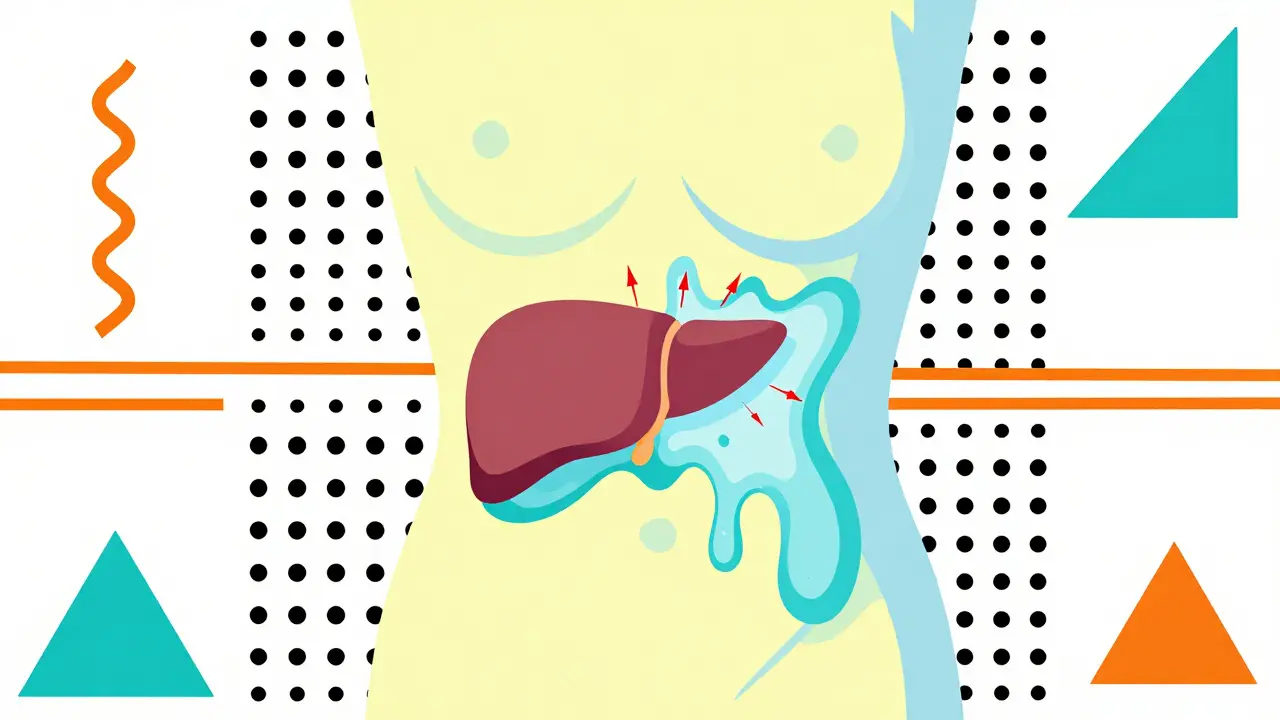
Fluid building up in your abdomen is not just uncomfortable; it is a major warning sign that your liver disease has moved into a more serious phase. This condition, known as ascites, is the pathological accumulation of fluid in the peritoneal cavity, affects about half of all people diagnosed with cirrhosis within ten years. When this happens, your body holds onto salt and water because your kidneys think you are dehydrated, even though you are actually retaining fluid. The standard medical response has long been simple: cut out salt and take water pills (diuretics). But recent studies are shaking up these old rules, suggesting that being too strict might actually hurt your kidneys.
The Core Problem: Why Fluid Builds Up
To understand how to treat ascites, you first need to know why it happens. It isn't just "water weight." It is a complex mechanical failure. In a healthy person, blood flows freely through the liver. In someone with cirrhosis, scar tissue blocks this flow. This creates high pressure in the portal vein, a condition called portal hypertension. When the pressure gradient exceeds 12 mmHg, fluid leaks out of the blood vessels and into the abdominal space.
At the same time, your effective circulating blood volume drops. Your brain senses this low volume and triggers emergency systems-like the renin-angiotensin-aldosterone system-to tell your kidneys to hold onto every bit of sodium and water they can find. This creates a vicious cycle: high pressure pushes fluid out, while hormonal signals pull salt and water in. Breaking this cycle is the entire goal of ascites management.
The Traditional Approach: Salt Limits and Diuretics
For decades, the guidelines from major organizations like the American Association for the Study of Liver Diseases (AASLD) and the European Association for the Study of the Liver (EASL) have been clear. You must restrict sodium. The AASLD recommends keeping dietary sodium under 2 grams per day. That is roughly equivalent to 5 grams of table salt, or about one teaspoon.
Why such a strict limit? Because if you eat more sodium than your kidneys can excrete, the excess pulls water into your body, worsening the swelling. However, diet alone rarely fixes ascites. That is where diuretics come in. These medications force your kidneys to dump sodium and water into your urine.
The standard drug regimen usually involves two types of diuretics:
- Spironolactone: This is an aldosterone antagonist. Since high aldosterone levels drive sodium retention in liver disease, blocking it helps correct the hormonal imbalance. Doctors typically start at 100 mg daily and may increase it to 400 mg daily.
- Furosemide: This is a loop diuretic that works on a different part of the kidney tubule. It is often added to spironolactone for stronger effect, starting at 40 mg daily and going up to 160 mg.
The goal is to lose weight steadily. If you do not have leg swelling (edema), aim for no more than 0.5 kg (about 1.1 lbs) of weight loss per day. If you do have edema, you can safely lose up to 1 kg (2.2 lbs) per day. Losing weight faster than this risks crashing your blood pressure and damaging your kidneys.
| Medication Type | Drug Name | Starting Dose | Maximum Daily Dose | Primary Mechanism |
|---|---|---|---|---|
| Aldosterone Antagonist | Spironolactone | 100 mg | 400 mg | Blocks aldosterone receptors in the kidney |
| Loop Diuretic | Furosemide | 40 mg | 160 mg | Inhibits sodium reabsorption in the loop of Henle |

The Controversy: Is Strict Salt Restriction Dangerous?
Here is where things get complicated. While guidelines say "cut salt to 2 grams," some recent randomized controlled trials suggest this might be doing more harm than good. A 2022 study published in the Gut and Liver Journal compared patients on a strict salt diet versus those allowed a moderate amount (5-6.5 grams of salt per day). Surprisingly, the group with less restriction had better outcomes. Forty-five percent of them saw their ascites resolve, compared to only 16% in the strict group.
Why would eating more salt help? The theory is that severe sodium restriction lowers the pressure in your arteries. When arterial pressure drops too low, your kidneys don't get enough blood flow. This can trigger hepatorenal syndrome, a deadly form of kidney failure common in advanced liver disease. Some data suggests that restricting salt too much increases the risk of this syndrome from 18% to 35%.
This has led to a split in expert opinion. Dr. Guadalupe Garcia-Tsao, a leading voice behind the AASLD guidelines, argues that salt restriction remains essential but must be balanced against malnutrition risks. On the other hand, Dr. Pere Gines, who led the controversial trial, argues that strict restriction is counterproductive when patients are already on diuretics. He suggests that moderate restriction is safer and more effective.
Navigating the Gray Area: Practical Advice
If you are managing ascites, you are likely caught between these conflicting messages. So, what should you actually do? Most hepatologists now agree on a middle ground. Instead of aiming for the impossible 2-gram limit, many recommend capping intake at 5-6.5 grams of salt per day. This is still lower than the average Western diet but avoids the dangers of extreme deprivation.
Remember that 75% of the sodium in your diet comes from processed foods, not the salt shaker. Reading labels is crucial. Avoid canned soups, deli meats, frozen dinners, and fast food. Focus on fresh vegetables, fruits, and lean proteins. However, do not skip meals to save on salt. Malnutrition is a huge killer in cirrhosis. Thirty-five to ninety percent of these patients suffer from protein-energy malnutrition. Starving yourself to avoid salt will weaken your muscles and worsen your overall prognosis.
You also need to watch out for hidden dangers in other medications. Nonsteroidal anti-inflammatory drugs (NSAIDs) like ibuprofen or naproxen can constrict blood vessels in the kidneys, drastically reducing blood flow. Studies show that using ACE inhibitors or ARBs (common blood pressure meds) can increase the risk of end-stage renal disease by 2.3 times in cirrhotic patients. Always check with your doctor before taking any new medication.

When Pills Aren't Enough: Refractory Ascites
Despite careful diet and maximum doses of diuretics, 5-10% of patients develop refractory ascites. This means the fluid keeps coming back, or your kidneys fail if you try to treat it aggressively. If this happens, diuretics are usually stopped because they become dangerous.
The primary treatment then shifts to large-volume paracentesis. This is a procedure where a doctor inserts a needle into your abdomen to drain liters of fluid at once. To prevent a drop in blood pressure after draining, doctors infuse albumin-a protein derived from human blood-at a rate of 8 grams for every liter of fluid removed. While effective, this requires hospital visits and carries a small risk of infection or bleeding.
Another option is a Transjugular Intrahepatic Portosystemic Shunt (TIPS). This is a stent placed inside the liver to bypass the blockage and reduce portal pressure. It can significantly reduce ascites, but it increases the risk of hepatic encephalopathy, a confusion caused by toxins building up in the brain. It is generally reserved for patients who are candidates for liver transplant or those who cannot tolerate repeated paracentesis.
Monitoring Your Progress
Managing ascites is a daily balancing act. You need to monitor three key things:
- Weight: Weigh yourself every morning after using the bathroom but before eating. Sudden gains indicate fluid retention. Sudden drops may indicate dehydration.
- Serum Sodium Levels: Your blood sodium level needs regular checking. Hyponatremia (low blood sodium) occurs in 30-40% of ascites patients. If your sodium drops below 130 mEq/L, your doctor may adjust your fluids or diuretics. If it gets very low (below 125 mEq/L), you may need to restrict water intake, not just salt.
- Kidney Function: Creatinine and blood urea nitrogen (BUN) tests will show if your kidneys are struggling. If these numbers rise, your diuretic dose may need to be lowered immediately.
Do not adjust your diuretic doses on your own. Changing them without monitoring electrolytes can lead to dangerous imbalances, including low potassium or severe dehydration.
How much salt should I eat if I have ascites?
Traditional guidelines recommend less than 2 grams of sodium per day (about 5 grams of salt). However, recent evidence suggests that a moderate restriction of 5-6.5 grams of salt per day may be safer and more effective, especially if you are taking diuretics. Extreme restriction can harm kidney function. Discuss a personalized target with your hepatologist.
Can I stop taking my diuretics if the swelling goes down?
No. Never stop diuretics without consulting your doctor. Ascites tends to return quickly if medication is halted abruptly. Your doctor will gradually taper the dose based on your weight and lab results to find the lowest effective maintenance dose.
What are the signs that my ascites is getting worse?
Watch for rapid weight gain (more than 2 lbs in a day or 5 lbs in a week), increased abdominal girth, shortness of breath due to pressure on the diaphragm, and reduced urine output. If you experience fever, abdominal pain, or confusion, seek immediate medical attention as these could signal spontaneous bacterial peritonitis or hepatic encephalopathy.
Is it safe to drink alcohol if I have ascites?
No. Alcohol accelerates liver damage and worsens portal hypertension. Complete abstinence is critical for anyone with cirrhosis and ascites to prevent further decompensation and improve survival rates.
What is hepatorenal syndrome?
Hepatorenal syndrome is a type of kidney failure that occurs in people with advanced liver disease. It happens when blood flow to the kidneys decreases significantly. It is a medical emergency with a poor prognosis if untreated, often requiring hospitalization and potentially a liver transplant.