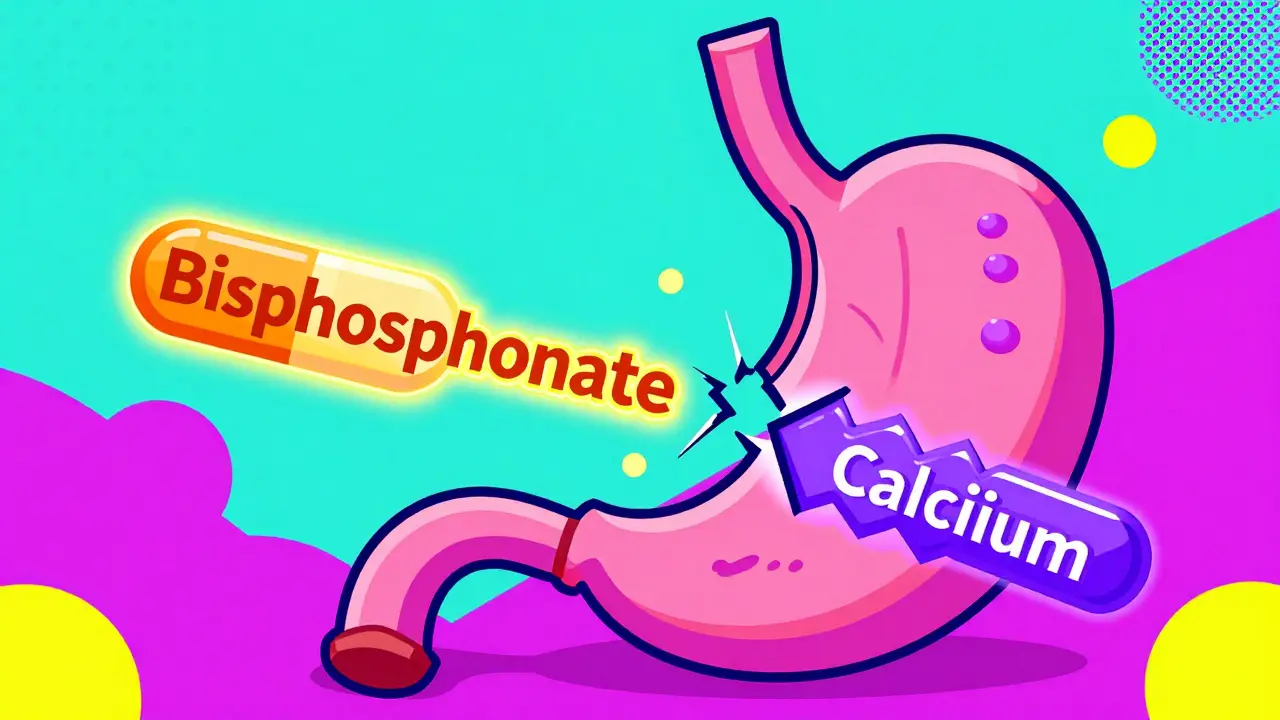
Bisphosphonate and Calcium Timing Calculator
Avoid 94% absorption loss! Calculate your optimal timing to prevent calcium and bisphosphonate interference. Enter when you take your bisphosphonate, and we'll show when you can safely take calcium supplements.
Your Optimal Calcium Schedule
Why Calcium and Bisphosphonates Don’t Mix Well
If you’re taking bisphosphonates for osteoporosis, and you also take calcium supplements, you might be wasting your medication. It’s not that either one is bad-it’s that they fight each other in your gut. When calcium and bisphosphonates meet in your stomach, they bind together like magnets, forming a compound your body can’t absorb. That means your bisphosphonate, which is supposed to strengthen your bones, ends up passing right through you. Studies show this can cut absorption by up to 94%. That’s not a small mistake-it’s the difference between your treatment working and failing.
How Bisphosphonates Actually Work (And Why Timing Matters)
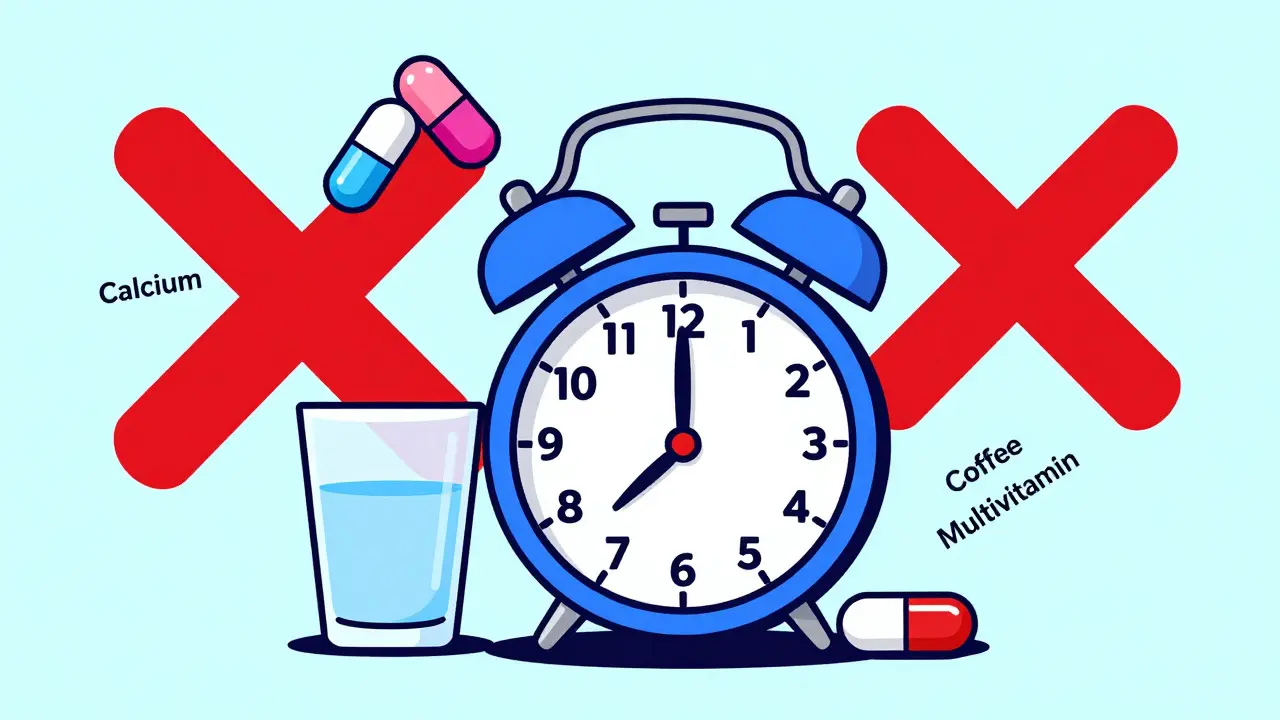
Bisphosphonates like alendronate (Fosamax), risedronate (Actonel), and ibandronate (Boniva) are designed to slow down bone loss. They stick to bone surfaces and tell the cells that break down bone to stand down. But here’s the catch: only about 1% of the pill you swallow actually gets into your bloodstream. The rest? It’s either wasted or causes stomach upset. To get that 1%, your stomach has to be completely empty. No food. No coffee. No juice. No other pills. Just plain water. The FDA requires this for all oral bisphosphonates. Alendronate needs 30 minutes before eating. Risedronate needs 60. And you have to stay upright the whole time. Lying down right after taking it increases your chance of esophageal irritation by over 60%, according to Mayo Clinic data.
Calcium Supplements: When to Take Them (And When to Avoid)
Calcium is essential for bone health, but not when it’s sharing a window with your bisphosphonate. Calcium carbonate-the most common form in supplements-is the worst offender. It cuts bisphosphonate absorption by 94%. Calcium citrate isn’t much better, dropping it by 88%. The solution? Separate them by at least two hours. Take your bisphosphonate first thing in the morning, right after waking up and before anything else. Then wait. Don’t even take your multivitamin or blood pressure pill until after the 30- to 60-minute window. Save your calcium supplement for dinner. That’s when your stomach has time to clear out, and vitamin D (which helps calcium absorb) is more effective when taken with food. Many patients use two pill organizers: one labeled “Bisphosphonate AM,” the other “Calcium PM.” That simple trick boosted adherence in one study by 73%.
What Happens If You Mix Them by Accident?
One time? Probably not a disaster. But if you do it every day, your bones keep weakening. A Johns Hopkins case study followed a 79-year-old woman who took her calcium with her alendronate because she forgot the rule. She thought she was doing everything right-she took her pill every week, ate dairy, took vitamin D. But her bone density kept dropping. Two vertebral fractures later, doctors found her calcium and bisphosphonate were being taken together. Her treatment had been useless for 18 months. That’s not rare. Patient forums show 45% of people who accidentally took calcium too close to their bisphosphonate reported stomach pain, nausea, or heartburn. The real danger? No one notices until it’s too late. Bone loss doesn’t hurt until it breaks.
IV Bisphosphonates: A Simpler Option?
If the morning ritual feels impossible, you’re not alone. Nearly three in four patients on Reddit who switched from oral to IV bisphosphonates did it to escape the strict timing rules. Zoledronic acid (Reclast) is given as a yearly IV infusion. No fasting. No waiting. No upright posture. It bypasses your gut entirely. That’s a huge win for people with GERD, swallowing issues, or just too many morning pills. But it’s not perfect. About 15-30% of people get flu-like symptoms after the first dose-fever, achiness, fatigue. It usually lasts a day or two. And you still need your calcium and vitamin D checked before the infusion. If your levels are too low, the IV can cause dangerous drops in blood calcium. So even with IV, you can’t ignore nutrition.
What Your Doctor Should Check Before You Start
Before you even take your first bisphosphonate pill, your doctor should run a few simple blood tests. Serum calcium, vitamin D (25-hydroxyvitamin D), phosphorus, and parathyroid hormone. If your vitamin D is below 30 ng/mL, your body can’t use calcium properly-even if you’re taking it. If your calcium is too low, your bones will keep leaching minerals, even with the drug working. The Endocrine Society now recommends checking these levels every six months during treatment, especially if you have kidney problems. Most primary care doctors now ask about this. In 2018, only 63% did. By 2023, it was 87%. That’s progress. But it still falls on you to bring it up if they don’t.

Real People, Real Solutions
One 68-year-old woman in Florida used a pill organizer with color-coded labels. “Bisphosphonate” in red for Monday morning. “Calcium + D” in green for dinner. She didn’t miss a dose in 18 months. Her hip bone density went up 6.2%. Another patient, a retired teacher with five daily medications, started using the National Osteoporosis Foundation’s free app. It sends a reminder: “Take Fosamax with water. Wait 30 min. No coffee.” She went from 30% adherence to 78%. These aren’t magic tricks. They’re systems. And they work because they’re simple, visual, and repeatable.
What to Do If You Can’t Stick to the Schedule
Some people just can’t manage the fasting window. Maybe you have acid reflux. Maybe you’re on too many meds. Maybe you’re elderly and forgetful. That doesn’t mean you give up. Dr. Andrea Singer from MedStar Georgetown says it plainly: “Inconsistent use is better than no use.” If you take your bisphosphonate with coffee once a week because you’re tired of the routine, you’re still getting some benefit. It’s not ideal-but it’s better than stopping entirely. Talk to your doctor about alternatives. Denosumab (Prolia) is a monthly injection that doesn’t care about food or calcium. Abaloparatide (Tymlos) is a daily shot that works differently and doesn’t have the same absorption issues. They’re more expensive, but for some, the trade-off is worth it.
The Bottom Line: Timing Is Everything
Bisphosphonates can cut your fracture risk by up to 70%. But only if you take them right. Calcium supplements aren’t the enemy-they’re part of the solution. But they need to be scheduled like a separate appointment. Morning: water, bisphosphonate, wait 30-60 minutes, stay upright. Evening: calcium, vitamin D, dinner. That’s it. No complicated rules. No guesswork. Just two simple windows. Use a phone alarm. Use a pill box. Use the app. The goal isn’t perfection-it’s consistency. Because your bones don’t care if you meant well. They only care if you did it right.


January 10, 2026 AT 19:54 PM
I used to mix my calcium with Fosamax like it was a smoothie until my spine screamed at me
Now I treat my meds like a morning ritual-water, wait, stand, no coffee, no excuses
Bone density went up and my back stopped acting like a broken accordion
January 12, 2026 AT 00:36 AM
in india we just take calcium with milk at night and forget about the timing
no one here reads the pamphlets
but somehow we dont break bones all the time
January 12, 2026 AT 20:42 PM
my grandma uses two pill boxes-one red for morning meds, one green for calcium at dinner
she doesnt even need alarms anymore
she just looks at the color and knows
January 14, 2026 AT 15:33 PM
if you cant stick to the 30 min wait take the iv
its not ideal but its better than nothing
your bones dont care about your schedule
January 16, 2026 AT 13:39 PM
the real issue isnt the calcium its the assumption that taking a pill is enough
bone health is a system not a supplement
you need movement sunlight and sleep too
but no one talks about that
January 17, 2026 AT 05:51 AM
The pharmacokinetic interference between divalent cations and bisphosphonates is a well-documented phenomenon in gastrointestinal absorption dynamics
Calcium carbonate induces chelation with nitrogen-containing bisphosphonates, thereby reducing bioavailability to subtherapeutic thresholds
It is imperative that clinicians emphasize temporal separation as a non-negotiable component of therapeutic adherence
January 17, 2026 AT 09:55 AM
they say calcium messes with bisphosphonates
but what they dont tell you is the pharma companies made sure the pills are designed to fail if you take them right
why? so you keep buying more
the real solution is to stop taking all of it and eat kale instead
January 17, 2026 AT 22:22 PM
Actually, the FDA labeling for alendronate explicitly requires administration with 6–8 oz of plain water and fasting for at least 30 minutes. Any deviation constitutes noncompliance and invalidates therapeutic intent.
It’s not a suggestion. It’s a regulatory requirement. If you’re not following it, you’re not treating osteoporosis-you’re gambling with your skeletal integrity.
January 18, 2026 AT 09:43 AM
I took my calcium with my Fosamax for two years and now I have three broken ribs
my doctor just shrugged and said 'well you know better now'
but what about the pain
what about the sleepless nights
what about the fact that I had to stop gardening because my spine feels like it’s made of dry spaghetti
they just hand you a pill and walk away
January 18, 2026 AT 15:48 PM
I’m from rural Nebraska and we don’t have fancy pill organizers
but my uncle took his bisphosphonate right after his morning coffee and never missed a dose
he’s 82 and still mows his lawn
maybe the rules aren’t as strict as they say
or maybe he’s just lucky
January 18, 2026 AT 17:02 PM
This article is dangerously oversimplified. In many European countries, calcium citrate is preferred precisely because it doesn't interfere with bisphosphonates in the same way as carbonate. The U.S. fixation on calcium carbonate is a product of corporate formulary decisions, not clinical superiority. Also, why is there no mention of magnesium’s role in bone mineralization? This is American medicine at its most reductive.
January 20, 2026 AT 03:31 AM
I used to take my calcium at night and forget the bisphosphonate until noon
then I realized I was just doing both wrong
so I started using a sticky note on my coffee maker: 'Water. Wait. Stand.'
it’s not glamorous
but it’s mine