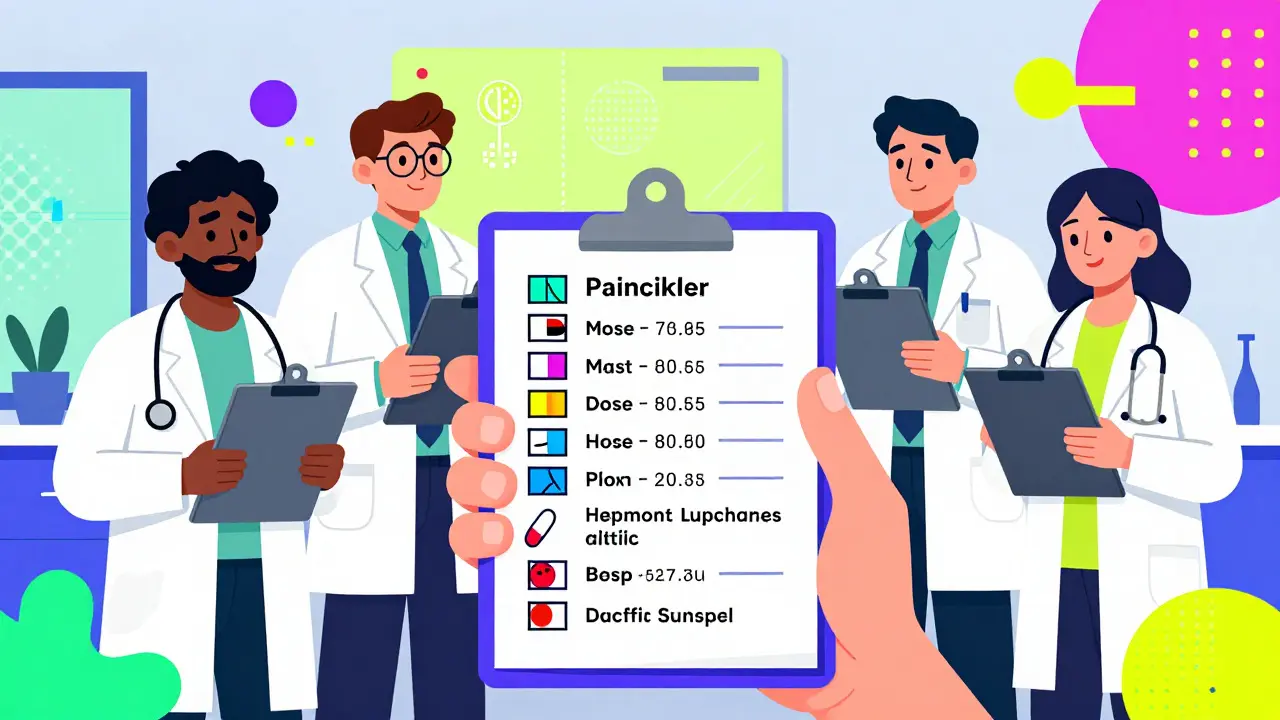
When you’re seeing more than one doctor, it’s easy to assume they’re all talking to each other. But they’re not. Not always. And that gap? It’s where mistakes happen.
Imagine this: You’re on five different medications. One doctor prescribes a new painkiller. Another adds a blood pressure pill. A third gives you an antidepressant. None of them know what the others have ordered. Then you get dizzy, nauseous, and end up in the ER. That’s not rare. It’s common. In fact, medication communication failures are behind nearly 80% of serious medical errors, according to data from the Joint Commission. And for patients seeing three or more providers, the risk of harmful drug interactions jumps 3.2 times.
Why Medication Communication Breaks Down
Your care team might include a primary care doctor, a cardiologist, a rheumatologist, a pharmacist, a nurse, and maybe even a mental health provider. Each one has a piece of your health puzzle. But unless they’re all sharing the same playbook, pieces go missing.
Electronic health records (EHRs) were supposed to fix this. But here’s the truth: only 38% of providers can access your full medication history across different systems. That means if you saw a specialist at a different hospital, they might not see that you’re already taking warfarin - until you start bleeding.
Even worse, specialists often make changes without telling your primary doctor. A 2022 NIH study found that 57% of patients had a specialist change their meds without consulting their main provider. And patients? 83% thought their doctors were talking to each other. They weren’t.
The Four Essentials of a Medication List
You can’t fix what you can’t see. That’s why the simplest tool - a written, updated list - is the most powerful one you have.
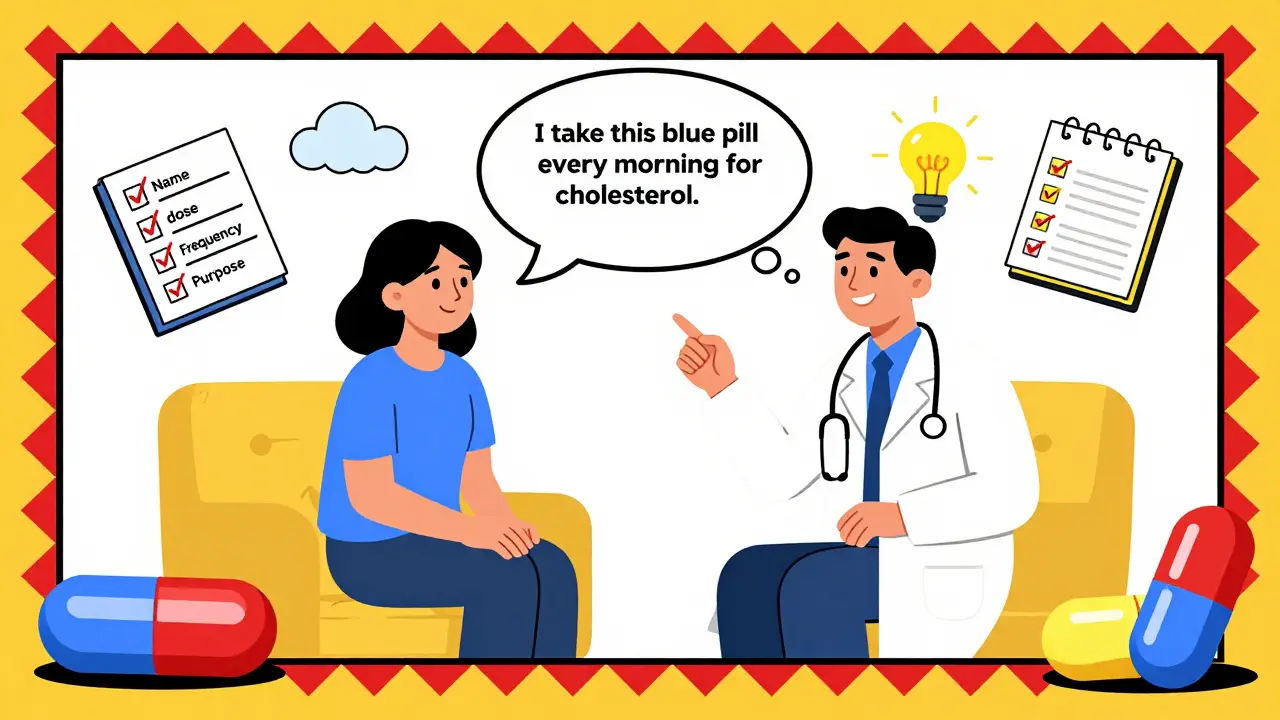
Every time you see a provider, bring this list. Not just a note on your phone. A printed copy. And make sure it includes four things:
- Name of the medication (brand and generic if different)
- Dosage (e.g., 10 mg, not just "one pill")
- Frequency (e.g., "twice daily," "every 8 hours")
- Purpose (e.g., "for high blood pressure," "for sleep")
Studies show that patients who use this exact format reduce medication errors by 37%. Why? Because when a pharmacist sees "as needed" without a purpose, they ask questions. When a nurse sees "10 mg" but the chart says "5 mg," they double-check. Clarity saves lives.
Who’s Really in Charge of Your Meds?
Most people think their primary care doctor is the captain of the ship. But in reality, pharmacists are the hidden backbone of medication safety.
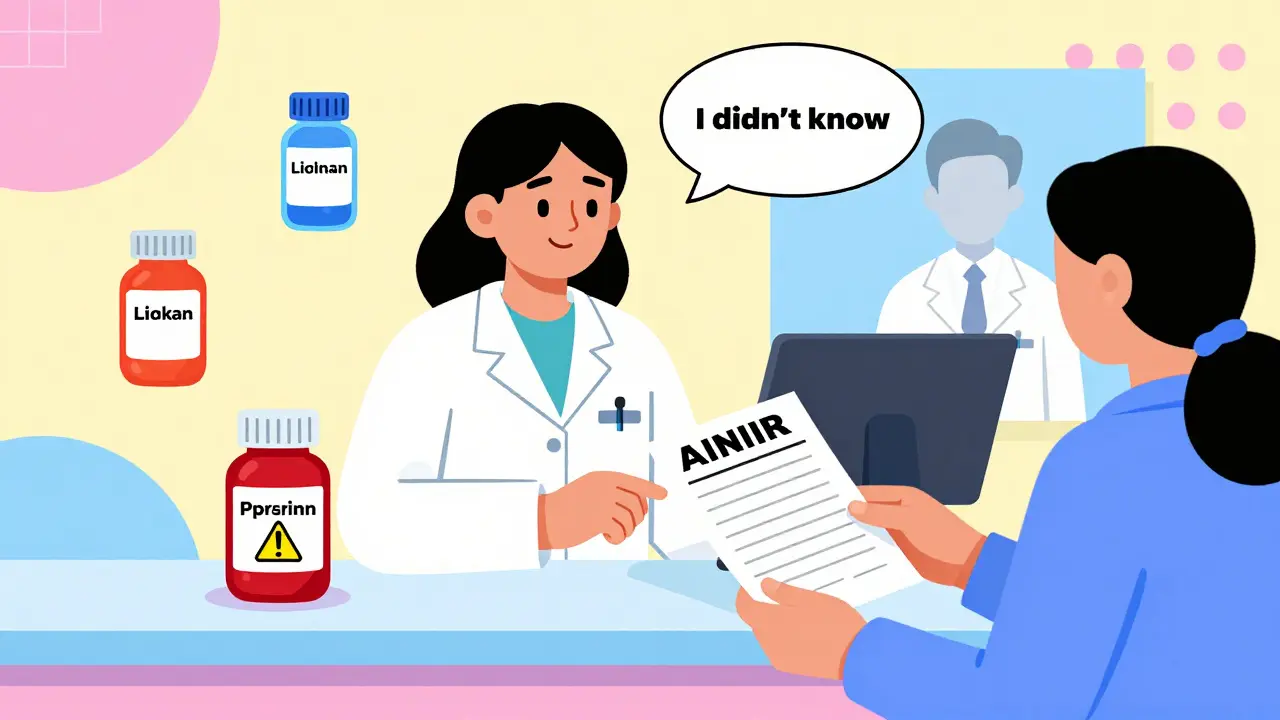
Pharmacists don’t just fill prescriptions. They review every drug you take - across all providers - for interactions, duplications, and unnecessary use. A 2023 study by Asteroid Health found that when pharmacists are actively involved in care teams, medication adherence jumps 32%. Patients also report 63% higher confidence in their regimens.
Don’t wait for them to call you. Walk into your pharmacy and say: "I’m seeing three doctors. Can you help me make sure all my meds work together?" Many independent pharmacies now offer Medication Therapy Management (MTM) services for free under Medicare. By 2025, 78% of them will offer this. Start now.
The Teach-Back Method: Don’t Just Say Yes
When a provider says, "Take this twice a day," do you nod and leave? That’s how mistakes happen.
Instead, use the Teach-Back Method. Ask: "Can you explain to me how I’m supposed to take this?" Then, in your own words, repeat it back. "So I take this blue pill every morning with breakfast, right? And it’s for my cholesterol?"
According to the Agency for Healthcare Research and Quality, this simple trick cuts misunderstanding by 45%. It works because it turns passive listening into active confirmation. Providers don’t mind. They appreciate it. And it stops errors before they start.
Track Your Body’s Response
Medications don’t just work or not work. They change how you feel. And you’re the only one who notices those subtle shifts.
Start a short health journal. Just a few lines a day:
- Did you feel dizzy after taking the pill?
- Did your sleep improve or get worse?
- Any new rashes, nausea, or mood swings?
University of California San Francisco tracked patients using this method for six months. They had 22% fewer adverse drug events. Why? Because when you show your doctor, "I’ve been tired since you added this," they don’t guess. They know.
Who Should You Call When Something Feels Off?
When you’re on multiple meds, you need a go-to person. Not five different voicemails.
Here’s the rule: If it’s about side effects, interactions, or confusion - call your pharmacist first. They’re trained to triage medication questions. If it’s about a new symptom or a change in condition, call your primary care provider.
Don’t wait for a specialist to notice. Don’t assume someone else is handling it. If you feel off, speak up. And keep a record of who you talked to, when, and what they said.
What’s Changing - And What’s Working
The system is slowly improving. Accountable Care Organizations (ACOs) - groups of doctors and hospitals that get paid to keep patients healthy - have cut medication-related hospital readmissions by 27%. Why? Because they’re forced to coordinate.
CMS now requires practices in its Primary Care First model to do structured medication reconciliation at every transition - like when you leave the hospital. That means someone has to sit down with your full list, compare it to what’s being prescribed, and fix mismatches.
And new tools are emerging. At Mayo Clinic, AI is now scanning medication lists in under a minute. It used to take nurses 15 minutes per patient. Now? 47 seconds. That’s not science fiction. It’s happening now.
What You Can Do Today
You don’t need to wait for the system to fix itself. Here’s your action plan:
- Write down your full medication list - name, dose, frequency, purpose - on paper.
- Update it every time a med changes. Keep a copy in your wallet and on your phone.
- Visit your pharmacist. Ask for a medication review. It’s free if you’re on Medicare.
- Use the Teach-Back Method at every appointment. Repeat back what you’re told.
- Start a daily journal. Note any changes in how you feel.
- When in doubt, call your pharmacist. Not your doctor. Not the ER. The pharmacist.
It takes 3 to 6 months of consistent use before these habits become automatic. But once they do, you’re not just safer - you’re in control.
Medication safety isn’t about having the best doctors. It’s about having the best communication. And that starts with you.
What if my doctors won’t talk to each other?
You can’t force them to communicate, but you can become the bridge. Bring your updated medication list to every appointment and say, "Can you please share this with my other providers?" Many clinics now have secure messaging systems that let you request records be sent. If they refuse, ask for a referral to a care coordinator or pharmacist who can help. You have the right to request that your records be shared.
Can I ask my pharmacist to contact my doctors?
Yes - and many pharmacists do this routinely. If you’re on Medicare and enrolled in a Medication Therapy Management (MTM) program, your pharmacist is expected to reach out to your providers to resolve conflicts. Even if you’re not on Medicare, most independent pharmacies will call your doctor’s office to clarify prescriptions or flag potential interactions. Just ask.
How often should I update my medication list?
Update it every time you start, stop, or change a medication - even if it’s a new vitamin or over-the-counter drug. Also update it after every hospital visit, ER trip, or specialist appointment. Keep a printed copy with you at all times. Many patients keep one in their purse, one in their car, and one on their phone.
Are there apps that help with medication tracking?
Yes, but don’t rely on them alone. Apps like MyTherapy or Medisafe are great for reminders, but they don’t replace a printed list with all four key details (name, dose, frequency, purpose). Use apps as a supplement, not your only source. Always carry a paper copy to appointments.
What if I’m taking supplements or herbal remedies?
Include them. Herbal supplements like St. John’s Wort, ginkgo, or garlic can interact with blood thinners, antidepressants, and blood pressure meds - sometimes dangerously. Many providers don’t ask about them. You have to volunteer the information. Write them down on your list with the same detail: name, dose, frequency, purpose.


February 22, 2026 AT 13:12 PM
OMG this is SO TRUE 😭 I was almost hospitalized last year because my cardiologist didn’t know I was on that new NSAID from my rheumatologist. My pharmacist caught it before I took my second dose-seriously, walk into your pharmacy like it’s your job. They’re the real MVPs.
February 23, 2026 AT 10:10 AM
YES!! I started doing the teach-back method after my mom had that scary interaction with warfarin and aspirin… and now my whole family does it! I even printed out the four essentials list and laminated it 😄 I keep one in my purse, one in my glove compartment, and one taped to my fridge. It’s weird how such a simple thing changes everything.
February 24, 2026 AT 11:31 AM
It’s remarkable how the burden of systemic failure is placed squarely on the patient’s shoulders. We are expected to become de facto care coordinators, archivists, and pharmacists-all while managing chronic illness, work, and family. The irony is that the very system designed to heal us requires us to perform administrative labor far beyond what any reasonable human should be expected to manage. And yet, we do it. Not because we want to, but because the alternative is death by oversight. This isn’t patient empowerment. It’s patient triage under capitalism.
February 25, 2026 AT 10:33 AM
I used to think my PCP was running the show… until I got my first ER visit for a drug combo no one told me about. Now? I treat my pharmacist like my personal health quarterback. I walk in every 3 months with my list, ask for a full review, and sometimes they even call my docs for me. Best $0 I’ve ever spent. Seriously, if you’re on more than 3 meds, this is non-negotiable.
February 27, 2026 AT 04:42 AM
Look, I get that this post is well-intentioned, but let’s be real-the entire healthcare system is a dumpster fire. You think writing down your meds is going to fix a fragmented, profit-driven, EHR-incompatible mess? That’s like telling someone to use duct tape to fix a leaking dam. The real problem is that insurance companies don’t pay providers to coordinate care. They pay them to see more patients, faster. So yeah, you should bring your list. But don’t expect it to change anything. It’s a Band-Aid on a hemorrhage. And if you’re lucky, you’ll live long enough to see the system collapse under its own weight.
February 28, 2026 AT 09:14 AM
WHY IS NO ONE TALKING ABOUT THIS?!?!?!?!?! I had a 3-day hospital stay because my neurologist prescribed a new migraine med and my PCP had no idea I was on it. I almost died. I cried in the parking lot after they discharged me. Now I carry a laminated card in my wallet like it’s my driver’s license. My pharmacist knows me by name. I’m not ‘just a patient’-I’m a warrior. And if you’re not doing this? You’re playing Russian roulette with your life. 😭
March 2, 2026 AT 07:28 AM
ok but have you heard of the shadow pharm? i heard from my cousin’s friend’s neighbor that big pharma and ehr companies are secretly selling your med data to insurance firms so they can deny coverage if you take too many drugs. also, your pharmacist might be a spy. i saw a guy in scrubs at walgreens whispering into a headset. i think they’re tracking us. update your list every 12 hours. just in case.
March 4, 2026 AT 02:37 AM
Let’s be honest-this is just another ‘personal responsibility’ solution to a systemic failure. The fact that we’re expected to be our own case managers says everything about how broken this is. And don’t get me started on ‘Medication Therapy Management’-it’s a buzzword for ‘we’re not paying pharmacists enough to do this properly.’ You think a free service under Medicare is a solution? Nah. It’s a PR stunt. The real fix? Pay providers to communicate. Not make patients jump through 17 hoops.
March 4, 2026 AT 18:50 PM
lol imagine being this grateful for a system that makes you carry your own medical file like a medieval pilgrim with a scroll. Meanwhile, doctors in other countries just… talk. Like, they have a shared system. No laminated cards. No ‘teach-back.’ Just… coordination. We’re doing manual labor in 2025. This isn’t empowerment. It’s humiliation dressed up as advice.
March 6, 2026 AT 08:51 AM
I’ve been doing the journal for 8 months now. It’s changed everything. Not just the meds-I started noticing patterns in my sleep, mood, even my digestion. My doctor said, ‘I wish more patients did this.’ So I printed a blank template and gave it to my sister. She’s on 6 meds too. Small things, but they matter. You don’t have to fix the system. Just protect yourself. One page at a time.
March 8, 2026 AT 08:05 AM
This is the most dangerous advice I’ve seen in a long time. Why are we encouraging people to rely on pharmacists? They’re not doctors. They’re not even supposed to be making clinical decisions. And what if your pharmacist misreads your handwriting? Or gets distracted? Or is just having a bad day? You’re putting your life in the hands of someone who’s paid minimum wage to scan barcodes. This isn’t safety-it’s a gamble. The real solution? Consolidate care under one provider. Not more paperwork. Not more middlemen.
March 9, 2026 AT 14:27 PM
THIS. THIS. THIS. 🙌 I started using the teach-back method after my grandma had a bad reaction. Now I do it with my kids, my partner, even my dog’s vet (yes, really). I carry my list in my wallet, on my phone, and on my fridge. I even have a little sticker that says ‘ASK ME ABOUT MY MEDS.’ People ask me about it. I’ve become the neighborhood medication guru. It’s weirdly empowering. You’re not just a patient-you’re the CEO of your health. 💪❤️
March 10, 2026 AT 18:26 PM
you know what’s REALLY scary? they’re already using AI to track your meds. i read it on a forum. the government is building a national drug database and linking it to your social security number. they’ll know if you skip a pill. if you take too many. if you’re ‘non-compliant.’ next thing you know, your insurance drops you. or worse-they start denying your meds based on ‘risk profiles.’ don’t update your list. don’t go to the pharmacist. just… disappear. and pray.