When it comes to catching lung cancer early, low-dose CT screening is one of the few tools proven to save lives. But it’s not for everyone. If you’re wondering whether you should get screened, the answer depends on your history, your age, and whether you’ve smoked-or still do. This isn’t just a routine scan. It’s a targeted prevention strategy backed by over a decade of hard data from tens of thousands of people. And the results? They’re clear: for the right people, it cuts the chance of dying from lung cancer by about 20%.
Who Is Eligible for Low-Dose CT Screening?
The guidelines have changed. In 2013, you needed to be at least 55, with a 30-pack-year smoking history, and either still smoking or having quit within the last 15 years. Now? The rules are broader. As of 2021, the U.S. Preventive Services Task Force says you qualify if you’re between 50 and 80 years old, have smoked at least 20 pack-years (that’s one pack a day for 20 years, or two packs a day for 10), and you either still smoke or quit within the past 15 years.
That 15-year quit window is a big deal. It’s based on evidence showing lung cancer risk stays high for years after quitting-but not forever. Studies show that after 15 years, the risk drops significantly. But here’s the twist: some experts argue that’s still too short. Dr. Peter Bach from Memorial Sloan Kettering points out that more than a third of lung cancers in former smokers happen after they’ve quit for over 15 years. That’s why the American Cancer Society and the National Comprehensive Cancer Network don’t strictly enforce the 15-year cutoff. They say if you’ve got other risk factors-like a family history of lung cancer, exposure to asbestos or radon, or a history of lung disease-you might still benefit from screening even if you quit 20 years ago.
Medicare covers the scan for people aged 50 to 77, while most private insurers follow the 50-80 range. The bottom line? If you’re in that 50-80 range and have a significant smoking history, you’re likely eligible. But if you’ve quit more than 15 years ago and have no other risks, screening may not be recommended. Talk to your doctor. Don’t assume.
What Happens During the Scan?
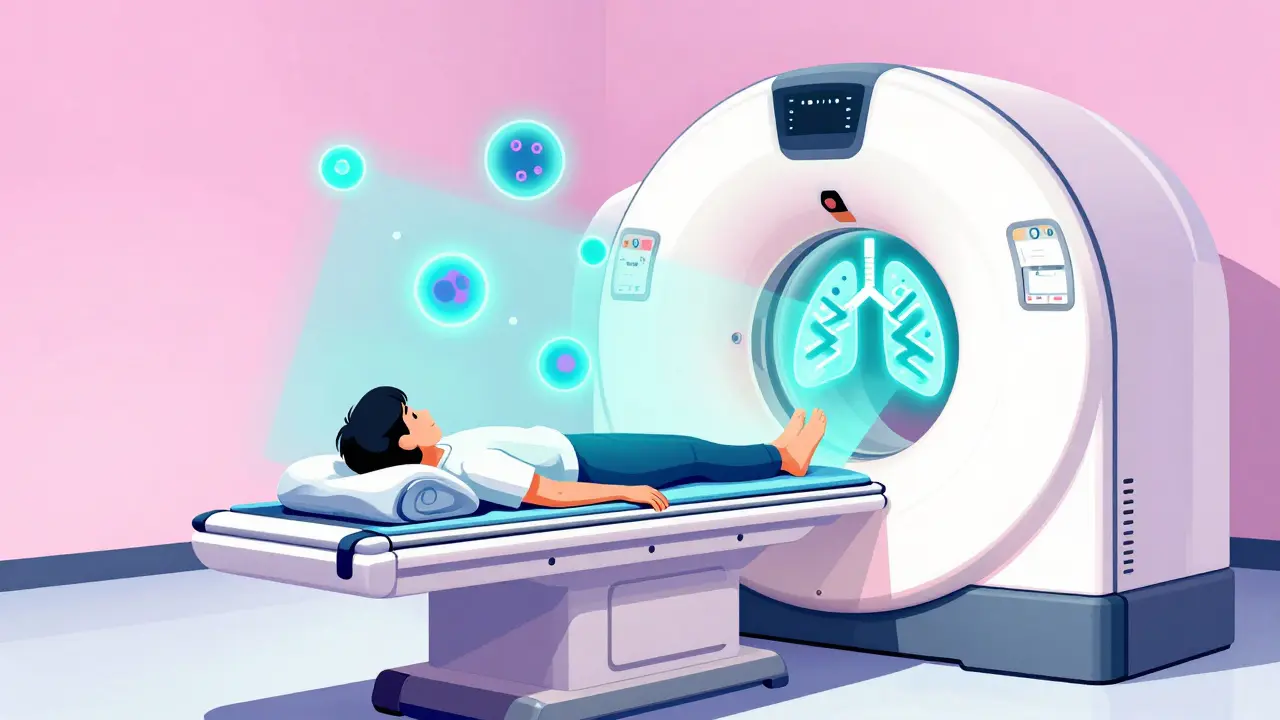
There’s no preparation needed. No fasting. No injections. You just lie on a table while the machine takes a quick scan of your chest. It takes less than 10 seconds. The machine uses a fraction of the radiation of a regular CT scan-about 1.2 millisieverts on average. That’s roughly one-tenth of a standard chest CT and about the same as you’d get from natural background radiation over four months.
The scan is designed to catch tiny nodules-abnormal spots in the lungs-that might be early cancer. Modern machines use thin slices and advanced software to make those spots stand out. The American College of Radiology requires that screening centers use protocols that keep radiation under 1.5 mSv. Most do better than that now. Some newer machines use AI to help radiologists spot nodules faster and more accurately. One FDA-approved tool, LungPoint®, cuts reading time by 30% without missing anything important.
It’s not a diagnostic test. It’s a screening test. That means it’s meant to find things that might need further checking-not to give you a final answer.
What Do the Results Mean?
Most scans come back normal. About 75% of people get a clean bill of health. But for the rest, something shows up. That doesn’t mean cancer. In fact, more than 96% of all positive scans turn out to be harmless-scar tissue, old infections, or benign growths.
Here’s how it breaks down:
- Nodules smaller than 4 mm: Almost always benign. No follow-up needed.
- Nodules 4-6 mm: Watchful waiting. A repeat scan in 6 to 12 months.
- Nodules 6-8 mm: More concern. A follow-up in 3 to 6 months, sometimes with a higher-res scan.
- Nodules larger than 8 mm: Usually need further testing-PET scan, biopsy, or both.
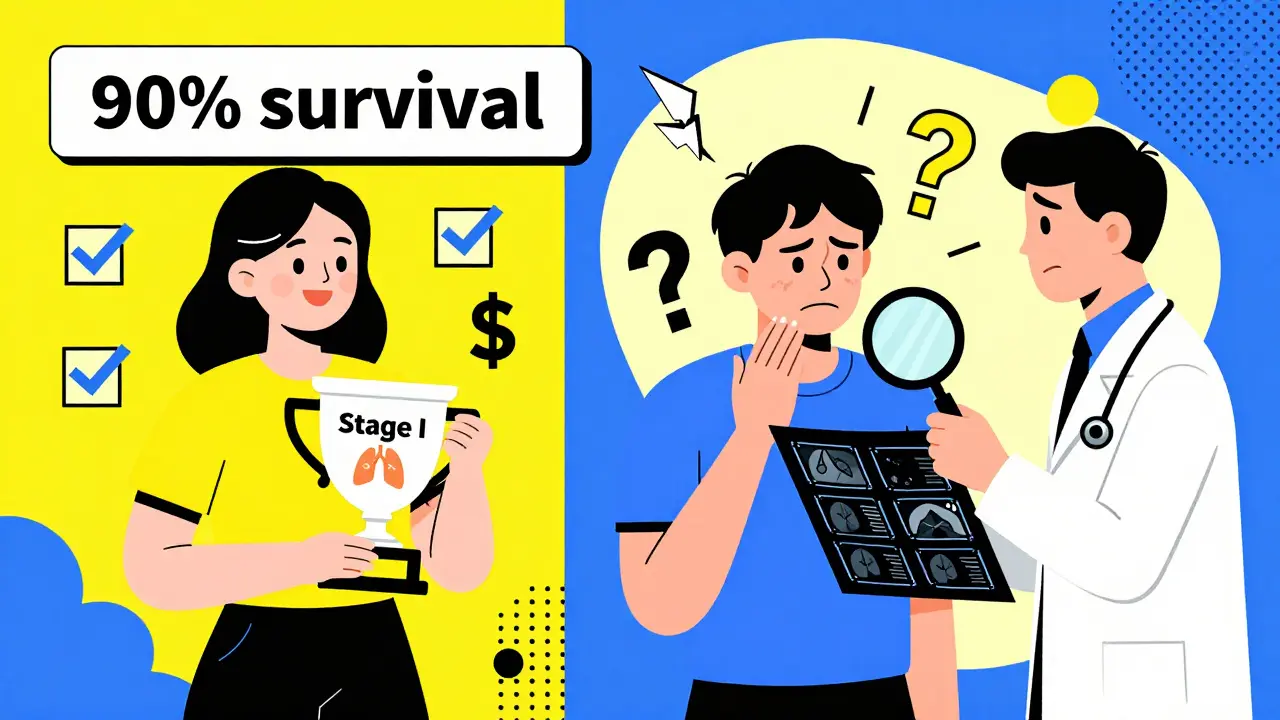
The NLST trial found that LDCT finds three times more early-stage cancers than a regular chest X-ray. In fact, 71% of cancers caught by LDCT were Stage I-meaning they hadn’t spread yet. That’s huge. Stage I lung cancer has a 90% five-year survival rate with surgery. Stage IV? That drops to under 10%.
But here’s the catch: false positives cause stress. A 2023 survey of 1,200 people found that 42% felt anxious during the weeks waiting for follow-up results. One woman from Ohio, Mary Johnson, had a 6mm nodule found on her scan. It was Stage I adenocarcinoma. She had surgery and is now cancer-free. Another man, James Wilson from Texas, spent three months in anxiety and paid $450 out of pocket for extra scans-only to find out it was nothing. That’s the emotional cost.
What Are the Risks?
There are three main risks: radiation, false positives, and overdiagnosis.
Radiation from LDCT is extremely low. The NLST estimated that for every 1,000 people screened annually for 10 years, you might cause one extra cancer death from radiation. But you’d prevent 15 lung cancer deaths. The math is clear: the benefit far outweighs the risk.
False positives are the bigger issue. About 24% of first-time scans show something suspicious. That number drops to 10% by the third year. But each false alarm means more scans, more anxiety, and sometimes invasive tests. In one study, patients paid an average of $187 out of pocket for follow-up imaging.
Overdiagnosis is trickier. Some slow-growing cancers might never have caused harm if left alone. But we can’t tell which ones those are. So we treat them all. That’s why screening is only recommended for high-risk people. For low-risk folks, the chance of being harmed by unnecessary treatment is higher than the chance of being saved.
What Happens If Something Is Found?
If a nodule looks suspicious, you’ll be referred to a multidisciplinary team: a pulmonologist, a thoracic surgeon, a radiologist, and often an oncologist. They’ll decide whether to monitor, biopsy, or remove it. Most early cancers are removed with minimally invasive surgery-video-assisted thoracoscopic surgery (VATS). That means small incisions, less pain, and a hospital stay of just 2 to 3 days. Recovery is fast. Most people are back to work in two weeks.
For those who need more than surgery, treatment options include targeted therapy, immunotherapy, or radiation. But the goal of screening is to catch cancer before any of that is needed.
Why Isn’t Everyone Getting Screened?
Despite the evidence, only about 23% of eligible people in the U.S. get screened. That’s a huge gap. Why?
- Access: In rural areas, the nearest screening center might be 32 miles away. Many people don’t have transportation.
- Awareness: Many doctors still don’t talk about it. Patients don’t know they qualify.
- Fear: People are scared of what the scan might find-or scared of the follow-up costs.
- Disparities: Black Americans are 15% more likely to get lung cancer but 28% less likely to be screened.
States that expanded Medicaid have 37% higher screening rates. That tells you something: access isn’t just about medical guidelines. It’s about policy, money, and equity.
What’s Next for Lung Screening?
The future is getting smarter. Researchers are building risk models that look at more than just smoking. The LYFS-CT model, tested on over a million veterans, can identify people who’d gain at least three extra months of life from screening. That could help target screening better and reduce unnecessary scans.
AI is getting better at reading scans. Dual-energy CT scanners are cutting down false positives by 18%. Blood tests like EarlyCDT-Lung are showing promise-94% accuracy in ruling out cancer when the result is negative.
And the guidelines might change again. In January 2024, Medicare announced it’s reviewing whether to remove the 15-year quit limit and extend screening past age 80. If they do, millions more people could qualify. One analysis suggests that change alone could save 12,000 more lives a year.
Should You Get Screened?
If you’re 50 to 80, have smoked at least 20 pack-years, and you still smoke or quit within the last 15 years-yes. Talk to your doctor. Ask about a shared decision-making visit. That’s required for Medicare, and it’s a good idea even if you’re privately insured. You should understand the risks, the benefits, and what happens if something shows up.
If you quit more than 15 years ago but have other risk factors-family history, asbestos exposure, COPD-ask your doctor if screening might still help. Don’t assume you’re off the hook.
If you’ve never smoked? Screening isn’t recommended. The risk is too low, and the harms outweigh the benefits.
Low-dose CT isn’t a magic bullet. But for the right person, it’s the best tool we have to catch lung cancer early-when it’s still curable. The data doesn’t lie. If you qualify, don’t wait. Get screened.

January 31, 2026 AT 09:39 AM
I got screened last year after my dad passed from stage IV. Turned out clean, but the anxiety? Brutal. I spent three weeks Googling every tiny shadow on the scan. Then they called and said 'no nodules' - I cried in the parking lot. Worth it.
January 31, 2026 AT 18:46 PM
Why are we letting the government decide who lives and dies? I quit smoking 20 years ago and now I'm 'not eligible'? This is socialist healthcare nonsense. I paid my taxes, I deserve a scan. #FreedomToBreathe
February 2, 2026 AT 16:50 PM
One cannot help but observe the epistemological tension inherent in population-based screening protocols: the conflation of statistical probability with individual existential risk. The very notion of 'eligibility' presupposes a utilitarian calculus that reduces human life to actuarial tables. One must ask - is it not the moral imperative of medicine to err on the side of vigilance, even when the data suggests marginal utility?
February 3, 2026 AT 09:05 AM
Okay but have you heard about the radiation being used to track your thoughts? They’re not just looking for nodules - they’re mapping your brainwaves. That’s why they only screen people who smoked. They need the nicotine residue to activate the AI. Also, the government’s using these scans to plant microchips. I read it on a forum. 🤫
February 4, 2026 AT 18:59 PM
Hey - if you’re even thinking about this, DO IT. I was terrified too. But my mom got screened at 58, quit 18 years ago, had a 5mm nodule - turned out to be Stage I. She’s been cancer-free for 4 years now. It’s not magic, but it’s your best shot. Talk to your doc. Don’t wait till you’re coughing blood.
February 5, 2026 AT 09:04 AM
I work in radiology. We see the scans every day. Most people panic over shadows that are just old TB scars or granulomas. But the ones who wait? They’re the ones who come back with Stage III. If you qualify - even if you’re on the edge - get it done. It’s 10 seconds. No needles. No prep. Just lie down and breathe.
February 5, 2026 AT 23:49 PM
lol why do we even bother with this? I got a scan last year, they found a 'nodule' - turned out to be a burrito I ate the night before. No seriously, I think the machine glitched. Also, my cousin’s neighbor’s dog had lung cancer and lived to 19. So yeah. Maybe we just need more tacos.
February 5, 2026 AT 23:49 PM
I’m 54, smoked a pack a day for 22 years, quit 10 years ago. I got screened last month - nothing. But I still feel like I owe it to my kids to keep going. I read the whole post twice. The part about false positives and anxiety? That hit me hard. I didn’t realize how much I was holding my breath every time I coughed. I started journaling after the scan. Not because I was scared - but because I finally felt like I was doing something real for my health. And that’s more than I’ve done in 15 years.
February 7, 2026 AT 20:04 PM
THEY’RE LYING. The 15-year cutoff? That’s because Big Pharma doesn’t want you getting screened after you’ve ‘paid your dues’ and stopped smoking. They need you to be terrified and dependent on their treatments. Also, the scans are funded by the CIA to monitor ex-smokers for ‘subversive thoughts’. I know a guy who works at the lab - he says they tag the data with GPS coordinates. I’m not even kidding. 😱
February 8, 2026 AT 01:54 AM
In India, we don’t have this luxury. My uncle smoked for 40 years, died at 56. We didn’t even know such a scan existed. Here, people think lung cancer is 'God’s will'. No screening centers, no insurance, no awareness. And you’re telling me Americans are debating eligibility? We’d kill for your guidelines. Stop complaining. Get screened. Be grateful.
February 8, 2026 AT 20:11 PM
Screening is not a right. It is a privilege granted by insurance policy and federal mandate. Those who do not meet criteria are not denied care - they are simply not prioritized. This is not injustice. It is resource allocation.
February 9, 2026 AT 00:53 AM
my mom got screened last year. nothing. she still checks her cough every morning. i think that’s the real cost - not the scan, but the never-ending worry
February 10, 2026 AT 23:57 PM
They say 'talk to your doctor.' But doctors don’t have time. My PCP spent 90 seconds on this and said 'you’re eligible, go get it.' No discussion of risks, no shared decision-making. That’s not care - that’s checkbox medicine. If Medicare requires a shared visit, why are they letting providers skip it? This system is broken.
February 11, 2026 AT 16:09 PM
Yeah, I had that exact same conversation with my doc. He just handed me a flyer. Felt like I was being sold a gym membership. But then I called the screening center myself - they had a 20-minute counseling session built in. That’s what made the difference. Not the scan. The talk.