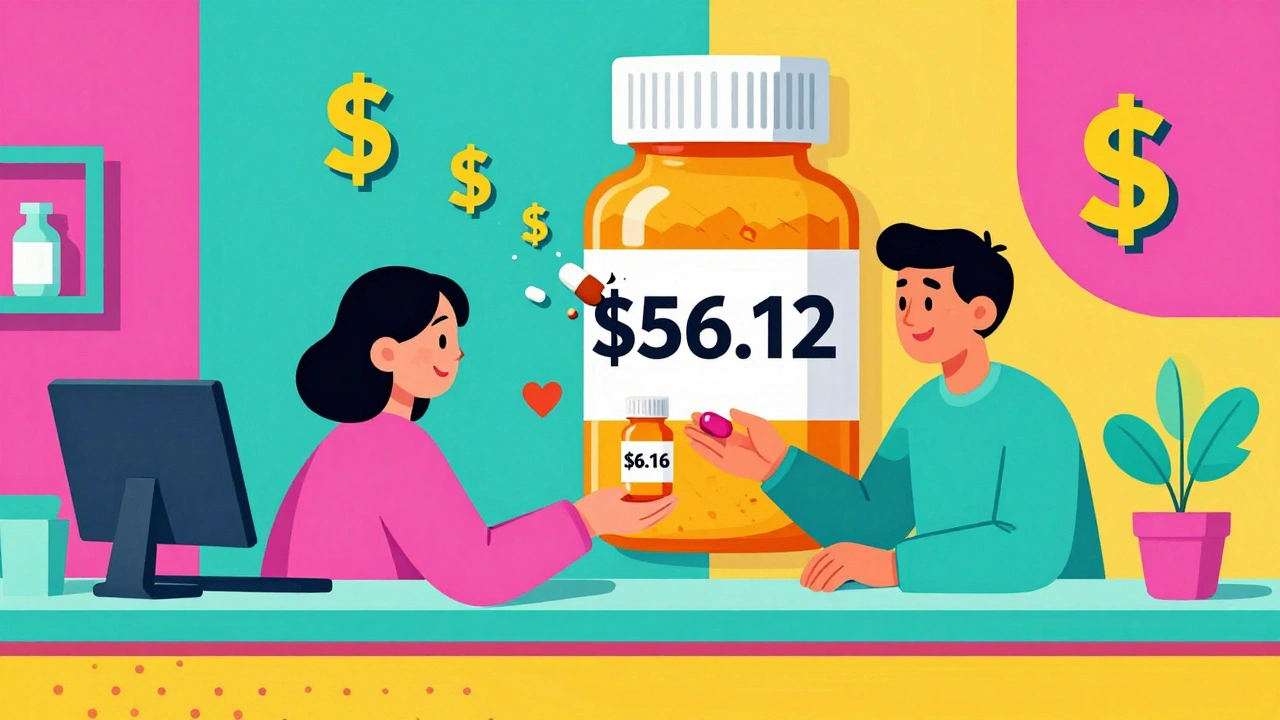
For millions of low-income Americans on Medicaid, the difference between a brand-name drug and its generic version isn’t just about the label-it’s about whether they can afford to take their medicine at all. In 2023, 91% of all prescriptions filled through Medicaid were for generic drugs. That’s not a coincidence. It’s the result of a system designed to keep costs down for people who can’t afford high prices. And it works. Generics cut out-of-pocket costs by nearly 90% compared to brand-name drugs, making treatment possible for families living paycheck to paycheck.
How Much Do Generics Actually Save Medicaid Patients?
The numbers speak for themselves. In 2023, the average copay for a generic drug under Medicaid was just $6.16. For a brand-name drug? $56.12. That’s more than nine times more. For someone on a fixed income, that difference isn’t just a number-it’s whether they refill their diabetes medication, fill their asthma inhaler, or skip their blood pressure pills entirely.
And it’s not just about what patients pay at the pharmacy. The entire Medicaid system saves billions because of generics. In 2023, Medicaid rebates-money drugmakers pay back to states-cut gross drug spending by 51.2%, saving $53.7 billion. That’s money that goes back into covering more services, more doctors, more care. Without generics, Medicaid’s drug budget would have exploded long ago.
Why Are Generics So Much Cheaper?
Generic drugs aren’t cheaper because they’re lower quality. They’re cheaper because they don’t need to recoup the billions spent on research, marketing, and advertising that brand-name drugs do. Once a brand-name drug’s patent expires, other companies can make the exact same medicine. The FDA requires generics to have the same active ingredient, strength, dosage form, and route of administration as the brand. They must also prove they work the same way in the body.
What makes Medicaid’s savings even stronger is the Medicaid Drug Rebate Program (MDRP). Created in 1990, this law forces drugmakers to give states a discount-often more than 80% off the list price-for every generic drug they sell to Medicaid. In 2023, for non-specialty generics, Medicaid got back an average of 86% of the retail price. No other government program gets prices this low. Even the Department of Veterans Affairs, which negotiates hard, doesn’t match Medicaid’s net pricing.
Who’s Making These Generics-and How Much Are They Making?
Most generic drugs sold to Medicaid come from a handful of big manufacturers: Teva, Viatris (which includes Mylan), and Sandoz. Together, they supply nearly half of all generic prescriptions filled under Medicaid. These companies make money on volume, not high prices. A single pill might cost pennies to produce, and Medicaid buys them in bulk.
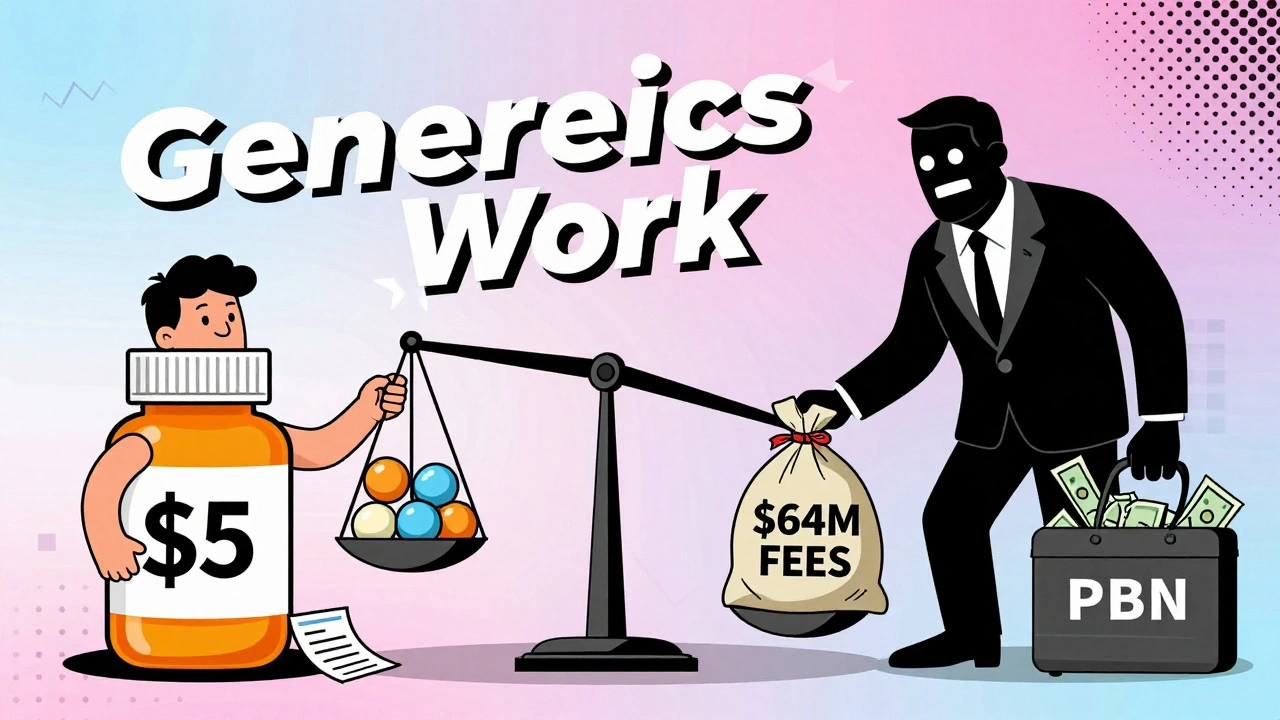
But here’s where things get messy. Between the drugmaker and the pharmacy, there’s a middleman: the Pharmacy Benefit Manager, or PBM. In 2025, the Ohio Auditor found that PBMs took 31% in fees on $208 million worth of generic drugs in just one year. That’s over $64 million in fees on drugs that were already cheap. That money doesn’t go to the patient. It doesn’t go to the state. It goes into corporate pockets. Experts warn that these fees are eating away at the savings generics were supposed to deliver.

Generics vs. Brand Names: The Real Cost Difference
Let’s say a Medicaid patient needs a common blood pressure pill. The brand-name version might cost $150 for a 30-day supply. The generic? $5. Even after the $6.16 copay, the patient pays less than half the cost of a single brand-name dose. That’s why 93% of generic prescriptions cost under $20 at the counter. Only 59% of brand-name prescriptions do.
Some people think buying generics online or from discount pharmacies like Mark Cuban Cost Plus Drug Company saves more. But studies show that for Medicaid patients, that’s rarely true. In one 2023 analysis, uninsured people saved a few dollars per prescription using those services-but Medicaid patients were already getting better prices. For low-income patients with coverage, Medicaid’s system is usually the cheapest option available.
What About High-Cost Drugs? Are Generics Still Enough?
Here’s the problem: while generics make up 91% of prescriptions, they don’t make up 91% of spending. A tiny fraction of drugs-less than 2% of all claims-are specialty drugs that cost over $1,000 per prescription. These are things like cancer treatments, rare disease therapies, and complex biologics. Even though they’re rarely used, they account for more than half of Medicaid’s total drug spending.
That’s why Medicaid’s net drug spending jumped from $30 billion in 2017 to $60 billion in 2024. It’s not because people are taking more generics. It’s because they’re taking more of these ultra-expensive drugs. The federal government is trying to fix this with the new GENEROUS Model, launched in 2024. It’s designed to cut costs by better managing which drugs get covered, pushing for biosimilars (generic versions of biologic drugs), and cracking down on unnecessary spending.
What Patients Actually Experience
Most Medicaid patients don’t think twice about generics. Pharmacists automatically substitute them unless a doctor says otherwise. But the system isn’t perfect. Some patients report delays getting approved for even generic versions of essential drugs. One Reddit user, ‘MedicaidMom2023,’ shared that her daughter’s asthma inhaler switched to a generic and her copay dropped from $25 to $3-but it took three weeks and multiple phone calls to get approval.
Another issue? Copays are creeping up in some states. Even when the cost of the drug drops, some Medicaid programs raise the patient’s copay. That’s not how it’s supposed to work. The point is to make drugs affordable, not to shift costs onto patients.
How to Make the Most of Medicaid’s Generic Drug Benefits
If you’re on Medicaid, here’s what you need to know:
- Always ask if a generic version is available. Even if your doctor prescribes a brand, you can request the generic.
- Know your state’s formulary. Some states have tiered systems where generics are in the lowest tier-meaning the lowest copay.
- Check your state’s Medicaid website for approved drug lists. Many list which drugs require prior authorization.
- If you’re denied a drug, appeal. Medicaid must cover medically necessary drugs. If your doctor says you need it, you have a right to it.
- Use mail-order pharmacies if available. They often have lower copays and can save you trips to the store.
Most importantly: don’t skip doses because of cost. If you’re struggling to afford your copay, talk to your pharmacist or Medicaid caseworker. Many states have programs to reduce copays for low-income patients.
What’s Next for Medicaid and Generics?
The future looks mixed. On one hand, biosimilars-generic versions of complex biologic drugs-are starting to hit the market. Experts predict they could save Medicaid another $100 billion a year by 2027. On the other hand, drugmakers are finding new ways to delay generic competition, and PBMs continue to take large cuts.
One big change could come from the Inflation Reduction Act. It lets Medicare negotiate drug prices. If that power is extended to Medicaid, it could bring down costs even further-potentially saving $15 to $20 billion over ten years.
But the core truth remains: generics are the backbone of affordable care for low-income Americans. They’re safe, effective, and dramatically cheaper. Without them, millions would go without treatment. The challenge now isn’t whether generics work-it’s whether the system is still doing everything it can to protect those savings.
Are generic drugs as safe and effective as brand-name drugs?
Yes. The FDA requires generic drugs to have the same active ingredient, strength, dosage form, and route of administration as the brand-name version. They must also prove they work the same way in the body. Generics are not cheaper because they’re weaker-they’re cheaper because they don’t need to pay for marketing or research costs.
Why is my generic drug copay higher than expected?
Even if the drug’s price drops, some states raise patient copays to balance budgets. This goes against the spirit of Medicaid’s goal to make care affordable. If your copay increased without a clear reason, contact your state Medicaid office or ask your pharmacist to check if the drug was moved to a higher tier.
Can I switch from a brand-name drug to a generic without my doctor’s permission?
In most cases, yes. Pharmacists are allowed to substitute a generic unless the doctor writes "dispense as written" or "no substitution." But if you’re on a specialty drug or have a condition where small differences matter, your doctor may need to approve the switch. Always check with your pharmacist first.
Do all Medicaid programs offer the same generic drug benefits?
No. While federal rules set minimum standards, each state runs its own Medicaid program. Some states have lower copays, better formularies, or faster approval for generics. A few even offer $0 copays for generics. Check your state’s Medicaid website or call their helpline to find out your specific benefits.
Why are some generic drugs not available in my state?
Sometimes, manufacturers don’t produce a generic version of a drug because it’s not profitable. Other times, the state Medicaid program hasn’t added it to its approved list yet. If you need a drug that’s not covered, ask your doctor to file a prior authorization request. Many drugs get added after enough requests.

December 5, 2025 AT 08:16 AM
The data here is statistically sound, but let’s be real-this entire system is a house of cards built on corporate loopholes. The FDA? They’re understaffed. The rebate system? It’s a shell game. And don’t even get me: PBM’s are the real predators here-they’re not middlemen, they’re leeches with corporate lawyers.
December 6, 2025 AT 19:11 PM
Generics save lives. Simple as that.
December 7, 2025 AT 12:22 PM
I’ve noticed something... every time a generic gets approved, the pharmacy always runs out within two days. Coincidence? Or is someone hoarding them? I’ve seen the same pills on dark web forums priced at 3x. Someone’s gaming the system-and it’s not the patients.
December 9, 2025 AT 04:32 AM
We are all just atoms in a machine designed to extract value from suffering. Generics are a band-aid on a bullet wound. The real problem? Capitalism. 💔
December 9, 2025 AT 20:21 PM
I swear to god if one more pharmacist says "it’s the same thing" after I’ve been on brand for 12 years and suddenly my anxiety spikes... I’m gonna lose it. It’s not the same. It’s not. And they know it. They just don’t care.
December 10, 2025 AT 10:06 AM
This is one of those rare posts where the facts actually line up with what real people experience. I’ve seen grandparents choose between insulin and groceries. I’ve seen kids miss school because their inhaler was too expensive. Generics aren’t just a cost-saving trick-they’re a lifeline. And the fact that PBMs are siphoning off 31% on top of that? That’s not capitalism. That’s theft with a corporate logo.
December 12, 2025 AT 09:19 AM
I just looked up my copay for my generic blood pressure med 🤯 $3.50. My dad paid $180 for the same thing in 2008. I’m so grateful for this system. 🙏
December 13, 2025 AT 22:24 PM
It is worth noting that the Medicaid Drug Rebate Program, established pursuant to 42 U.S.C. § 1396r-8, constitutes a critical regulatory mechanism that ensures fiscal sustainability within the broader Medicaid framework. The economic efficiency achieved through generic substitution is not merely a byproduct-it is a deliberate policy outcome.
December 15, 2025 AT 03:45 AM
I’ve been on Medicaid for 17 years. I’ve had my pills switched to generics so many times I lost count. I’ve had them denied. I’ve had them delayed. I’ve had my copay go up even when the drug got cheaper. This isn’t a system. It’s a trap.
December 16, 2025 AT 12:54 PM
Let me tell you what they don’t want you to know. The real reason generics are so cheap? They’re made in China. And no, I’m not joking. The FDA doesn’t inspect those factories. They just take the word of a PDF. And the active ingredient? Sometimes it’s not even the same. I’ve seen people go into seizures after switching. They call it ‘bioequivalence’-I call it Russian roulette with your life. And the government? They’re in bed with Big Pharma and Big China. Wake up.
December 17, 2025 AT 15:29 PM
I used to think generics were just cheaper. Then my sister got cancer. She was on a biologic that cost $12,000 a month. When the first biosimilar came out? It dropped to $4,000. She’s alive today because of it. Generics aren’t about savings-they’re about dignity. They’re about letting someone live without begging for a discount.
December 17, 2025 AT 21:27 PM
I’m not saying the system is perfect, but I do believe in the science behind generics. The FDA’s standards are rigorous. The manufacturing is monitored. The data is peer-reviewed. The conspiracy theories floating around? They’re not just wrong-they’re dangerous. People stop taking meds because they think generics are ‘fake.’ That’s how people die.
December 19, 2025 AT 12:05 PM
We don’t need welfare for drugs. We need welfare for jobs. If you can’t afford your meds, get a better job. Or move to a state that doesn’t bankrupt itself.
December 20, 2025 AT 08:16 AM
Why do generics cost less? Because they dont have the fancy packaging or ads. Same pill. Same results. Why overpay?
December 22, 2025 AT 08:01 AM
You say generics save money, but what about the ones that don’t work? I had a generic for my thyroid and my TSH went through the roof. Switched back to brand-fixed in two weeks. So no, not all generics are created equal. And if you’re telling me the FDA doesn’t know this, you’re lying.
December 24, 2025 AT 04:00 AM
I think the government is using generics to control us. Like, they want us dependent on cheap meds so we don’t get sick enough to revolt. Also, I read online that the pills are laced with lithium to keep us calm. That’s why I always feel sleepy after taking them.
December 25, 2025 AT 10:43 AM
I’ve been on Medicaid for 10 years. I’ve had bad days. I’ve had good days. But I’ve never missed a dose because of cost. That’s not luck. That’s policy. And people who say this system is broken? They’re right-but not because generics don’t work. Because we don’t fight hard enough to protect them.
December 26, 2025 AT 00:42 AM
Let’s not pretend this is about helping the poor. This is about control. The government wants you dependent. They want you to believe that a $6 pill is enough. They don’t want you to know that the real cost is in the long-term damage caused by underdosing, delayed refills, and the psychological toll of living in a system that treats your health like a budget line item. You think you’re saving money? You’re being exploited. And you’re okay with it because they told you it’s ‘affordable.’