DAPT Bleeding Risk Calculator
This calculator uses the PRECISE-DAPT score to determine your bleeding risk while on dual antiplatelet therapy. A score of 25 or higher indicates high bleeding risk (HBR).
When you’ve had a heart stent placed or survived a heart attack, doctors often prescribe dual antiplatelet therapy-a combo of aspirin and another drug like clopidogrel, prasugrel, or ticagrelor. It’s meant to stop blood clots from forming inside the stent, which could trigger another heart attack or even death. But here’s the catch: while DAPT saves lives, it also makes you bleed more easily. And for many people, that’s not just a side effect-it’s a daily worry.
Why DAPT Works (and Why It’s Risky)
Dual antiplatelet therapy blocks platelets from sticking together. That’s good when you’re trying to prevent a clot in a coronary artery. But platelets also help stop bleeding when you cut yourself or get a nosebleed. When they’re suppressed, even small injuries can turn into bigger problems.
Studies show DAPT reduces major heart events by 15-30% compared to taking just one drug. But it also increases the risk of major bleeding by 1-2%-meaning for every 100 people on DAPT, 1 or 2 will have a serious bleed. That might sound low, but when it’s you, it’s not a statistic. It’s a hospital visit. It’s lost sleep. It’s fear every time you brush your teeth or bump your arm.
The two main drugs used with aspirin are clopidogrel, prasugrel, and ticagrelor. Clopidogrel is older and gentler on bleeding risk but less powerful at preventing clots. Prasugrel and ticagrelor are stronger-they work faster and better-but they also raise bleeding rates by 20-30% compared to clopidogrel. The TRITON-TIMI 38 trial found ticagrelor caused 27% more major bleeding than clopidogrel. That’s not a small difference. It’s the difference between a bruise and a blood transfusion.
Who’s at Highest Risk for Bleeding?
Not everyone on DAPT will bleed. But some people are far more likely to. Doctors use a tool called the PRECISE-DAPT score to figure out who’s in danger. If your score is 25 or higher, you’re classified as high bleeding risk (HBR). Here’s what pushes your score up:
- Age 75 or older
- History of bleeding (even a simple nosebleed that wouldn’t stop)
- Low hemoglobin (anemia)
- Chronic kidney disease (creatinine clearance under 60 mL/min)
- Platelet count below 100,000
- Taking blood thinners like warfarin or apixaban at the same time
One in five patients getting a stent now falls into the HBR category. That’s up from just 15% in 2017. And it’s not just about age. A 68-year-old with kidney disease and a history of stomach ulcers has the same risk as an 80-year-old. The score doesn’t care about birthdays-it cares about your body’s reality.
What Does Bleeding Actually Look Like?
When people say "bleeding," they often think of a gushing wound. But with DAPT, bleeding is quieter-and more annoying.
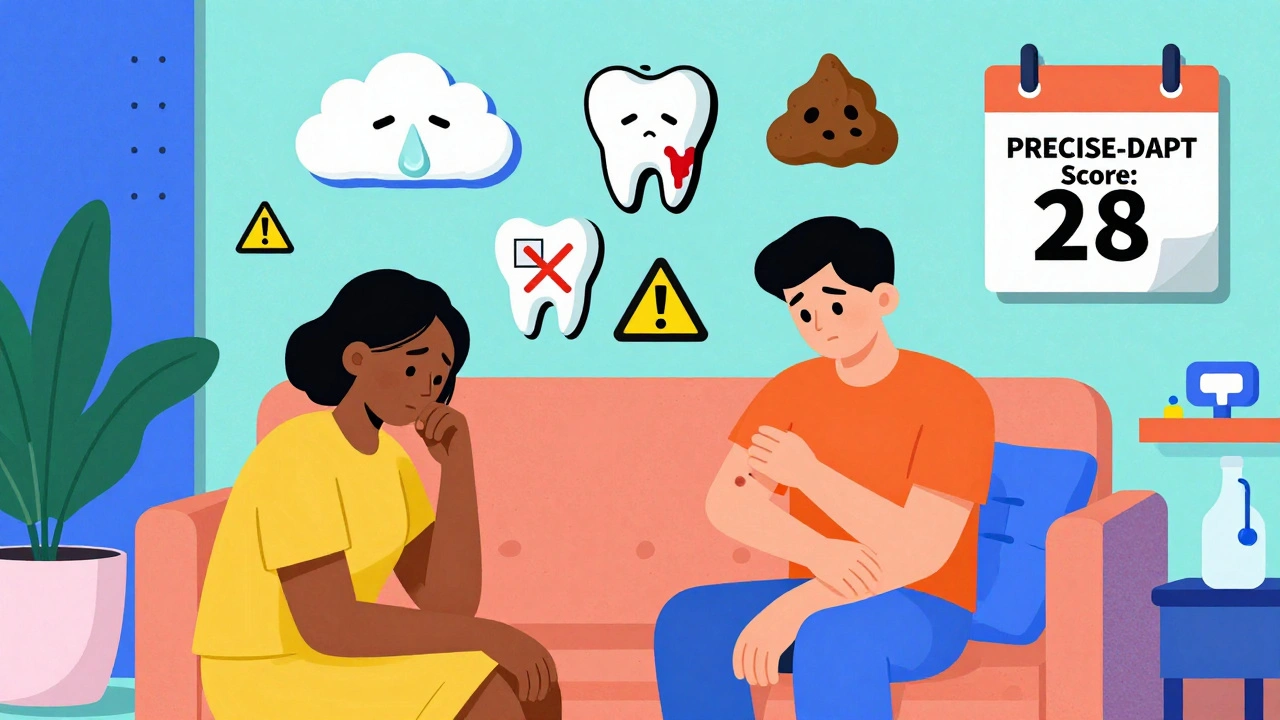
According to the TALOS-AMI trial, 15% of patients on ticagrelor-based DAPT had what’s called "nuisance bleeding"-minor bleeds that don’t need emergency care but still mess up your life. That means:
- Nosebleeds that last longer than 10 minutes
- Bleeding gums when brushing teeth
- Black, tarry stools (a sign of stomach bleeding)
- Unexplained bruising on arms or legs
- Periods that are heavier than usual
- Minor cuts that take 20+ minutes to stop bleeding
Patients in Reddit forums and surveys say these aren’t just inconveniences. They cause anxiety. One woman said she stopped hugging her grandchildren because she was afraid she’d bruise. Another stopped going out to dinner because he was embarrassed by bleeding gums. A third stopped running because she didn’t want to risk a fall.
And here’s the worst part: 18.7% of patients with nuisance bleeding stopped taking their meds within six months. That’s dangerous. Stopping DAPT too early-before six months in most cases-raises your risk of stent clotting by two to three times. You’re trading one life-threatening risk for another.
How Doctors Are Changing the Game
For years, the rule was simple: take DAPT for 12 months after a stent. No exceptions. But that one-size-fits-all approach was hurting more people than helping.
Now, the guidelines have shifted. The MASTER DAPT trial (2022) showed that for high-risk patients, cutting DAPT down to just one month-then switching to just aspirin-reduced major bleeding by 6.9% over two years. And guess what? Heart attacks didn’t go up. Deaths didn’t go up. The protection stayed.
Another smart move: de-escalation. Start with a strong drug like ticagrelor for the first month or two, then switch to clopidogrel. The TALOS-AMI trial found this cut major bleeding by 2.1% without increasing heart risks. It’s like starting with a sledgehammer, then switching to a hammer. You still get the job done, but with less damage.
Doctors now use the PRECISE-DAPT score within 24 hours of placing a stent to decide: Do you need 12 months? Or can we cut it to 3 or 6? If you’re high risk, you might even get 1 month of DAPT and then go solo on aspirin. This isn’t experimental anymore. It’s standard care in top hospitals.
What to Do If You’re Bleeding
If you’re on DAPT and start bleeding, don’t panic-but don’t ignore it either.
For minor bleeding (nosebleeds, gum bleeding, small cuts):
- Apply pressure for at least 10 minutes
- Don’t blow your nose or pick at scabs
- Use a cold compress on bruises
- Avoid NSAIDs like ibuprofen or naproxen-they make bleeding worse
For serious bleeding (vomiting blood, black stools, dizziness, fainting, large unexplained bruises):
- Call emergency services immediately
- Do NOT stop your meds unless a doctor tells you to
- Bring your medication list with you
Here’s something surprising: platelet transfusions aren’t always the answer. They’re only recommended for life-threatening bleeding in people who took clopidogrel within the last five days. And even then, one unit only gives about 30% improvement. There’s no magic pill to reverse ticagrelor or prasugrel yet. That’s why prevention matters more than treatment.
What You Can Do Right Now
You don’t have to live in fear. Here’s how to take control:
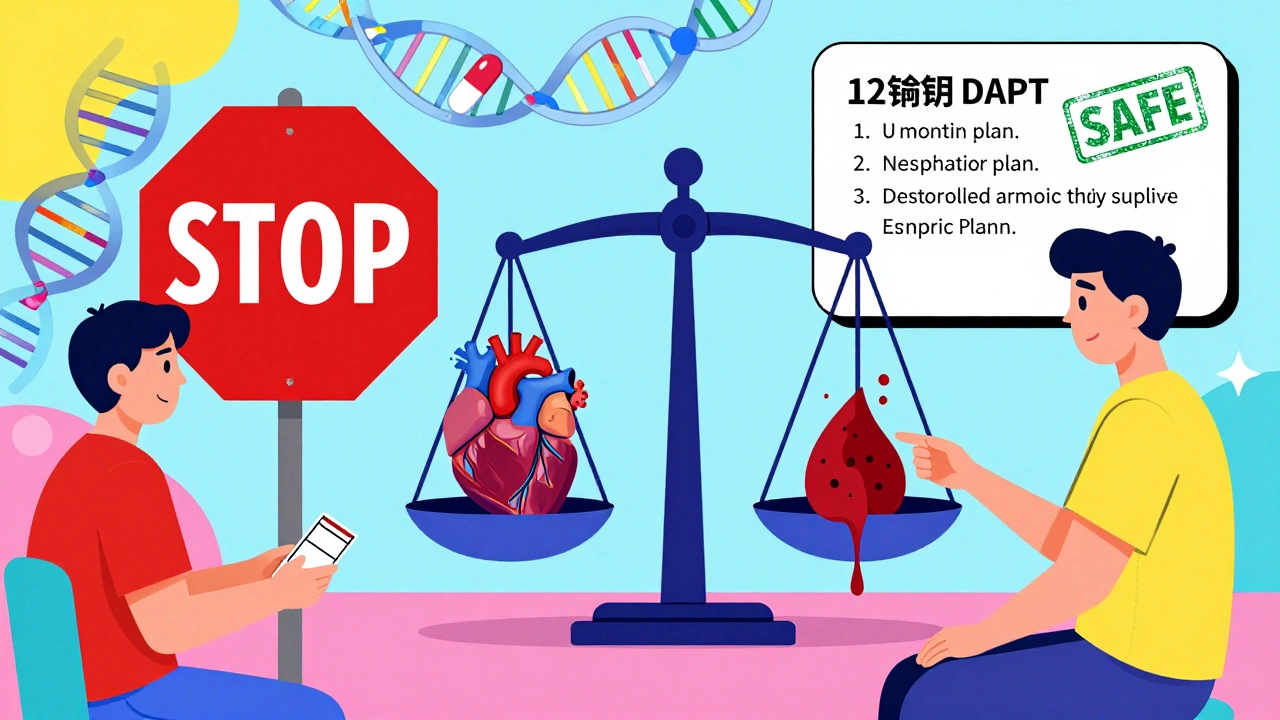
- Ask your doctor for your PRECISE-DAPT score. If you don’t know it, you can’t manage your risk.
- If you’re on ticagrelor or prasugrel, ask if switching to clopidogrel after 1-3 months is right for you.
- If you’re over 75 or have kidney disease, ask if 1-month DAPT followed by aspirin alone is an option.
- Keep a bleeding journal: note when, where, and how long bleeding lasted. Bring it to your next appointment.
- Never stop DAPT on your own-even if you’re bleeding. Talk to your cardiologist first.
And if you’re feeling anxious? You’re not alone. Studies show patients who get clear, personalized advice on bleeding risk report better quality of life. Their anxiety drops. Their adherence goes up. Their hearts stay protected.
The Future: Personalized DAPT Is Coming
By 2028, experts predict 90% of stent patients will get personalized DAPT plans-not 12 months for everyone. Machine learning models are being trained on data from 15,000 patients to predict exactly who needs longer therapy and who can stop early. The goal? Cut major bleeding by 8-10% each year without losing any heart protection.
And yes, scientists are working on antidotes. Two experimental drugs are already in early trials to reverse ticagrelor’s effects. That’s huge. Right now, if you bleed badly, doctors can only wait and hope your body makes new platelets. In five years, they might have a pill to undo it.
For now, the best tool you have is knowledge. Know your risk. Ask questions. Don’t accept "it’s just the way it is." DAPT isn’t a one-size-fits-all prescription. It’s a tool-and like any tool, it needs to be shaped to fit you.
Can I stop taking DAPT if I’m bleeding?
No, never stop DAPT on your own-even if you’re bleeding. Stopping too early raises your risk of a deadly stent clot by 2-3 times. If bleeding is serious, go to the hospital. Your doctor may adjust your meds or switch you to a safer combo, but only they can decide when it’s safe to change your treatment.
Is clopidogrel safer than ticagrelor?
Yes, clopidogrel causes significantly less bleeding than ticagrelor-about 30-40% less. But it’s also slightly less effective at preventing heart attacks. For people at high bleeding risk, clopidogrel is often the better choice. For those at higher risk of clots, ticagrelor may still be preferred, especially if de-escalation (switching later) is planned.
How do I know if I’m at high bleeding risk?
Your doctor can calculate your PRECISE-DAPT score using your age, weight, hemoglobin, creatinine, and history of bleeding. A score of 25 or higher means you’re high risk. If you’re over 75, have kidney disease, anemia, or a past bleed, you likely qualify. Ask for your score after your stent procedure.
Can I take ibuprofen while on DAPT?
No. Ibuprofen, naproxen, and other NSAIDs increase bleeding risk and can interfere with aspirin’s effect. Use acetaminophen (paracetamol) for pain instead. Always check with your doctor before taking any new medication, even over-the-counter ones.
Will I need DAPT forever?
No. Most people take DAPT for 6-12 months after a stent. For high-risk patients, it can be as short as 1 month. After that, you’ll usually switch to aspirin alone for the long term. Your doctor will decide based on your heart condition, bleeding risk, and how you’ve tolerated the drugs.
Are there any new treatments coming for DAPT bleeding?
Yes. Two experimental reversal agents for ticagrelor are in early human trials. These could stop bleeding quickly without needing platelet transfusions. Also, machine learning models are being developed to predict exactly how long each patient needs DAPT. By 2028, personalized plans will be the norm, not the exception.
What’s Next?
If you’re on DAPT, the next step isn’t just taking your pills-it’s having a conversation. Ask your doctor: "Based on my risk, how long should I stay on this? Is there a safer option? Can we switch drugs?" Don’t wait for them to bring it up. You’re not just a patient-you’re a partner in your care.
And if you’ve had a bleed and stopped your meds? Go back. Talk to your cardiologist. There’s a way to protect your heart without living in fear of every bruise. The science has moved forward. Your treatment should too.

December 7, 2025 AT 08:13 AM
Stop taking DAPT if you bleed. Just stop. It’s not that complicated.
December 9, 2025 AT 05:38 AM
Wow. Just wow. You think it’s that simple? People don’t die from nosebleeds-they die from clots. You’re not a doctor, you’re a danger to yourself and others. I’ve seen three patients in my clinic alone this month who stopped their meds because some Reddit guru told them to. One of them had a stent thrombosis at 3 a.m. while watching Netflix. Don’t be that person.
December 9, 2025 AT 15:59 PM
Listen here, you Westerners with your fancy trials and your overpriced pills-India has been managing heart disease for decades with aspirin and willpower! Why are we copying your overmedicated, overtested, over-analyzed nonsense? My uncle had a stent in 2008, took aspirin, drank turmeric milk, and lived to 89! You don’t need ticagrelor-you need discipline! And stop blaming the drugs-blame your lazy, sugar-filled, Netflix-binging lifestyles!
December 10, 2025 AT 03:10 AM
It’s fascinating how the PRECISE-DAPT score operationalizes bleeding risk through a multidimensional, risk-stratified algorithm-essentially a probabilistic model calibrated against longitudinal cohort data from the TRITON-TIMI 38 and MASTER DAPT trials. But what’s even more compelling is the emergent paradigm shift from population-based guidelines toward individualized pharmacodynamic profiles. The future is N-of-1 therapy, folks. And yes, I’ve already submitted my genomic data to my cardiologist’s AI-driven decision engine.
December 10, 2025 AT 20:35 PM
While the clinical evidence supporting de-escalation strategies in high bleeding risk patients is robust, as evidenced by the 2022 MASTER DAPT trial, it remains imperative that such decisions be made within the context of a structured, multidisciplinary care pathway. The absence of standardized protocols across institutions may lead to therapeutic heterogeneity, potentially compromising patient outcomes. Therefore, I would advocate for institutional implementation of algorithmic decision support tools integrated into electronic health records to ensure fidelity to evidence-based guidelines.
December 11, 2025 AT 04:40 AM
You’re not alone in this. I’ve been on DAPT for 14 months after my stent, and yes, I’ve had a few nosebleeds and bruises. But here’s the thing: I’m alive. My heart is beating. I talk to my doctor every three months. I keep a journal. I don’t take ibuprofen. I don’t stop the meds. I don’t listen to random strangers online. You can do this. One day at a time. You’ve got this.
December 13, 2025 AT 01:06 AM
They’re lying to you. They always lie. You think they care if you bleed? No. They care about the pill count. The insurance codes. The profit margins. Ticagrelor? Made by a company that paid doctors $4 million last year to push it. Clopidogrel? Generic. Cheap. Forgotten. They want you dependent. They want you scared. And they want you paying. You think your ‘doctor’ is helping you? Look at the receipts. They’re all in the same system. The bleeding? It’s not a side effect. It’s the cost of compliance.
December 13, 2025 AT 07:12 AM
Studies show 18.7% of patients discontinue DAPT due to nuisance bleeding. But the CDC data on stent thrombosis mortality post-discontinuation is 2.8x higher than baseline. Therefore, statistically, the risk-benefit ratio remains overwhelmingly in favor of continuation unless contraindicated. The emotional response to minor hemorrhage is not a valid clinical indicator. Your fear is not data.
December 13, 2025 AT 23:59 PM
My dad’s on DAPT. He’s 78, has kidney issues, and once bled through his toothbrush for 20 minutes. Scared the hell out of us. But he didn’t quit. He asked his doc for the PRECISE-DAPT score. Turned out he was HBR. Switched to clopidogrel after a month. Now he’s got zero bleeds, zero anxiety, and he’s back to gardening. Don’t let fear run your life. Ask questions. Get smart. Talk to your doctor. It’s not magic. It’s medicine.
December 15, 2025 AT 11:40 AM
But what if the real risk isn’t the clot or the bleed-but the system that makes you choose between them? What if the entire framework of DAPT is just another way to medicalize normal aging? What if the ‘solution’ is just a more expensive version of the same problem? We treat symptoms like sins. We don’t ask why our bodies are breaking down in the first place. Maybe we need less pills… and more sleep. More walks. Less stress. Less corporate-sponsored cardiology.