
Quitting smoking isn’t just about willpower. It’s a medical challenge-and the good news is, science has powerful tools to help. If you’ve tried quitting before and relapsed, it’s not because you failed. It’s because most people try alone, without the right support or medication. The truth is, smoking cessation medications combined with simple behavioral strategies can double-or even triple-your chances of quitting for good.
Why Most Quit Attempts Fail (And How to Fix It)
Eight out of ten people who try to quit smoking without help end up smoking again within six months. That’s not because they’re weak. It’s because nicotine rewires your brain. When you stop, your body goes into withdrawal: irritability, trouble sleeping, intense cravings, even trouble concentrating. These aren’t just inconveniences-they’re biological signals screaming for nicotine.
The key isn’t to fight the cravings. It’s to manage them with tools proven to work. The U.S. Public Health Service says the best approach? Combine medication with counseling. Even five minutes of advice from a doctor boosts success by 30%. You don’t need hours of therapy. You need the right meds, a clear plan, and someone to hold you accountable.
The Three Main Medications That Actually Work
There are three FDA-approved medications that change the game. Each works differently. One reduces cravings. One blocks nicotine’s effects. One replaces it. Here’s how they stack up.
Varenicline (Chantix)
Varenicline is the most effective single medication for quitting smoking. Developed by Pfizer and approved in 2006, it targets the same brain receptors as nicotine-but without the high. It gently reduces cravings and blocks nicotine from giving you a rush if you slip up.
Studies show it works better than anything else. In the landmark EAGLES trial, 21.8% of people using varenicline were still smoke-free after six months, compared to just 9.4% on placebo. That’s more than double the success rate. A 2022 analysis of 363 studies found varenicline was 32% more effective than nicotine patches and 46% more effective than bupropion.
But it’s not perfect. About 30% of users get nausea, especially at first. Some report vivid dreams or trouble sleeping. A small number quit because of side effects. Still, for people who stick with it, the payoff is huge. One 2023 study found Black smokers-often less responsive to other treatments-had significantly better quit rates with varenicline.
How to take it: Start at 0.5 mg once daily for three days, then 0.5 mg twice daily for four days. Then move to 1 mg twice daily. Begin one to two weeks before your quit date. Take it for 12 weeks. If you’re doing well, extend it to 24 weeks. That’s the secret: don’t stop too soon.
Bupropion (Zyban)
Bupropion is an antidepressant that was accidentally found to help people quit smoking. It doesn’t contain nicotine. Instead, it affects dopamine and norepinephrine-chemicals linked to mood and reward. It’s especially helpful if you’ve struggled with depression or low energy after quitting.
Success rates are lower than varenicline, but still meaningful. Around 10-16% of users are smoke-free at six months. It’s also cheaper. At Walmart, a 30-day supply costs just $15 as a generic.
Side effects? Insomnia and dry mouth are common. About 24% of users in one survey stopped because sleep problems got too bad. But if you have depression, you might feel better overall. One 2022 survey found 62% of users with depression reported improved mood along with fewer cravings.
How to take it: Start at 150 mg once daily for three days, then increase to 150 mg twice daily (12 hours apart). Begin one week before your quit date. Don’t take it too close to bedtime-it can keep you awake.
Nicotine Replacement Therapy (NRT)
NRT is the most familiar option: patches, gum, lozenges, sprays, inhalers. It works by giving your body a steady, safe dose of nicotine so you don’t go into withdrawal.
It’s not as powerful as varenicline, but it’s safer and easier to get. You can buy gum and lozenges over the counter. Patches are available at pharmacies without a prescription.
Success rates vary: 9.4% to 15.7% at six months, depending on the product and how you use it. The key is using it correctly. If you smoke more than 10 cigarettes a day, start with the 21mg patch. Combine it with gum or lozenges for sudden cravings. Use the faster-acting form when you feel the urge, then stick with the patch for steady relief.
How to use it: Wear the patch for 16-24 hours a day. Taper down every 4 weeks: 21mg → 14mg → 7mg. Chew gum slowly-don’t bite it. Let it sit in your cheek until the taste is strong, then park it between your cheek and gum. Do this for 30 minutes. Don’t eat or drink 15 minutes before or after using lozenges.
Combining Medications: The Hidden Advantage
Most people think you pick one. But the best results come from combining them.
A 2022 meta-analysis found that using varenicline with a nicotine patch doubled the odds of quitting compared to either alone. The odds ratio? 5.75. That means for every 100 people who use both, 57 more quit than if they used nothing.
How to do it safely: Start varenicline one to two weeks before your quit date. On your quit day, add a 21mg patch. Use gum or lozenges as needed for breakthrough cravings. After 8 weeks, drop the patch. Keep varenicline for the full 12-24 weeks.
This combo works because varenicline handles the brain’s craving signals, while the patch smooths out the physical withdrawal. It’s like using both a shield and a sword.
What About Cytisine? The Cheap Alternative
There’s a new player on the scene: cytisine. It’s a plant-based compound similar to varenicline, used for decades in Eastern Europe. It’s cheaper-about $25 for a full course-and just as effective in some studies.
A 2024 analysis found cytisine had slightly higher quit rates than varenicline in some trials. But it’s not yet FDA-approved in the U.S. You can buy it online, but quality control varies. If you’re cost-sensitive and can’t access varenicline, cytisine might be worth considering-talk to your doctor first.
Behavioral Strategies That Actually Stick
Medication helps. But without a plan, you’re setting yourself up to fail.
Here’s what works:
- Set a quit date. Pick a day within the next two weeks. Mark it on your calendar. Tell three people.
- Identify your triggers. Do you smoke after meals? When you’re stressed? After a drink? Write them down. Plan alternatives: chew gum, take a walk, sip water.
- Remove temptation. Toss ashtrays, lighters, and cigarettes. Clean your car and home. Ask others not to smoke around you.
- Use apps. SmokeFree, QuitGuide, and MyQuit Coach give daily tips, track savings, and offer support.
- Call a quitline. In Australia, 13 7848 is free and confidential. Counselors help you build a plan and check in weekly.
Even a 5-minute chat with your doctor increases your chance of success by 30%. You don’t need a therapist. You just need someone to say, “You’ve got this.”
Cost, Access, and Insurance
Cost is a real barrier. Varenicline costs about $500 for 12 weeks without insurance. But in Australia, the Pharmaceutical Benefits Scheme (PBS) subsidizes it. If you have a Medicare card, you pay around $30 per script. Bupropion is even cheaper-under $10 with PBS.
NRT patches cost about $45 for a week’s supply at retail, but PBS covers them too. Gum and lozenges are partially subsidized. If you’re on a low income, ask your doctor about PBS eligibility. Many people don’t know they qualify.
Medicaid in the U.S. covers cessation meds in expansion states-but only 29% of non-expansion states do. In Australia, the system is simpler. If you’re a citizen or permanent resident, you’re likely covered.
What to Do If You Slip
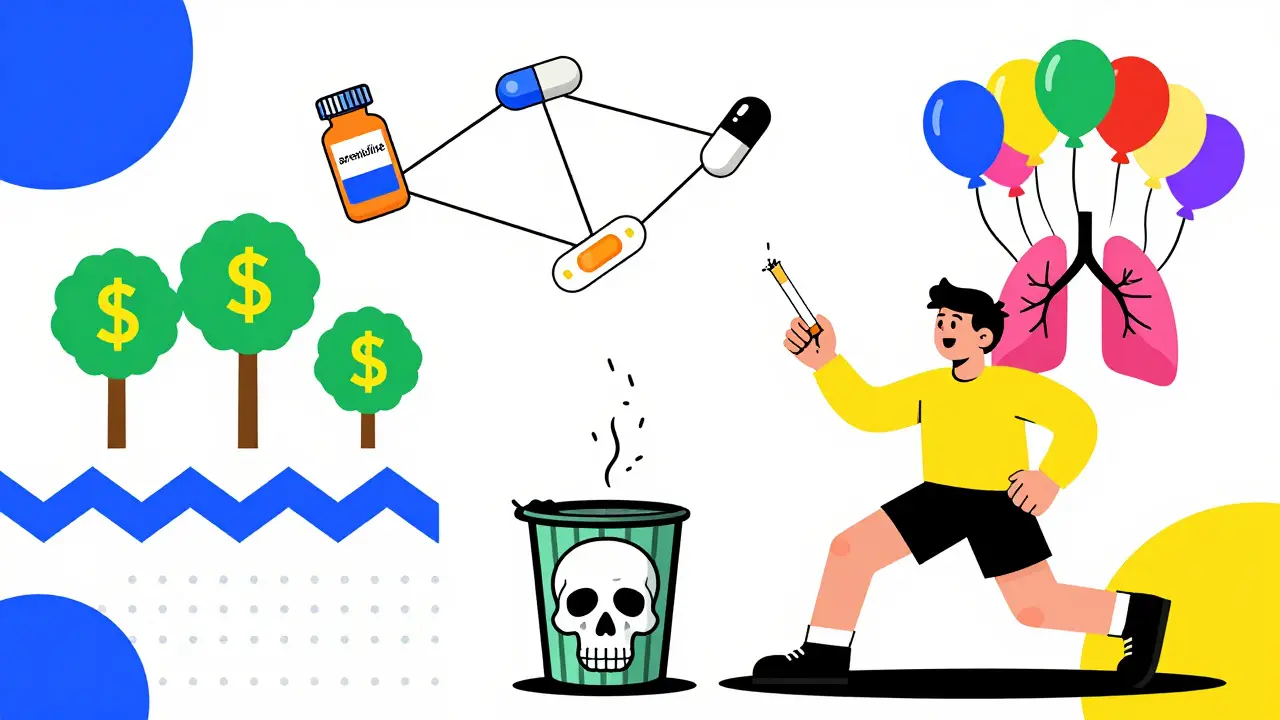
Relapse isn’t failure. It’s data.
Most people try to quit multiple times. The average is 3-5 attempts before quitting for good. If you smoke one cigarette, don’t throw the whole pack away.
Ask yourself: What triggered it? Were you stressed? Around smokers? Did you skip your medication? Adjust your plan. Maybe you need more gum. Maybe you need to avoid bars for a while. Maybe you need to restart varenicline.
Keep taking your meds. Don’t stop because you slipped. Your brain still needs support.
What’s Next? The Future of Quitting
Science is moving fast. Researchers are now testing personalized quitting plans based on how fast your body breaks down nicotine. Some people metabolize it slowly-they respond better to patches. Others are fast metabolizers-they need varenicline.
There’s also new research into digital tools: AI chatbots that text you when cravings hit, wearable sensors that detect stress spikes, and apps that use your phone’s location to avoid trigger zones.
But for now, the best tools are simple: the right medication, a clear plan, and someone who believes in you.
Final Thought: You’re Not Alone
Every year, over 480,000 people in the U.S. die from smoking. That’s more than HIV, car accidents, and illegal drugs combined. But every day, thousands quit. And they didn’t do it by willpower alone. They used medicine. They got support. They kept trying.
If you’re reading this, you’re already ahead of most. You’re looking for real solutions. That’s the first step. Now take the next one: talk to your doctor. Ask about varenicline. Ask about NRT. Ask about help. Your lungs, your heart, your future-you’re worth it.
Which smoking cessation medication is most effective?
Varenicline (Chantix) is the most effective single medication for quitting smoking, according to guidelines from the American Thoracic Society and the U.S. Public Health Service. Clinical trials show it doubles quit rates compared to placebo and outperforms nicotine patches and bupropion. About 22% of users remain smoke-free at six months, versus 9-16% with other options.
Can I use nicotine patches and varenicline together?
Yes. Combining varenicline with a nicotine patch significantly increases success rates. A 2022 meta-analysis found this combination nearly tripled the odds of quitting compared to using either alone. Start varenicline one to two weeks before your quit date, then add the patch on your quit day. Use gum or lozenges for sudden cravings. After eight weeks, stop the patch but keep varenicline for 12-24 weeks.
Is bupropion safe if I have depression?
Bupropion is often recommended for people with depression because it can improve mood while reducing cravings. A 2022 survey found 62% of users with depression reported better mood after starting bupropion. However, it can cause insomnia or anxiety in some people. Talk to your doctor before starting-it’s not for everyone, especially if you have a history of seizures or eating disorders.
How long should I take smoking cessation medication?
Most guidelines recommend at least 12 weeks. For varenicline, extending treatment to 24 weeks increases long-term success. NRT should be tapered over 8-12 weeks. Don’t stop early just because cravings feel better. Your brain still needs time to reset. Stopping too soon is one of the top reasons people relapse.
Are smoking cessation meds covered by insurance in Australia?
Yes. In Australia, varenicline, bupropion, and most nicotine replacement therapies are subsidized under the Pharmaceutical Benefits Scheme (PBS). With a Medicare card, you pay around $30 per script for varenicline and under $10 for bupropion. NRT patches and gum are also partially covered. Check with your pharmacist or doctor to confirm eligibility.
What should I do if I have side effects from varenicline?
Nausea is the most common side effect-about 30% of users feel it, especially at first. Take the medication with food and a full glass of water. If it’s too strong, ask your doctor about lowering the dose temporarily. Vivid dreams or sleep issues are also common. If they’re unbearable, don’t quit cold turkey-talk to your doctor. You might switch to bupropion or NRT. Side effects usually fade after the first two weeks.
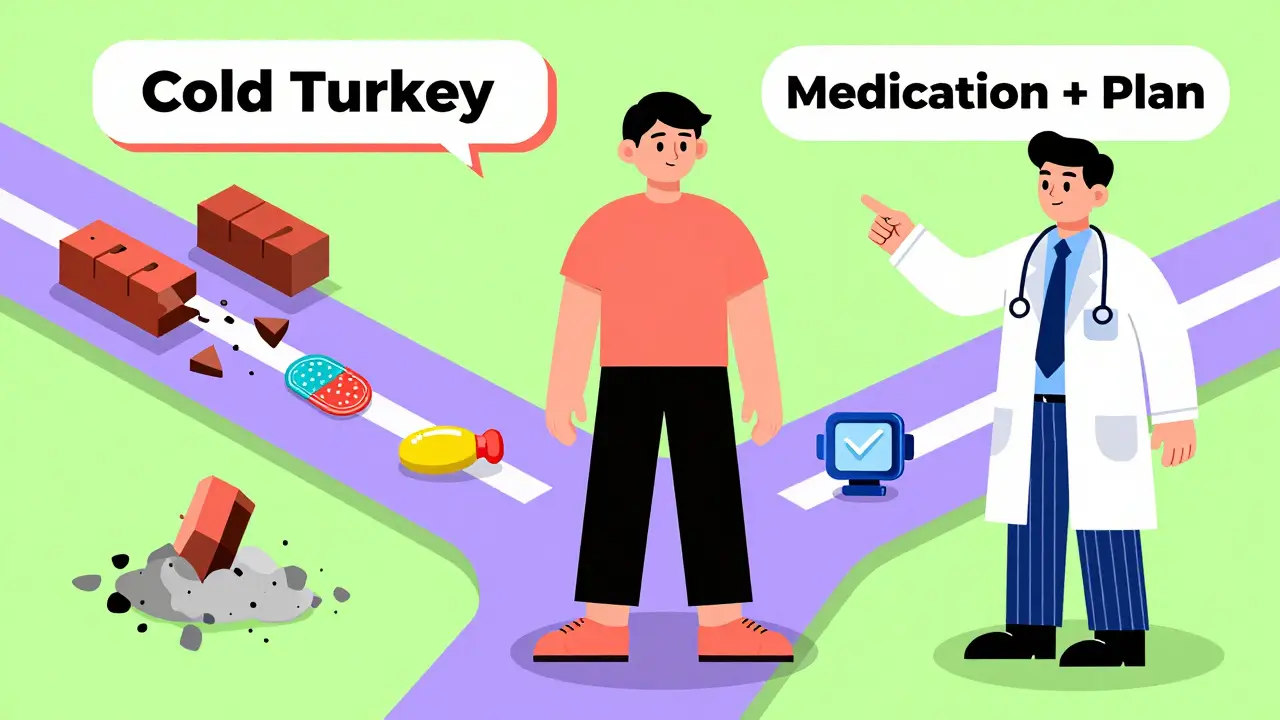
Can I quit smoking without medication?
Yes, but it’s harder. Only about 5-7% of people who quit cold turkey stay smoke-free after one year. Medication doubles or triples those odds. If you prefer not to use meds, combine behavioral strategies-like counseling, apps, and quitlines-with strong social support. But if you’ve tried before and failed, medication is your best next step.


December 24, 2025 AT 05:02 AM
So let me get this straight - Big Pharma spent billions to make us believe we need pills to quit smoking, but the real fix is just not buying cigarettes? 🤔 Meanwhile, my cousin quit by staring at a picture of his dad’s funeral. No meds. Just trauma. Coincidence? I think not.
December 24, 2025 AT 07:02 AM
Varenicline + NRT combo is the real MVP. I used it. 14 months clean. The nausea faded after week two. Worth it.
December 24, 2025 AT 12:02 PM
The pharmacokinetic individualization angle is fascinating - fast vs. slow nicotine metabolizers. We’re moving toward precision cessation science. The 2024 biomarker studies are promising, especially with CYP2A6 genotyping becoming more accessible in primary care.
December 26, 2025 AT 09:21 AM
They don’t want you to quit. They want you to cycle. Every time you relapse, you buy more patches, more pills, more ‘hope.’ The FDA approves these drugs not because they work - but because they create repeat customers. You think this is medicine? It’s a subscription model with side effects.
December 27, 2025 AT 19:24 PM
You got this 💪 Seriously - if you’re reading this, you’re already 10x stronger than you think. Medication isn’t cheating. It’s strategy. And you deserve to breathe easy. 🌿❤️
December 27, 2025 AT 22:46 PM
If you’re still debating whether to use varenicline, you’re not trying hard enough. This isn’t a lifestyle choice - it’s a life-or-death decision. Stop being lazy and take the damn pill. Your lungs don’t care about your excuses.
December 29, 2025 AT 21:10 PM
Did you know the FDA only approved varenicline after a secret meeting with Pfizer executives in 2005? And that the EAGLES trial excluded people with bipolar disorder? They’re hiding the real data. I’ve got the leaked emails. Want me to send them?
December 30, 2025 AT 09:46 AM
Your grammar is atrocious in the section about NRT usage. 'Chew gum slowly-don’t bite it.' Should be 'Chew the gum slowly; do not bite it.' Also, you misattribute the 2022 meta-analysis. It’s from the Cochrane Review, not some blog. Fix your citations. Credibility matters.
December 30, 2025 AT 23:29 PM
The human condition is one of habitual attachment - nicotine merely externalizes an inner void. To quit smoking is not merely to cease inhaling tar, but to confront the silence that follows the ritual. Medications may soothe the body, but only self-awareness can mend the soul. One must ask: what is it that the cigarette promises, and why do we believe it?
January 1, 2026 AT 09:55 AM
The pharmacodynamics of varenicline as a partial agonist at α4β2 nAChRs is well-documented, but the long-term neuroadaptation data beyond 24 weeks remains underpowered. Most studies lack longitudinal fMRI follow-up to assess dopaminergic re-sensitization. We need more RCTs with biomarker endpoints.
January 2, 2026 AT 23:45 PM
They told me varenicline was safe. Then my friend had a psychotic break after 3 weeks. Coincidence? No. The FDA knew. The WHO knew. But they kept pushing it because the profits were too big. And now they want you to combine it with patches? That’s not medicine. That’s chemical warfare.
January 4, 2026 AT 20:38 PM
Man, I tried Chantix. Dreams so wild I woke up screamin’ at my cat like she was a DEA agent. But I quit. And now I save $200 a month. My kids say I smell like a human again. That’s worth the nightmares.
January 6, 2026 AT 08:58 AM
Oh wow, a 22% success rate? That’s like saying ‘I have a 1 in 5 chance of winning the lottery if I buy a ticket while wearing socks.’ Still better than your ‘just quit’ advice from 2003. Thanks for the update, I guess.
January 7, 2026 AT 21:54 PM
You’re not failing because you’re weak. You’re failing because you’re trying to win a marathon with a limp. Varenicline + patch isn’t cheating - it’s leveling the playing field. Now go call your quitline. I’ll wait.