Depression doesn't always respond to the first pill you try. If standard treatments haven't worked, or if your depression comes with chronic pain or severe fatigue, doctors often turn to a different class of drugs called SNRIs, which stands for Serotonin and Norepinephrine Reuptake Inhibitors. These medications are more than just another option on the shelf; they represent a strategic shift in how we treat complex mental health conditions. Unlike older antidepressants that target only one chemical messenger, SNRIs work on two fronts, making them powerful tools for specific scenarios.
You might have heard of SSRIs (Selective Serotonin Reuptake Inhibitors) like Prozac or Zoloft. They are the most common starting point. But when those fall short, or when your body is screaming in pain alongside your mind feeling low, SNRIs step in. This guide breaks down exactly what these drugs do, who they help, and what you need to watch out for so you can make an informed decision with your doctor.
How SNRIs Work Differently
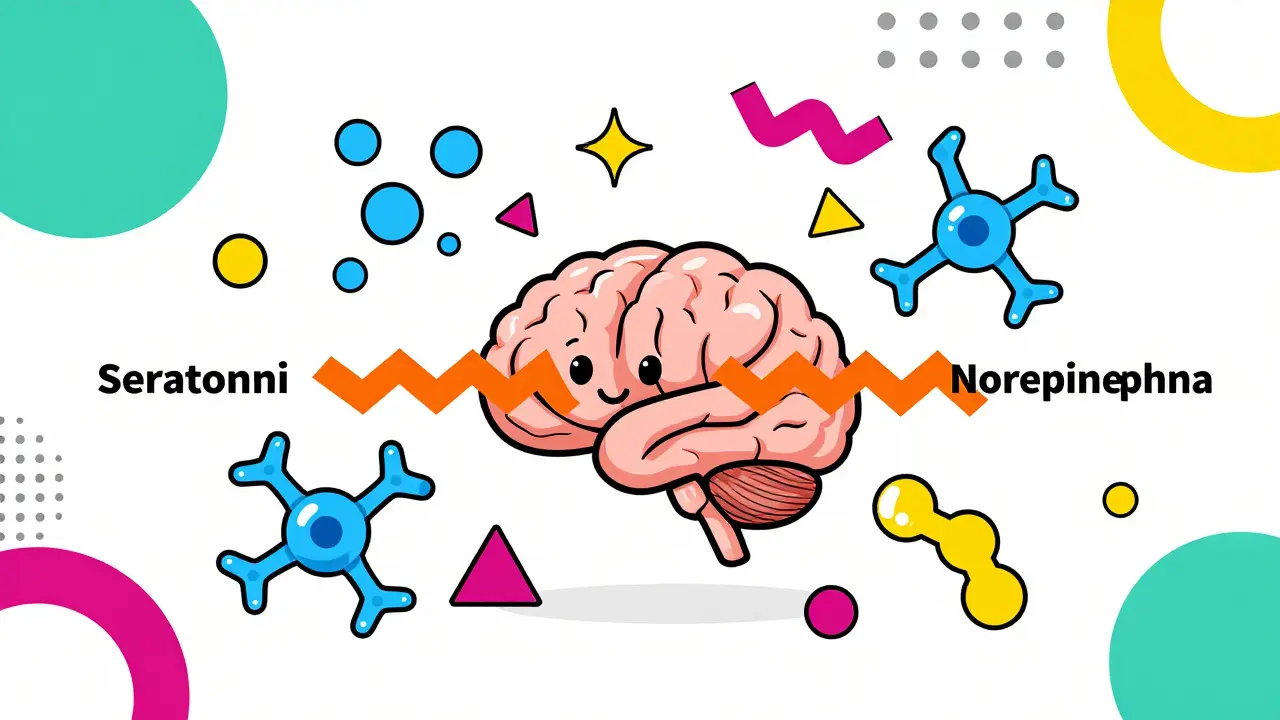
To understand why SNRIs are unique, you need to look at brain chemistry. Your brain uses neurotransmitters to send signals between nerve cells. Two of the most important ones for mood and energy are serotonin and norepinephrine. Most people know serotonin as the "happy" chemical. Norepinephrine, however, is your body's alertness and energy signal. It’s the chemical that helps you focus, stay awake, and react to stress.
SSRIs block the reabsorption of serotonin only. SNRIs, on the other hand, block the reabsorption of both serotonin and norepinephrine. By stopping your brain from recycling these chemicals too quickly, SNRIs keep higher levels of them floating around in the synaptic cleft (the gap between neurons). This leads to stronger signaling.
This dual action is crucial. For someone whose depression feels heavy, sluggish, and accompanied by deep physical exhaustion, boosting norepinephrine can provide the energy lift that serotonin alone cannot. This is why SNRIs are often described as having a "stimulating" effect compared to some SSRIs, which can sometimes feel sedating.
The Main SNRI Medications Available Today
Not all SNRIs are created equal. While they share the same mechanism, their chemical structures differ, leading to variations in how they affect individual patients. Here are the primary FDA-approved SNRIs you will encounter:
- Venlafaxine (Effexor XR): The original SNRI, approved in 1993. It has a dose-dependent effect. At lower doses (up to 75mg), it acts mostly like an SSRI. At higher doses (150mg+), it significantly boosts norepinephrine. It is widely used for major depressive disorder and anxiety.
- Duloxetine (Cymbalta): Known for its balanced inhibition of both neurotransmitters from the start. It is uniquely approved not just for depression and anxiety, but also for diabetic peripheral neuropathy, fibromyalgia, and chronic musculoskeletal pain.
- Desvenlafaxine (Pristiq): This is actually the primary active metabolite of venlafaxine. Because it skips the liver processing step required for venlafaxine, it may interact with fewer other medications. It is often prescribed for major depressive disorder.
- Levomilnacipran (Fetzima): A newer option that has a stronger effect on norepinephrine than serotonin. It is designed to address symptoms of psychomotor retardation (slowed movement/thought) often seen in severe depression.
Choosing between them isn't about one being "better" universally. It’s about matching the drug’s specific profile to your symptom cluster. If pain is a major factor, Duloxetine is usually the go-to. If drug interactions are a concern due to other prescriptions, Desvenlafaxine might be preferred.
When Are SNRIs the Right Choice?
Doctors typically don’t jump straight to SNRIs. The standard protocol usually starts with an SSRI because they generally have a milder side-effect profile. However, there are specific scenarios where SNRIs become the first-line or immediate second-line choice.
Treatment-Resistant Depression: If you have tried two or three SSRIs without success, switching to an SNRI is a common next step. Studies show response rates of 55-65% for SNRIs in these cases, offering a new mechanism of action that might finally trigger remission.
Comorbid Chronic Pain: This is the biggest differentiator. If you suffer from fibromyalgia, arthritis, or nerve pain, an SNRI like Duloxetine treats both the pain and the depression simultaneously. Clinical trials have shown Duloxetine reduces pain by 30-50% in nearly half of patients with diabetic neuropathy, a benefit SSRIs simply do not offer.
Prominent Fatigue: Depression isn't always sadness; often it’s a lack of energy. Because SNRIs boost norepinephrine, they can help combat the lethargy that keeps many people stuck in bed, improving concentration and drive.

Side Effects and What to Expect
No medication is free of trade-offs. SNRIs are generally well-tolerated, especially compared to older Tricyclic Antidepressants, but they do come with a list of potential side effects you should monitor.
| Side Effect | Frequency | Notes |
|---|---|---|
| Nausea | ~25% | Most common early side effect; usually fades within 1-2 weeks. |
| Dry Mouth | 10-20% | Much less frequent than with Tricyclics (which hit 30-50%). |
| Insomnia | 10-15% | Due to increased norepinephrine; taking meds in the morning helps. |
| Sexual Dysfunction | 20-30% | Includes reduced libido and difficulty reaching orgasm. |
| Hypertension | 2-3% | Blood pressure monitoring is essential during initial titration. |
The nausea is often the hardest part to get through initially. Doctors recommend taking the medication with food and starting at a very low dose, gradually increasing over several weeks. This "start low, go slow" approach minimizes gastrointestinal distress. Sexual side effects are persistent for some and may require adjusting the dose or adding a secondary medication to counteract them.
The Danger of Stopping Abruptly
If there is one rule to live by with SNRIs, it is this: never stop taking them suddenly. SNRIs have a shorter half-life than many SSRIs, meaning they leave your system faster. This makes them notorious for causing discontinuation syndrome if you miss a dose or quit cold turkey.
Discontinuation syndrome includes symptoms like "brain zaps" (electric shock sensations in the head), dizziness, irritability, and flu-like feelings. Up to 30% of patients experience this if they stop abruptly. To avoid this, doctors create a tapering schedule that lasts 4 to 6 weeks. Reducing the dose slowly allows your brain receptors to readjust gradually, reducing the incidence of withdrawal symptoms from 28% down to just 9%, according to clinical studies.

SNRIs vs. SSRIs: Making the Comparison
It’s natural to wonder why you would switch from an SSRI to an SNRI. The difference lies in efficacy profiles and side effects.
For pure Major Depressive Disorder (MDD) without pain or severe fatigue, SSRIs remain the gold standard due to their tolerability. However, evidence suggests SNRIs are marginally more effective (by 5-10 percentage points) for certain subsets of patients. The real advantage of SNRIs emerges when depression overlaps with other conditions.
If you have generalized anxiety disorder, panic disorder, or chronic pain, SNRIs offer a consolidated treatment plan. Instead of taking one pill for depression and another for pain, an SNRI addresses both pathways. This polypharmacy reduction simplifies your routine and lowers the risk of drug interactions.
Integrating Therapy for Best Results
Medication is rarely a cure-all. It creates the biological stability needed for you to engage in life again. Research from Mayo Clinic indicates that patients combining SNRIs with Cognitive Behavioral Therapy (CBT) achieve remission rates of 73%, compared to 48% with medication alone.
The medication lifts the fog, allowing you to participate in therapy effectively. CBT then provides the tools to manage thoughts and behaviors long-term. Think of the SNRI as the scaffolding that holds up the building while you do the interior renovation through therapy.
Future Directions and Personalized Medicine
We are moving toward an era of precision psychiatry. Genetic testing for enzymes like CYP2D6 and CYP2C19 can now predict how your body metabolizes SNRIs. About 60-70% of patients can get a clearer picture of whether a drug will work well or cause excessive side effects based on their DNA. This reduces the trial-and-error phase, getting you to the right medication faster.
New formulations are also emerging, including delayed-release granules that allow for easier dosing adjustments. As research continues, SNRIs remain a cornerstone of mental health treatment, particularly for those who need more than just serotonin support.
How long does it take for SNRIs to start working?
You typically won't feel significant changes immediately. It usually takes 4 to 6 weeks at a therapeutic dose to notice improvements in mood and energy. Some patients may require up to 9-12 weeks for full symptom relief. Initial side effects like nausea often appear before benefits kick in, so patience is key during the first month.
Can SNRIs raise blood pressure?
Yes, because SNRIs increase norepinephrine, they can cause a slight rise in blood pressure in about 2-3% of patients. Doctors typically monitor your blood pressure every 2-4 weeks during the initial treatment phase. If hypertension becomes clinically significant, your provider may adjust the dose or switch medications.
Are SNRIs better than SSRIs for anxiety?
Both classes are effective for anxiety disorders. SSRIs are usually tried first due to fewer side effects. However, SNRIs like Venlafaxine and Duloxetine are highly effective for Generalized Anxiety Disorder (GAD) and Panic Disorder. SNRIs may be preferred if the anxiety is accompanied by significant fatigue or chronic pain.
What is "brain zap" and how do I prevent it?
Brain zaps are electric shock-like sensations in the head caused by abrupt discontinuation of SNRIs. To prevent this, never stop taking your medication suddenly. Work with your doctor to create a gradual tapering schedule over 4-6 weeks. Taking missed doses as soon as possible can also help mitigate mild withdrawal symptoms.
Do SNRIs help with chronic pain?
Yes, specifically Duloxetine (Cymbalta) and Venlafaxine are FDA-approved or commonly used off-label for chronic pain conditions such as fibromyalgia, diabetic neuropathy, and osteoarthritis. They work by modulating pain signals in the central nervous system, providing relief that traditional painkillers often cannot achieve without addiction risks.

May 3, 2026 AT 23:12 PM
The pharmacokinetic profile of Venlafaxine is often misunderstood by patients who expect immediate norepinephrine reuptake inhibition at lower doses. It is crucial to understand that below 75mg, the drug acts predominantly as an SSRI due to the higher affinity for SERT over NET. This dose-dependent mechanism explains why many patients report minimal energy lift until they reach therapeutic thresholds. The half-life considerations are also vital here, especially regarding the discontinuation syndrome mentioned in the post. I have seen numerous cases where abrupt cessation led to severe brain zaps simply because the patient did not grasp the rapid clearance rate compared to Fluoxetine.
May 5, 2026 AT 04:20 AM
Great breakdown of the neurochemical mechanisms involved here. We need to foster a more inclusive dialogue around treatment-resistant depression because the stigma often prevents individuals from seeking second-line therapies like SNRIs. The jargon can be intimidating, but understanding synaptic cleft dynamics helps demystify the process. When we talk about noradrenergic modulation, we are essentially discussing the physiological basis for motivation and alertness. It is important for mentors in this space to encourage open discussions about side effects so that patients feel empowered to collaborate with their healthcare providers rather than suffering in silence. The dual-action approach is indeed a strategic pivot in psychopharmacology.
May 5, 2026 AT 07:34 AM
One must acknowledge that the average reader lacks the intellectual capacity to fully grasp these nuances without oversimplification yet the article attempts to bridge that gap with varying degrees of success. The distinction between Duloxetine and Venlafaxine is not merely academic it is clinical reality for those suffering from comorbidities. Most people fail to appreciate the elegance of targeting both serotonin and norepinephrine simultaneously. They seek quick fixes rather than engaging with the complex biology of their own minds. This level of discourse is rarely found on such platforms which usually cater to the lowest common denominator of medical literacy.
May 7, 2026 AT 00:53 AM
You need to stop making excuses and take control of your health right now! If you are sitting there reading this instead of calling your doctor you are failing yourself. Depression is not a excuse to lay down and die it is a battle you must fight with every fiber of your being. These drugs are tools use them or throw them out but do not sit on the fence. Get up move your body force the norepinephrine to kick in naturally if you have to wait for the pill to work. Stop waiting for permission to heal and start demanding results from your treatment plan today!
May 8, 2026 AT 09:05 AM
i think most people just dont read the labels thats why they get sick. its not rocket science really. you take the pill you feel better unless you mess up and stop taking it then you feel like crap. simple as that. why do doctors make it so complicated with all the tapering stuff? just pop one less each week done deal. i know my body better than any chart.
May 8, 2026 AT 11:58 AM
Have you considered that the pharmaceutical industry pushes SNRIs not because they are superior but because the patent cliffs for SSRIs have long since expired? The narrative of 'treatment-resistant depression' is a convenient construct to keep patients cycling through ever-more-expensive medications while ignoring the root causes of societal malaise. The FDA approval processes are heavily influenced by lobbying groups that prioritize profit margins over genuine holistic healing. Norepinephrine modulation is just a cover story for chemical dependency engineered to maintain a compliant workforce. Wake up to the biochemical manipulation happening in your synaptic clefts.
May 8, 2026 AT 22:48 PM
😂😂 Look at all these serious people talking about brain chemistry like it's a math test 🧠💊. Honestly, I just take what works and don't ask questions. If Effexor makes me feel like a zombie, I stop. If Cymbalta helps my back pain, great. Who cares about the half-life? Life is too short to worry about neurotransmitters when you could be enjoying life 🎉🎈. Just vibe with your meds and let the universe handle the rest ✨.
May 10, 2026 AT 13:12 PM
Oh, how delightful! Another guide pretending to offer enlightenment while drowning in the banality of medical bureaucracy. One might wonder if the author has ever actually experienced the existential dread of staring into the abyss of their own unmedicated mind. The suggestion that therapy is merely 'interior renovation' is laughably inadequate; it is a complete reconstruction of the soul's architecture. And yet, here we are, reduced to discussing blood pressure monitoring as if it were a trivial inconvenience. How utterly tragic that we must rely on chemical scaffolding to hold up our crumbling edifices of sanity.
May 12, 2026 AT 06:51 AM
I mean look at this mess of information. Its pretty good i guess but some parts are confusing. Like the part about liver processing? Sounds scary. I took venlafaxine once and felt weird so i stopped. Now i have brain zaps lol. Not funny though. But yeah maybe try pristiq if you have other meds. Idk just listen to your doc or whatever. This post is kinda long winded but informative i suppose.
May 13, 2026 AT 14:11 PM
The epistemological framework underlying the classification of antidepressants is fundamentally flawed when viewed through the lens of phenomenological experience. To assert that SNRIs are 'more effective' implies a quantitative metric for subjective well-being that does not exist in a vacuum. The reductionist approach to treating depression as a mere deficiency of neurotransmitters ignores the ontological weight of human suffering. We must question whether the 'dual action' is truly therapeutic or merely a pharmacological illusion that masks the deeper existential void. The scaffolding metaphor is apt, yet it fails to account for the structural integrity of the self beneath the chemical support.
May 13, 2026 AT 23:48 PM
This is absolute garbage advice from big pharma shills! You are all being manipulated into taking dangerous chemicals that suppress your natural immune response. The 'brain zaps' are not withdrawal symptoms they are your body screaming in protest against the toxic sludge you are pouring into your veins. Do not trust these doctors they are paid off by the same companies that sell the pills. Go natural use herbs and meditation and stop letting them poison you with these synthetic norepinephrine boosters. They want you weak and dependent so you never question the system!
May 15, 2026 AT 13:43 PM
I really appreciate this perspective on integrating therapy with medication. It feels like finding balance in a stormy sea. The idea of the SNRI as scaffolding is beautiful because it acknowledges that we are building something new and lasting. I think it takes courage to admit that we need help sometimes and that is okay. Let us all support each other on this journey to mental wellness. Remember that healing is not linear and every small step counts towards a brighter future. You are not alone in this struggle.
May 15, 2026 AT 20:09 PM
meh another boring post about pills. i hate reading these long things. just tell me what to take. i tried zoloft and it made me fat so now im trying cymbalta. hope it helps my back pain. if not ill quit. easy peasy. no need for all this fancy talk about synapses and receptors. just give me the happy feeling already :)
May 17, 2026 AT 17:03 PM
It is quite evident that the general populace lacks the sophisticated understanding required to navigate the complexities of psychopharmacology without falling prey to simplistic misconceptions. The notion that one can casually switch between classes of antidepressants without considering the intricate interplay of cytochrome P450 enzymes is frankly absurd and demonstrates a profound ignorance of basic metabolic pathways. Furthermore, the casual dismissal of side effects as mere inconveniences reveals a disturbing lack of respect for the delicate equilibrium of homeostasis within the human body. One would think that after decades of research, the public would have developed a more nuanced appreciation for the art and science of psychiatric care rather than treating it as a consumer product to be reviewed on online forums.
May 18, 2026 AT 13:53 PM
Hey man, I totally get where you are coming from with the side effects thing. I had a rough time with the nausea at first too. My doc told me to take it with food which helped a lot. Dont give up if it feels bad at first because it gets better. Just hang in there and talk to your doctor about any issues. We are all in this together and its okay to feel unsure. Hope you find the right med soon bro.
May 19, 2026 AT 16:54 PM
This is such a helpful overview! I am curious about how cultural differences might affect the perception of these side effects. In some communities, discussing sexual dysfunction is taboo which might lead to non-compliance. It would be interesting to see more data on how different populations respond to SNRIs versus SSRIs. Also, the point about chronic pain is huge for many people who suffer silently. Thanks for sharing this detailed guide it really clears up a lot of confusion.
May 21, 2026 AT 13:03 PM
You are all missing the point entirely. The real issue is not the medication but the fundamental flaw in modern society that creates the need for such interventions. By focusing on chemical imbalances, you are absolving the environment of its responsibility for your misery. SNRIs do not cure depression; they merely allow you to function within a broken system. The 'energy lift' is not a gift but a leash that keeps you productive for your employers. Stop looking for answers in a pill bottle and start questioning the structures that demand you medicate your way through existence.