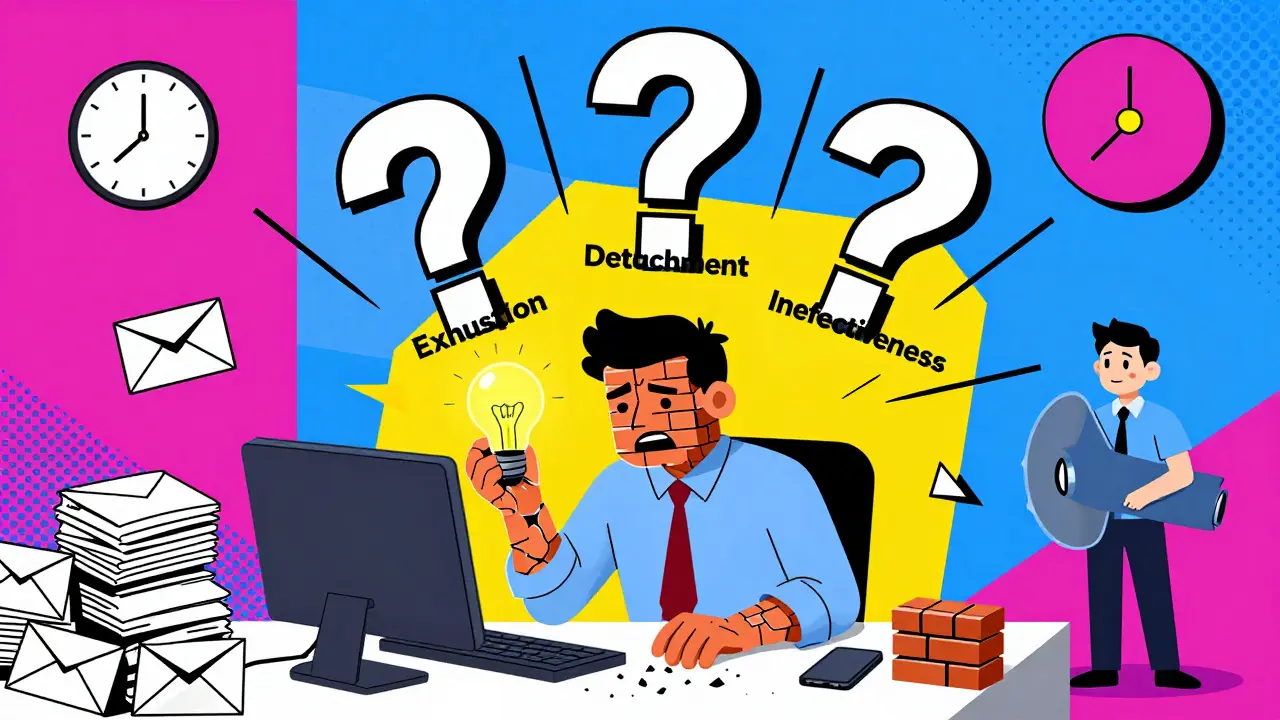
By 2026, nearly half of all workers globally still report feeling stressed every day. And one in five says they’re burned out - not just tired, but emotionally drained, detached from their work, and convinced they’re not making a difference. This isn’t normal. It’s not something you just need to push through. Burnout is a real condition, recognized by the World Health Organization since 2019, and it’s costing companies billions while breaking people down. The good news? It’s preventable. And if you’re already burned out, recovery isn’t just possible - it’s predictable when you know where to start.
What Burnout Really Looks Like (Beyond Just Being Tired)
Burnout isn’t the same as having a rough week. It’s a slow erosion. The World Health Organization defines it by three clear signs: constant exhaustion that doesn’t go away with rest, emotional distance from your job - like you’re just going through the motions - and a sharp drop in how effective you feel at work. Gallup’s 2023 data shows 63% of burned-out employees report chronic fatigue. Another 42% struggle with sleep. And 57% say they can’t focus, even on simple tasks.
It’s not about working harder. It’s about working in a system that’s broken. The Job Demands-Resources model, developed by researchers Arnold Bakker and Evangelia Demerouti, identifies six key drivers: too much work (cited by 67% of employees), lack of control over your tasks, feeling underappreciated (42%), isolation at work (38%), unfair treatment (34%), and values that don’t match your company’s actions (29%). If any of these are your daily reality, burnout isn’t a matter of if - it’s a matter of when.
Organizational Fixes: What Companies Actually Need to Do
Most companies throw yoga mats and meditation apps at burnout and call it a day. That fixes maybe 20% of the problem, according to the American Psychiatric Association. Real change comes from restructuring how work gets done.
Start with workload. Annual reviews don’t cut it. Gallup recommends quarterly workload audits - literally mapping out who’s doing what and adjusting before people break. Companies like Salesforce and Microsoft have cut burnout by 32% using AI tools that track task distribution and flag imbalances. No more assuming someone’s “fine” because they haven’t complained.
Flexibility matters. Pollack Peacebuilding’s 2023 study found that simple rules - like “Work-from-Home Wednesdays” or letting people start and end their day when they’re most alert - reduced burnout by 27%. MIT’s 2024 study of remote workers showed that just 15-minute walks before and after work - a “bookending routine” - dropped stress levels by 22%.
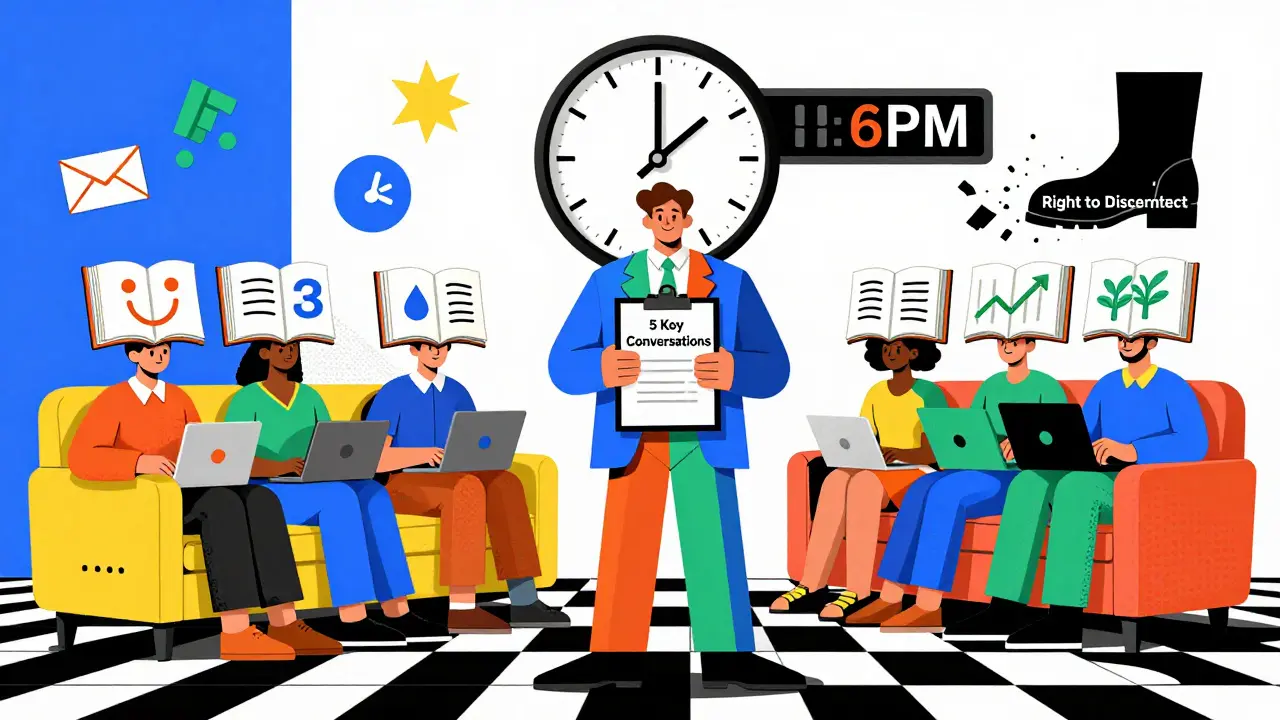
And then there’s the digital sunset. Companies that automatically shut down email and Slack systems after hours saw a 31% drop in after-work messages and 26% lower burnout. The EU’s 2023 Work-Life Balance Directive, now active in all member states, made “right to disconnect” a legal requirement. France, which had similar laws since 2017, saw after-hours communication drop 37%. If your company still expects replies at 10 p.m., you’re not being loyal - you’re being outdated.
Managerial Impact: The 70% Factor
Jim Harter, Gallup’s Chief Workplace Scientist, says managers account for 70% of the difference in employee engagement - and burnout. That’s not a suggestion. That’s a responsibility.
Managers who regularly have five key conversations - about strengths, purpose, wellbeing, growth, and recognition - see 41% less burnout in their teams. That doesn’t mean asking “How are you?” once a year. It means making wellbeing part of every 1:1. This is Calmer’s 2024 guide found that teams where managers explicitly asked about mental health saw 28% higher retention.
Psychological safety is the foundation. Google’s Project Aristotle proved that teams where people feel safe to speak up, make mistakes, and ask for help have 47% less burnout. That’s not fluffy leadership talk. It’s measurable. If your manager shuts down questions, ignores concerns, or punishes vulnerability, they’re not managing - they’re accelerating burnout.
What You Can Do Right Now: Individual Strategies That Work
You can’t fix your company overnight. But you can protect yourself. The American Psychological Association found that employees who set hard boundaries - like no emails after 6 p.m. - experienced 39% lower burnout. Start small. Turn off notifications after work. Block your calendar for lunch. Say no when your plate is full.
Time-blocking helps. Neurobloom Colorado’s 2024 study of 1,200 knowledge workers showed that scheduling focused work blocks - and protecting them - improved task completion by 28% and cut burnout symptoms by 22%. You’re not being unproductive. You’re being strategic.
Micro-breaks are non-negotiable. Harvard Business Review found that taking 5-10 minutes every 90 minutes increased productivity by 13% and lowered burnout markers by 17%. Stand up. Walk around. Stare out the window. Don’t scroll. Your brain needs reset.
Physical habits matter too. Keystone Partners’ 2025 guide found that companies offering protein snacks and hydration stations saw 19% fewer fatigue-related absences. Walking meetings? Used by 68% of Fortune 500 companies. They cut sedentary time by 27 minutes a day. That’s not a perk - it’s a health intervention.
Recovery Isn’t a Vacation - It’s a Process
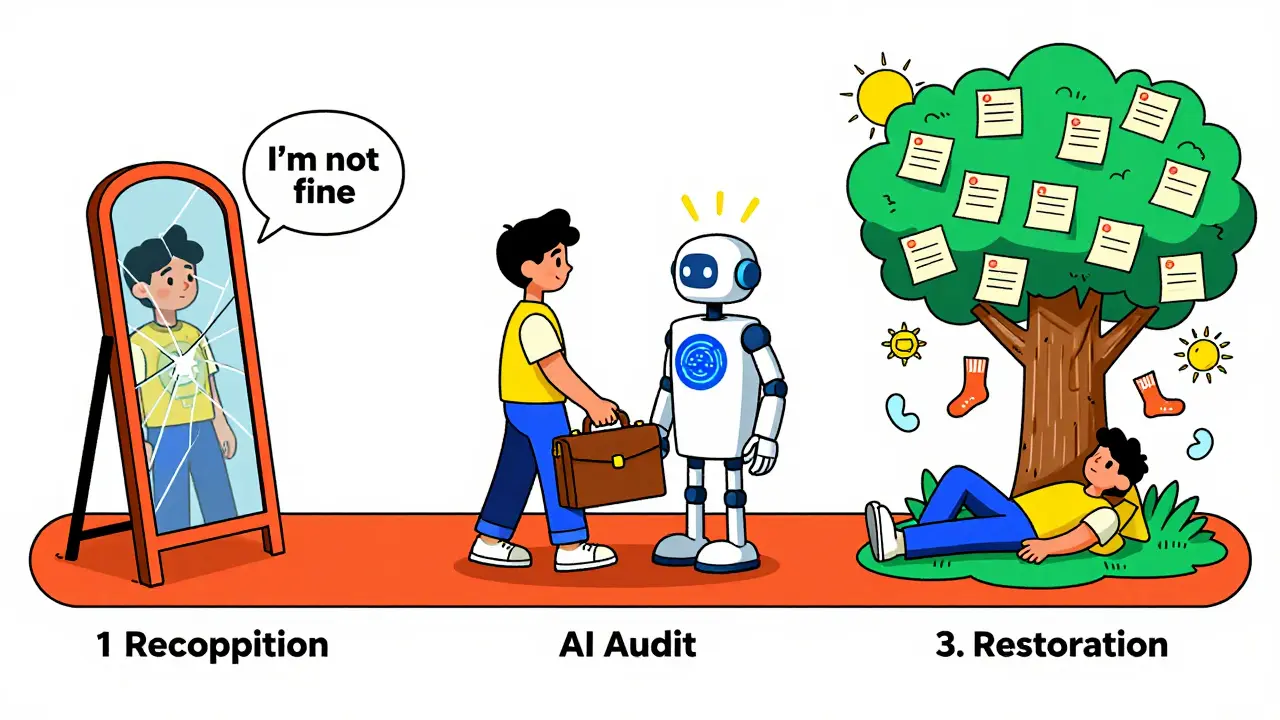
If you’re already burned out, rest alone won’t fix it. Recovery needs structure. Gallup’s three-phase model works: recognition, intervention, restoration.
First, recognize it. Use tools like the Maslach Burnout Inventory or just ask yourself: Do I feel exhausted most days? Do I dread Monday? Do I feel like I’m barely keeping up? If yes, don’t wait.
Second, intervene. Ask for temporary help. Reduce your scope. Shift tasks. Companies that adjust workload immediately - not in 30 days - see faster recovery. Spring Health’s 2024 research found that employees who used mental health benefits within 14 days of noticing symptoms recovered 82% faster than those who waited.
Third, restore. A 48-72 hour digital detox - no work emails, no Slack, no checking in - can improve emotional exhaustion by 63%, according to the APA. Add a gratitude practice: write down three things you accomplished each day, not what’s left undone. Keystone Partners found this accelerates return-to-productivity by over three weeks.
Why Most Burnout Programs Fail - And How to Avoid It
Eighty-three percent of companies launch wellness programs. Only 17% keep them going past a year. Why? They treat burnout like a perk, not a priority. They don’t tie it to performance reviews. They don’t hold managers accountable.
Successful programs make wellbeing part of manager evaluations. Companies that now include it in 30% of manager reviews (up from 12% in 2021) see real results. Pollack Peacebuilding found that integrating burnout prevention into onboarding - with 4.5 hours of training - boosted adherence by 52%.
The best timeline? 30-60-90 days. In 30 days, build psychological safety. In 60, run your first workload audit. In 90, make burnout prevention part of your culture. Companies that follow this see 44% higher success rates.
The Future Is Predictive - Not Reactive
By late 2025, 65% of Fortune 500 companies will use AI to predict burnout before it happens. These systems analyze email patterns, calendar density, meeting frequency, and even typing speed to flag at-risk employees with 82% accuracy. Companies like American Express and Procter & Gamble are already using integrated data - sick days, EAP usage, productivity dips - to create burnout risk scores. Their burnout rates dropped 38%.
Four-day workweeks are no longer fringe. Pollack Peacebuilding predicts 37% of tech companies will adopt them by 2025. Neurobloom Colorado’s 2025 strategies now include HRV (Heart Rate Variability) monitoring - measuring your body’s stress response - which reduced burnout 29% more than traditional methods in pilot programs at Google and Intel.
The shift isn’t just about fixing people. It’s about fixing systems. As Dr. Christina Maslach, who created the gold-standard burnout inventory, said: “Burnout is not an individual failure. It’s a systems failure.” Your job isn’t to be superhuman. It’s to work somewhere that doesn’t expect you to be.

January 13, 2026 AT 13:17 PM
Man, this hits different in India. We don’t even get ‘work-from-home Wednesdays’ - it’s ‘work from your cousin’s couch if you’re lucky.’ No one talks about burnout here like it’s a real thing. They just say, ‘Beta, zyada soch mat, kaam karo.’ But the silence? It’s deafening. I’ve seen friends collapse. No one checks in. Just another ghost in the corporate machine.
January 14, 2026 AT 03:15 AM
My manager sent me a Slack at 11:30 p.m. last night with ‘Just checking in!’ Like I’m not sleeping, I’m just… paused. This isn’t work culture. It’s emotional harassment dressed up as ‘dedication.’ I’m not a robot. I have a life. And no, I won’t reply to ‘urgent’ emails after hours. Not anymore.
January 15, 2026 AT 02:24 AM
Let’s be real - this article is just corporate virtue signaling wrapped in APA citations. You think throwing AI at burnout fixes systemic exploitation? The real issue is that companies treat humans as KPIs with eyeballs. They don’t care if you’re broken - they care if your output didn’t dip below 85%. And now they’re using HRV monitors like it’s some kind of sci-fi wellness upgrade? Pathetic. You don’t fix a broken system with biometric wearables. You fix it by firing the managers who think ‘grind culture’ is a value proposition.
January 15, 2026 AT 13:39 PM
Oh honey, the real tragedy isn’t burnout - it’s that we’ve normalized it to the point where people are now *proud* of being exhausted. ‘Oh, I slept 3 hours last night!’ like it’s a badge of honor. We’ve turned suffering into a status symbol. And now we’re monetizing it with ‘micro-breaks’ and protein snacks? The capitalist machine doesn’t care if you live - it just needs you to produce until your soul evaporates. And then it’ll sell you a mindfulness app to cope with the void.
January 16, 2026 AT 06:59 AM
I used to think I just needed to ‘try harder.’ Then I hit 18 months of chronic fatigue, panic attacks before meetings, and started forgetting my own birthday. I finally went to HR and asked for a reduced workload. They gave me a meditation app. So I quit. Not because I’m weak - because I finally understood: my value isn’t measured in hours logged. I’m now a freelance writer. I work 25 hours a week. I sleep 8 hours. I cry less. I’m happier. And I make more. Burnout isn’t your fault. It’s the system’s. And walking away isn’t quitting - it’s winning.
January 16, 2026 AT 23:03 PM
Love this. My company started ‘No Meeting Wednesdays’ last year. It was the first time in 5 years I didn’t feel like a human calendar. I actually finished projects. I started reading again. I remembered what silence felt like. Small changes > big posters on the wall. Also, walking meetings? Yes. Sitting in a room for 45 minutes talking about ‘synergy’ while your legs go numb? No thanks.
January 17, 2026 AT 02:46 AM
They say ‘right to disconnect’ but my boss still DMs me at midnight like I’m his personal butler. And when I say ‘I’m off,’ he says ‘But you’re so good at this!’ - like my worth is tied to my availability. I’m tired. Not of work. Of being guilt-tripped for having a body that needs rest. I’m not lazy. I’m just not a battery that can be recharged with a motivational quote.
January 19, 2026 AT 00:20 AM
Stop lying to yourselves. Burnout is just a fancy word for ‘I can’t handle my job.’ If you’re burned out, maybe you’re in the wrong role. Or maybe you’re just lazy. Companies aren’t the problem - your work ethic is. I work 12 hours a day, 7 days a week. I don’t have time for ‘digital detoxes.’ I have bills. I have family. You want to fix burnout? Stop whining and get better at your job.
January 19, 2026 AT 10:00 AM
lol burnout? more like burnout™️
January 20, 2026 AT 23:56 PM
Okay so here’s the thing - everyone’s talking about AI predicting burnout like it’s magic, but what if the AI just flags the quiet ones? The ones who don’t complain? The ones who smile and say ‘I’m fine’ while their eyes are hollow? What if the real problem is that we’ve trained people to hide their pain? And now we’re using data to punish them for being too good at pretending? I’ve seen it. My teammate got flagged by the system. They ‘reduced his workload.’ He quit a week later. Said he didn’t want to be ‘a case study.’
January 22, 2026 AT 20:23 PM
Let’s not conflate burnout with poor time management. The real issue is the proliferation of ‘soft skills’ discourse that replaces structural reform. If you’re not optimizing your circadian rhythm in alignment with your chronotype while leveraging neuroplasticity-enhancing micro-interventions, you’re not just burned out - you’re *unoptimized*. And frankly, that’s an ethical failure in the age of cognitive capitalism. Also, have you considered the epistemic violence of ‘gratitude journals’? They’re neoliberal coping mechanisms disguised as self-care.
January 23, 2026 AT 21:05 PM
My boss told me to ‘recharge’ by taking a walk. So I did. I walked 12 miles. Came back. He asked if I felt better. I said yes. He said ‘Good, now get back to the spreadsheet.’ I’m not here to ‘recharge’ - I’m here to survive. And if your ‘solution’ is a walk and a pep talk, you’re not a leader. You’re a magician pulling bandaids off a hemorrhage.
January 25, 2026 AT 15:06 PM
bro i just wanna say… 🌿✨ sometimes the most radical act is saying ‘no’ and going to bed early. like, imagine that. no notifications. no emails. just you, your blanket, and the quiet. it’s not weakness. it’s rebellion. and honestly? the system hates that. 🛌💤
January 26, 2026 AT 22:52 PM
I’m from South Africa. We don’t have fancy AI tools or ‘right to disconnect’ laws. We have people working two jobs just to eat. And when they collapse? No one cares. Burnout is a luxury problem for people who still have jobs. My cousin works 16 hours a day in a call center. She’s 22. She hasn’t taken a day off in 11 months. No yoga mats. No Slack shutdowns. Just silence. And then a voicemail: ‘Why didn’t you answer?’ So don’t preach about ‘micro-breaks’ when people are fighting to survive. Fix the system first. Then talk about HRV.
January 28, 2026 AT 02:54 AM
You’re all overthinking this. Just stop being weak. I work 10 hours a day. I don’t have time for ‘values alignment’ or ‘psychological safety.’ If you can’t handle the job, quit. No one’s forcing you to stay. This whole article is just an excuse for people who don’t want to work hard. Grow up.
January 28, 2026 AT 10:39 AM
Let us not mistake the symptoms for the disease. Burnout is not an individual affliction - it is the inevitable consequence of a capitalist paradigm that commodifies human attention, reduces labor to extractive metrics, and pathologizes the natural human need for rest, autonomy, and dignity. The very architecture of modern work - hierarchical, surveilled, and performance-obsessed - is antithetical to psychological flourishing. AI-driven burnout prediction algorithms are not solutions; they are sophisticated mechanisms of control, transforming the body into a data point to be managed, not a person to be honored. Until we dismantle the foundational structures that equate human worth with productivity - until we replace the cult of output with the sanctity of being - we are merely rearranging deck chairs on the Titanic of our collective exhaustion.
January 28, 2026 AT 20:41 PM
And yet, here we are. The same company that gave me a ‘burnout prevention’ webinar last month just cut my team’s budget by 40%. They’re using AI to predict who’ll quit next. Not to help them - to replace them faster. So don’t tell me this is about ‘wellness.’ It’s about efficiency. And efficiency doesn’t care if you live. It just wants you to stop being a liability.