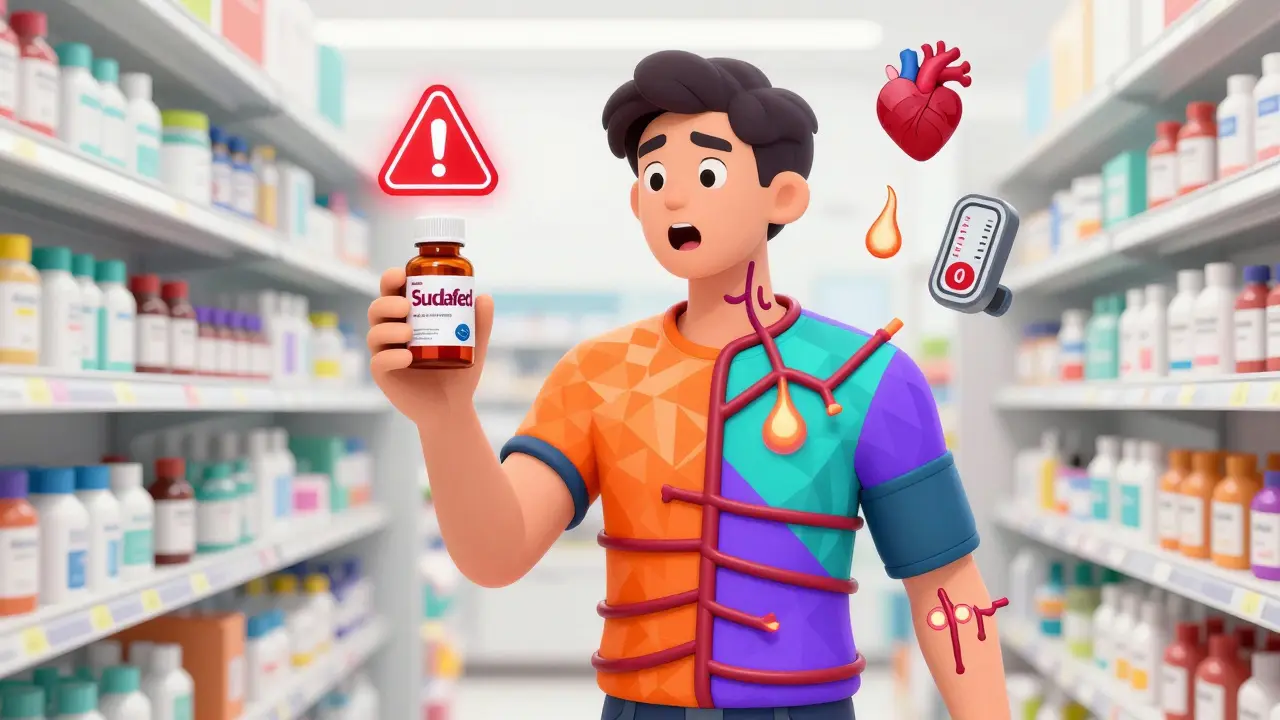
Decongestant Safety Checker
This tool helps determine if decongestants are safe for you based on your blood pressure status and medications. Remember, always consult your doctor before making changes to your medication regimen.
Many people reach for decongestants when they have a cold or stuffy nose. It’s quick, easy, and available right over the counter. But if you have high blood pressure, that little pill or spray could be doing more harm than good. You might not realize it until your blood pressure spikes - and then it’s too late.
How Decongestants Really Work
Decongestants like pseudoephedrine (found in Sudafed) and phenylephrine (in many cold formulas) work by tightening blood vessels in your nose. That reduces swelling and lets you breathe easier. But here’s the catch: they don’t just target your nasal passages. These drugs affect blood vessels all over your body. That means your arteries tighten everywhere - not just in your nose.
This vasoconstriction forces your heart to pump harder to get blood through narrower channels. The result? Your blood pressure goes up. It’s not a small bump. Studies show that even a single dose of pseudoephedrine can raise systolic blood pressure by 5 to 10 mmHg in some people. For someone with uncontrolled hypertension, that’s enough to trigger a dangerous spike.
The Real Danger: Hidden in Plain Sight
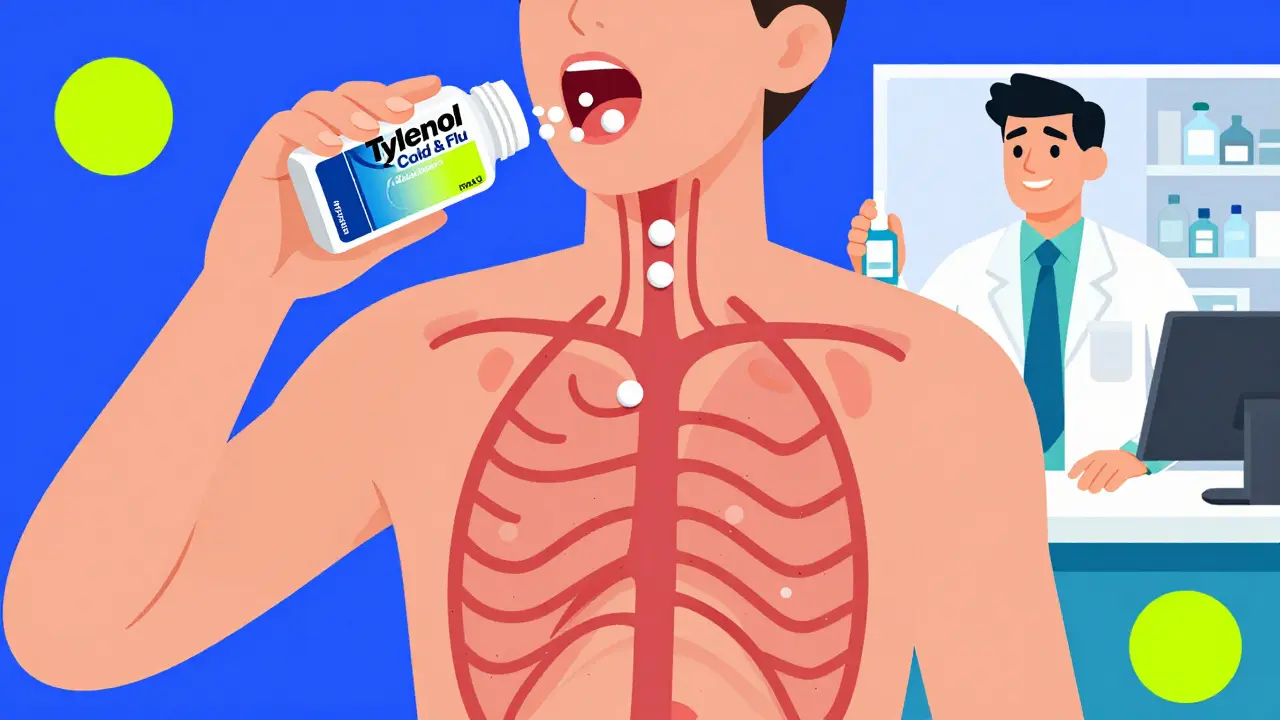
Most people think they’re just taking a cold medicine. But decongestants are rarely sold alone. They’re packed into multi-symptom formulas like Tylenol Cold and Flu, Advil Multi-Symptom, Benadryl Allergy Plus Congestion, and Mucinex Sinus Max. You take it for a headache and sinus pressure - and suddenly, your blood pressure is climbing because you didn’t check the label.
And it’s not just oral pills. Nasal sprays like Afrin (oxymetazoline) and Naphazoline can do the same thing. Even though they’re applied locally, enough of the drug gets absorbed into your bloodstream to cause systemic effects. One case study from 2023 tracked a 5-year-old child whose blood pressure rose to 135/80 after using a phenylephrine nasal spray four times a day for four days. Her pressure returned to normal only after stopping the medication.
Who’s at Highest Risk?
Not everyone with high blood pressure will have a bad reaction. But some people are far more vulnerable:
- Those with uncontrolled hypertension - if your blood pressure is consistently above 140/90, avoid decongestants entirely.
- People with heart disease, including past heart attacks or arrhythmias.
- Patients with Prinzmetal angina - a rare form of chest pain triggered by artery spasms.
- Anyone taking MAO inhibitors like Nardil or Marplan - combining these with decongestants can cause a life-threatening surge in blood pressure.
- Those on tricyclic antidepressants or certain Parkinson’s medications.
Research from the American Heart Association shows that 5% to 10% of hypertensive patients experience sharp, dangerous increases in blood pressure after using decongestants. And here’s the scary part: many don’t even know they’re at risk because they never checked the label.
What Your Doctor Won’t Always Tell You
Most doctors focus on prescription meds. But over-the-counter drugs are just as powerful - and often more dangerous because people assume they’re safe. The FDA now requires warning labels on decongestants, but they’ve softened the language over time. Older labels said, “Do not use if you have high blood pressure.” Now they say, “Ask your doctor before use.” That shift tells you everything: the risk isn’t black and white. It’s personal.
Harvard Health Publishing found that patients with well-controlled hypertension (below 130/80) who took pseudoephedrine had only minor increases in blood pressure - but only if they monitored it closely. The problem? Most people don’t. They take the pill, feel better, and forget about it. Until their head starts pounding or their chest feels tight.
What to Do Instead
You don’t have to suffer with a stuffy nose. There are safer ways to breathe:
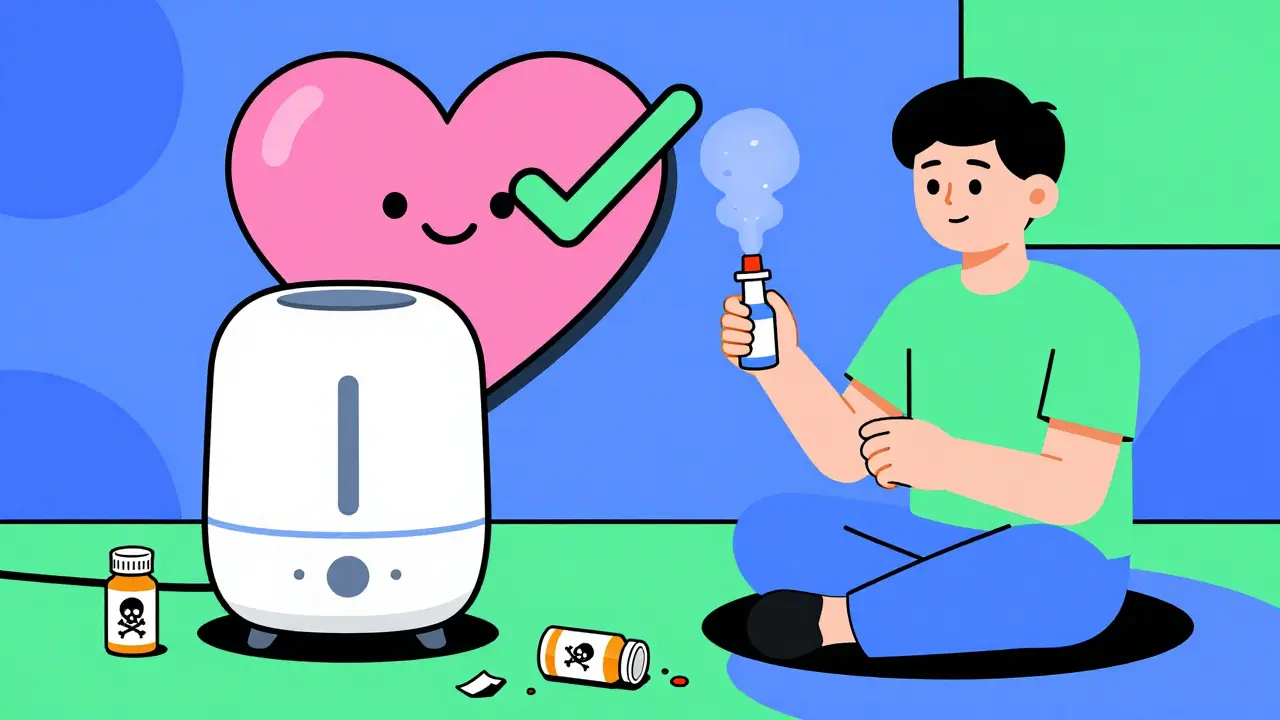
- Saline nasal spray - no drugs, no side effects. Just salt water to flush out congestion.
- Steam inhalation - breathe in warm, moist air from a bowl or shower. It loosens mucus naturally.
- Humidifiers - especially helpful at night. Dry air makes congestion worse.
- Antihistamines without decongestants - like plain loratadine (Claritin) or cetirizine (Zyrtec). These help with allergies but won’t raise your pressure.
Even these alternatives need caution. Some liquid antihistamines contain high levels of sodium - which can also raise blood pressure. Always check the ingredients.
Pharmacists Are Your Best Defense
In the U.S., pseudoephedrine is kept behind the counter. That’s not just for drug control - it’s a safety check. Pharmacists are trained to ask: “Do you have high blood pressure?” “Are you on heart meds?” “Have you had a stroke?”
But here’s the truth: many people skip this step. They grab a bottle off the shelf, head to the register, and assume it’s fine. Community pharmacists report spending 3 to 5 minutes per customer during cold season just explaining which products are risky. That’s how common this problem is.
If you’re unsure, ask. Don’t be embarrassed. Say: “I have high blood pressure. Is this safe?” Most pharmacists will appreciate the question - and they’ll help you find a better option.
Check Every Label - Even If You’ve Used It Before
Formulas change. A product you used last year might have added a decongestant this year. Labels get updated. Ingredients shift. Always read the “Active Ingredients” section. Look for these words:
- Pseudoephedrine
- Phenylephrine
- Ephedrine
- Oxymetazoline
- Naphazoline
If you see any of these - walk away. Even if you’ve taken it before without issues, your body changes. Your blood pressure changes. What was safe last month might not be safe today.
The Bottom Line
Decongestants aren’t evil. But they’re not harmless either - especially if you have high blood pressure. The risk isn’t theoretical. It’s documented, studied, and proven. A 2023 meta-analysis in US Pharmacist confirmed that pseudoephedrine causes measurable, clinically relevant increases in blood pressure. The American Heart Association calls it a serious concern.
If you’re hypertensive, your safest bet is to avoid these drugs altogether. Use saline sprays, steam, and humidifiers. If you absolutely must use a decongestant, talk to your doctor first. Monitor your blood pressure before and after. Never assume it’s safe just because it’s over the counter.
Because when it comes to your heart, you can’t afford to guess.
Can I take pseudoephedrine if my blood pressure is controlled?
Even if your blood pressure is well-controlled, pseudoephedrine can still cause spikes in some people. The American Heart Association recommends avoiding it unless absolutely necessary. If you must use it, do so under your doctor’s supervision, monitor your blood pressure closely, and stick to the lowest effective dose. Extended-release versions may be slightly safer than immediate-release ones, but no form is completely risk-free.
Is phenylephrine safer than pseudoephedrine?
No. While phenylephrine was once thought to be less risky, recent studies show it raises blood pressure just as much as pseudoephedrine in many people. In fact, the FDA reviewed evidence in 2023 and found that phenylephrine’s effectiveness as a decongestant is questionable - yet its cardiovascular risks remain. It’s not a safer alternative. It’s just another hidden risk.
What if I accidentally took a decongestant? What should I do?
Stop taking it immediately. Monitor your blood pressure over the next few hours. If your systolic pressure rises above 160 or you feel chest pain, dizziness, a rapid heartbeat, or severe headache, seek medical help right away. Even if you feel fine, notify your doctor - you may need to adjust your blood pressure meds temporarily. Don’t wait for symptoms to get worse.
Are nasal sprays like Afrin safe for people with high blood pressure?
No. Oxymetazoline (Afrin) and naphazoline are decongestants too. Even though they’re applied to the nose, enough enters your bloodstream to raise blood pressure. Long-term use can also cause rebound congestion. For hypertensive patients, saline sprays are the only safe nasal option.
Can I use antihistamines like Benadryl if I have high blood pressure?
Plain antihistamines like diphenhydramine (Benadryl) or loratadine (Claritin) without decongestants are generally safe. But always check the label. Many versions include pseudoephedrine or phenylephrine. Also, liquid forms may contain high sodium. Stick to tablets or capsules, and avoid alcohol-containing formulas.



March 16, 2026 AT 13:40 PM
So many people think OTC means safe. It’s a dangerous myth. I’ve seen friends with hypertension take Sudafed because ‘it’s just a cold pill’-and end up in the ER with a BP of 190/110. No one tells you this stuff. Pharmacists ask, sure, but most people just nod and walk out. We need better public education, not just fine print on labels.
And why is phenylephrine even still on the market? The FDA admitted it’s barely better than placebo as a decongestant, yet it’s everywhere. It’s not just ineffective-it’s a silent cardiovascular threat. Someone’s profit margin is prioritized over patient safety.
I get it. Congestion sucks. But there are 10 safer alternatives. Why do we keep letting Big Pharma sell us poison wrapped in rainbow packaging?
March 17, 2026 AT 11:43 AM
Ugh I just realized I’ve been taking Advil Cold & Sinus for weeks 😭 I thought I was fine because my BP is ‘controlled’… but now I’m paranoid. Thanks for the wake-up call. I’m switching to saline spray tonight. Also, steam inhalation sounds so chill, I’m gonna light a candle and breathe over a bowl like a spa day. 🌿💧
March 18, 2026 AT 01:28 AM
Oh wow, a *public health article* that doesn’t end with ‘drink more water’? Shocking. I’m so moved. You’ve basically just written a Yelp review for the American Heart Association.
But let’s be real-people take decongestants because they’re lazy. They want to go to work, not sit in a steamy bathroom for an hour. And guess what? The world doesn’t care if your blood pressure spikes. You’re not special. You’re just another person who forgot to read the back of the box. Maybe next time, don’t treat your nose like a goddamn emergency room.
March 18, 2026 AT 13:31 PM
Interesting. In India, most people use steam and saline naturally. We don’t have the same OTC culture. But I’ve seen friends buy cold medicines without checking ingredients. Even doctors here don’t always mention it. Maybe this is a Western problem? Or just a problem of marketing?
March 18, 2026 AT 23:39 PM
It is imperative that individuals with preexisting cardiovascular conditions exercise extreme caution when utilizing over-the-counter pharmaceutical agents. While the pharmacological mechanisms of vasoconstrictive agents are well-documented, public awareness remains critically insufficient. I commend the author for a thorough, evidence-based exposition. Healthcare providers must integrate OTC risk counseling into routine hypertensive management protocols. The FDA’s softened labeling language is indeed a regulatory failure.
March 20, 2026 AT 06:28 AM
I used to think decongestants were harmless until my mom had a stroke after taking NyQuil… now I read every label like it’s a legal contract. I even have a notepad. I write down every ingredient. I’m not paranoid. I’m prepared. 🤷♀️
March 21, 2026 AT 04:17 AM
I always ask my pharmacist and they always say its fine till I check the label myself and find pseudoephedrine hidden in the small print. We need to teach people to read. Its not that hard. Just slow down. Your body will thank you
March 23, 2026 AT 01:09 AM
Oh look, another ‘decongestants are evil’ article. Let me guess-you also think sugar is a poison, sunlight causes cancer, and breathing is a form of microaggression.
Here’s the truth: if you’re hypertensive and you take a decongestant, you’re not a victim-you’re a liability. You’re the person who blames the medicine instead of your own choices. The real danger isn’t the pill. It’s the delusion that you’re entitled to feel better without consequences.
Also, ‘saline spray’? That’s what you call a $7 bottle of salt water? I’ll take my $3 Sudafed and my 120/80 BP, thank you very much.
March 23, 2026 AT 07:37 AM
Just wanted to say thank you for this. I’ve been on blood pressure meds for 8 years and never knew about the hidden decongestants. I’ve been using saline spray for months now-it’s not perfect, but it works. I also started using a humidifier at night. My mornings are so much better. You don’t need a pill to breathe.
Also, pharmacists are heroes. The next time you’re at the counter, say hi. They’re doing the work no one else will.
March 23, 2026 AT 16:33 PM
Did you know that the FDA’s change in labeling was pushed by Big Pharma lobbyists? The original warning said ‘DO NOT USE’-now it says ‘ASK YOUR DOCTOR.’ That’s not safety. That’s liability shielding.
And what about the 2021 whistleblower report from a major drug manufacturer that admitted they knew phenylephrine was ineffective but kept it in products because it’s cheaper than saline? They’ve been burying this for decades.
Next time you see a cold medicine aisle, ask yourself: who really benefits from you breathing better?
…I’m not saying it’s a conspiracy. I’m saying the evidence is stacked.