Statin Muscle Symptom Checker
Disclaimer: This tool is for educational purposes only and is not a medical diagnosis. If you are experiencing severe pain or dark urine, seek immediate medical attention.
1. Select Your Primary Symptoms:
2. Known CK Level (Blood Test):
Select your symptoms and CK levels to see the potential classification.
You start a cholesterol medication to protect your heart, but a few weeks later, your legs feel like you've run a marathon you never actually signed up for. This is a common and frustrating experience. While statin-induced muscle pain is a spectrum of muscle-related adverse effects caused by HMG-CoA reductase inhibitors, not all muscle aches are the same. Some are just annoying nuisances, while others are serious medical emergencies that require immediate attention.
Quick Summary: What You Need to Know
- Myalgia: General muscle aches without enzyme spikes; the most common form.
- Myositis: Muscle inflammation marked by elevated Creatine Kinase (CK) levels.
- Rhabdomyolysis: Rare, severe muscle breakdown that can lead to kidney failure.
- Immune-Mediated Necrotizing Myopathy (IMNM): A rare autoimmune reaction where the body attacks its own muscles.
- Management: Often involves switching statins, adjusting doses, or, in rare cases, immunosuppressants.
The Spectrum of Statin Muscle Pain
When doctors talk about "statin myopathy," they aren't talking about one single condition. It's actually a range of issues that vary wildly in severity. According to data from the American College of Cardiology, up to 30% of people taking these meds experience some form of muscle trouble, from mild cramping to total exhaustion.
Most people fall into the category of Myalgia. This is the "classic" statin ache. You feel sore, maybe a bit stiff, but your blood tests come back normal. It's common-affecting 10% to 29% of users-and usually goes away shortly after you stop the medication.
Then there is Myositis. This is more than just a sore feeling; it's actual inflammation. The tell-tale sign here is an increase in Creatine Kinase (CK), an enzyme that leaks into your blood when muscle cells are damaged. If your CK levels are 10 to 40 times the normal limit, you've moved from simple aches into myositis territory.
At the extreme end is Rhabdomyolysis. This is a medical emergency. It happens when muscle breakdown is so severe that the proteins (myoglobin) clog your kidneys. You'll often see dark, tea-colored urine and CK levels that are 40 times higher than normal. While it sounds scary, it's incredibly rare, affecting only about 0.01% to 0.1% of patients.
| Condition | Main Symptoms | CK Levels | Frequency | Urgency |
|---|---|---|---|---|
| Myalgia | Aching, stiffness | Normal | Common (10-30%) | Low |
| Myositis | Pain, weakness | 10-40x Normal | Uncommon (~0.5%) | Moderate |
| Rhabdomyolysis | Severe pain, dark urine | >40x Normal | Very Rare | Critical |
| IMNM (Autoimmune) | Proximal weakness (hips/shoulders) | Very High | Ultra-Rare | High |
Why Statins Make Your Muscles Ache
To understand the pain, you have to look at the chemistry. Statins work by blocking an enzyme called HMG-CoA reductase. This is great for lowering cholesterol, but that same chemical pathway is used by your muscles to produce things they need to survive and function.
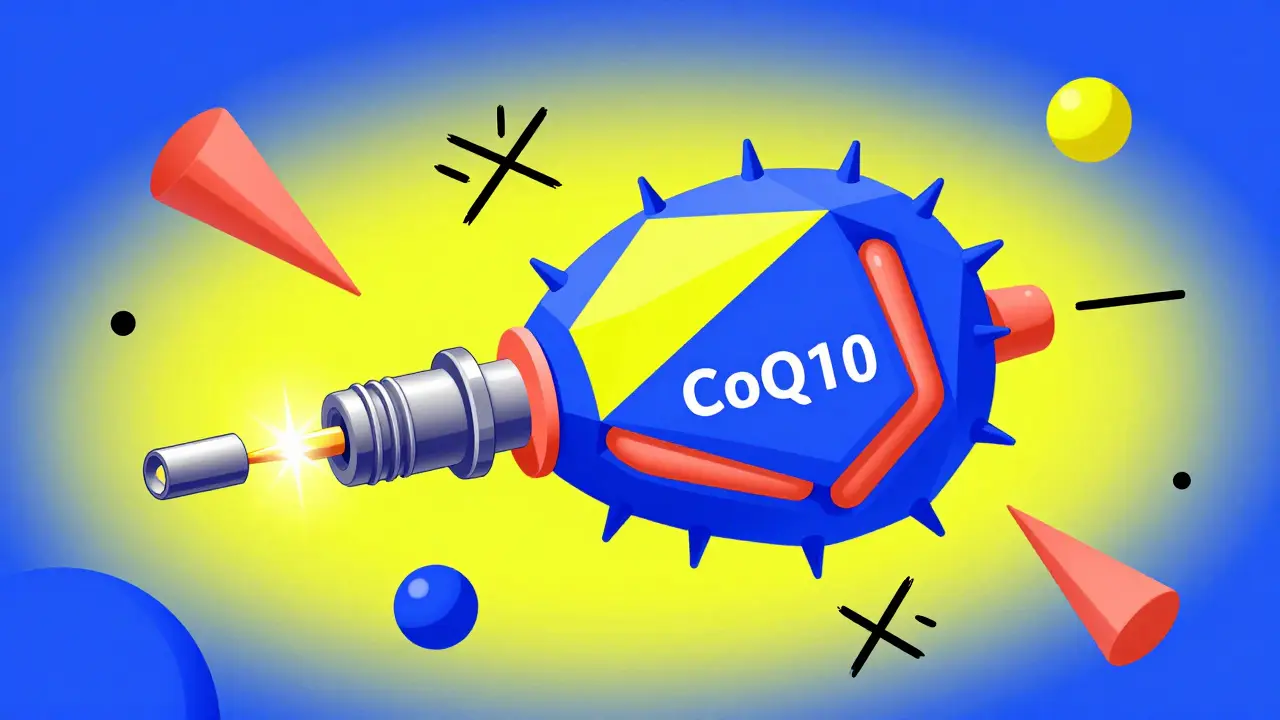
One major casualty of this process is Coenzyme Q10 (CoQ10). This molecule is like a spark plug for your mitochondria (the powerhouses of your cells). When CoQ10 levels drop-some studies show a 40% decrease in patients on high-dose simvastatin-your muscles can't produce ATP (energy) efficiently. If the engine doesn't have enough fuel, it starts to sputter, leading to that familiar fatigue and soreness.
There's also a more aggressive process happening. Statins can trigger the "ubiquitin-proteasome pathway," which is basically the cell's recycling system for proteins. In some people, this system goes into overdrive, accelerating the breakdown of muscle proteins by up to 400%. This is especially true if you're doing heavy eccentric exercise (like jogging downhill) while on a statin.
The Rare "Autoimmune" Trap
Most statin pain stops when you stop the drug. But there is a nightmare scenario called Immune-Mediated Necrotizing Myopathy (IMNM). In this rare case, the statin doesn't just irritate the muscle; it tricks your immune system into creating anti-HMGCR antibodies. These antibodies start attacking your muscles as if they were a foreign virus.
The scary part? Stopping the statin doesn't stop the attack. Because your immune system is now "programmed" to fight, the weakness continues and often gets worse. This typically hits people over 50 and manifests as symmetric weakness in the hips and shoulders. You might find it harder to get out of a chair or reach for a shelf.
Because it's so rare (about 2-3 cases per 100,000 people), many patients are misdiagnosed. Data from support forums shows that nearly 68% of these patients were first told they had fibromyalgia or chronic fatigue syndrome. If you stop your statins and the weakness doesn't vanish within a few weeks, this is something you need to discuss with a neurologist.

Managing the Pain and Staying Protected
You shouldn't just quit your meds the moment you feel a twinge. Stopping a statin can increase your 10-year risk of a cardiovascular event by 25% for high-risk patients. The goal is to find a way to keep your heart safe without making your legs feel like lead.
First, check for "drug-drug interactions." Some medications, like amiodarone, interfere with the CYP3A4 enzyme in your liver. Since your liver uses this enzyme to clear statins, blocking it can spike the concentration of the drug in your blood by 300-500%, making a normally safe dose suddenly toxic.
If you are experiencing pain, doctors often suggest these strategies:
- Statin Rotation: Not all statins are the same. Some are "lipophilic" (fat-soluble) and others are "hydrophilic" (water-soluble). Switching to a hydrophilic option like rosuvastatin often works; one study showed 73% of people who hated simvastatin tolerated rosuvastatin just fine.
- Intermittent Dosing: Taking a high-dose statin every other day rather than daily can maintain the cholesterol-lowering benefits while giving muscles time to recover.
- CoQ10 Supplements: Many people take 200 mg of CoQ10 daily. While the science is mixed (only a few clinical trials show a clear benefit), many patients find it helpful.
When to See a Specialist
If your symptoms are mild, your primary care doctor can handle it. But if you notice the following "red flags," you need a neuromuscular specialist:
- Persistent Weakness: The pain doesn't go away 2-4 weeks after stopping the medication.
- Proximal Weakness: You specifically struggle with your upper arms or thighs.
- Dark Urine: A sign of rhabdomyolysis and potential kidney failure.
- Extreme CK Spikes: Blood tests showing CK levels consistently over 2,000 IU/L.
For those with the rare autoimmune form (IMNM), the treatment is completely different. They don't use supplements; they use heavy hitters like corticosteroids (prednisone) and other immunosuppressants like methotrexate. The key is speed-patients treated within 6 months of onset have a 65% chance of complete remission, compared to only 28% if they wait longer than a year.
Can I just take CoQ10 to stop statin pain?
It might help, but it's not a guaranteed fix. While CoQ10 is depleted by statins, Cochrane reviews show inconsistent results across clinical trials. It is generally safe to try, but if you have severe weakness, a supplement won't be enough-you need a medical evaluation.
How do I know if I have myalgia or something more serious?
The biggest differentiator is the CK (Creatine Kinase) blood test. Myalgia involves pain with normal CK levels. Myositis and rhabdomyolysis involve significantly elevated CK levels. If you also have dark-colored urine or profound weakness in your hips and shoulders, it's a sign of a more serious condition.
Will my muscle pain go away if I stop taking the statin?
For most people (those with simple myalgia), symptoms resolve within 1 to 2 weeks of stopping the drug. However, if you have the rare autoimmune form (IMNM), the pain and weakness will persist or even progress despite stopping the medication, as the immune system continues to attack the muscle fibers.
Are some people more prone to statin muscle pain?
Yes. Factors like age (over 50), low vitamin D levels, and hypothyroidism increase risk. There is also a genetic component; polymorphisms in the SLCO1B1 gene can affect how your body transports statins, increasing the risk of muscle toxicity, particularly with simvastatin.
Is rhabdomyolysis common?
No, it is extremely rare, occurring in about 0.01% to 0.1% of users. However, because it can cause acute kidney failure due to the release of myoglobin into the bloodstream, it is treated as a critical emergency.

April 21, 2026 AT 20:22 PM
Oh look, another guide telling us that the medicine meant to save us actually makes our legs stop working. Absolute shocker. 🙄
April 23, 2026 AT 00:43 AM
Seroiusly?? Why is everyon so scared of statins?? I took them for years and felt fine. Most of these side efffects are probably just nocebo effect from reading too many online forums. Pure hype!!!
April 24, 2026 AT 14:07 PM
It is quite fascinating how the delicate balance of our internal chemistry can be so easily disrupted by a single compound, and while the prospect of an autoimmune reaction like IMNM is certainly daunting, I believe it is essential that we approach this with a sense of calm and cooperation between patient and provider to ensure the heart remains protected while the muscles are preserved in their natural state of health and vigor.
April 24, 2026 AT 16:45 PM
Listen, if you're getting these aches, you're probably just not drinking enough water or your diet is trash. Stop blaming the pill and look at your lifestyle choices first. Your body is telling you something about your habits, not just the drug.
April 26, 2026 AT 14:38 PM
I'm so glad this information is out there! It's really encouraging to know that switching to a hydrophilic statin like rosuvastatin can help so many people stay healthy without the pain. We can all find a path that works for our unique bodies!
April 26, 2026 AT 19:51 PM
basically just says talk to a doctor lol 🙄 anyway coq10 is a hit or miss for me 🤷♀️
April 28, 2026 AT 18:44 PM
been there... switched meds and its fine now. didnt even bother with the suppliments
April 29, 2026 AT 09:51 AM
The sheer lack of nuance in how people discuss SLCO1B1 gene polymorphisms is... appalling!!! Most of you don't even understand the pharmacogenomics involved here,,, obviously!!
April 30, 2026 AT 00:24 AM
It is absolutely disgraceful that patients are being misdiagnosed with fibromyalgia when the cause is a clear drug-induced autoimmune response! The medical system's incompetence in identifying IMNM is a systemic failure that puts thousands of lives at risk every single year!
May 1, 2026 AT 21:57 PM
There is a poetic irony in the way we trade one form of suffering for another to extend the timeline of our existence. We sacrifice the comfort of our movement for the longevity of our pulse, treating the body like a machine where we simply swap out a faulty part for a slightly less faulty one. It makes you wonder if the goal is actually health, or just the absence of a cardiac event, while we forget that the quality of the walk is just as important as the beating of the heart. Perhaps the pain is a reminder that we are not just biological equations to be solved by a pharmacy. We are tactile beings in a physical world, and when the medicine disconnects us from our own strength, we lose a piece of our humanity in exchange for a lower LDL number. It is a strange bargain we make with modernity, trusting a chemical to save us while it simultaneously whispers that our muscles are no longer our own. In the end, the balance between risk and reward is a personal philosophy that no clinical trial can ever fully dictate for the individual soul.
May 2, 2026 AT 18:31 PM
It is most imperative that we support one another through these medical journeys!!! Please, let us all be mindful of the red flags mentioned here, such as the dark urine, to ensure the safety of our community members!!!
May 2, 2026 AT 21:25 PM
Absolute madness! Imagine actually trusting a pill that could literally eat your muscles from the inside out just because a doctor told you to! 😱 I'm sticking to my natural oils and prayers, thanks! 💅