When your shoulder starts hurting for no clear reason, then slowly locks up so you can’t reach behind your back, lift your arm, or even sleep on that side-it’s not just a bad posture or a pulled muscle. It’s likely frozen shoulder, or adhesive capsulitis. This isn’t a quick ache. It’s a slow, frustrating process that can steal your mobility for months, sometimes years. But here’s the good news: you don’t have to wait it out. With the right approach at the right time, you can cut recovery time in half.
What Exactly Is Frozen Shoulder?
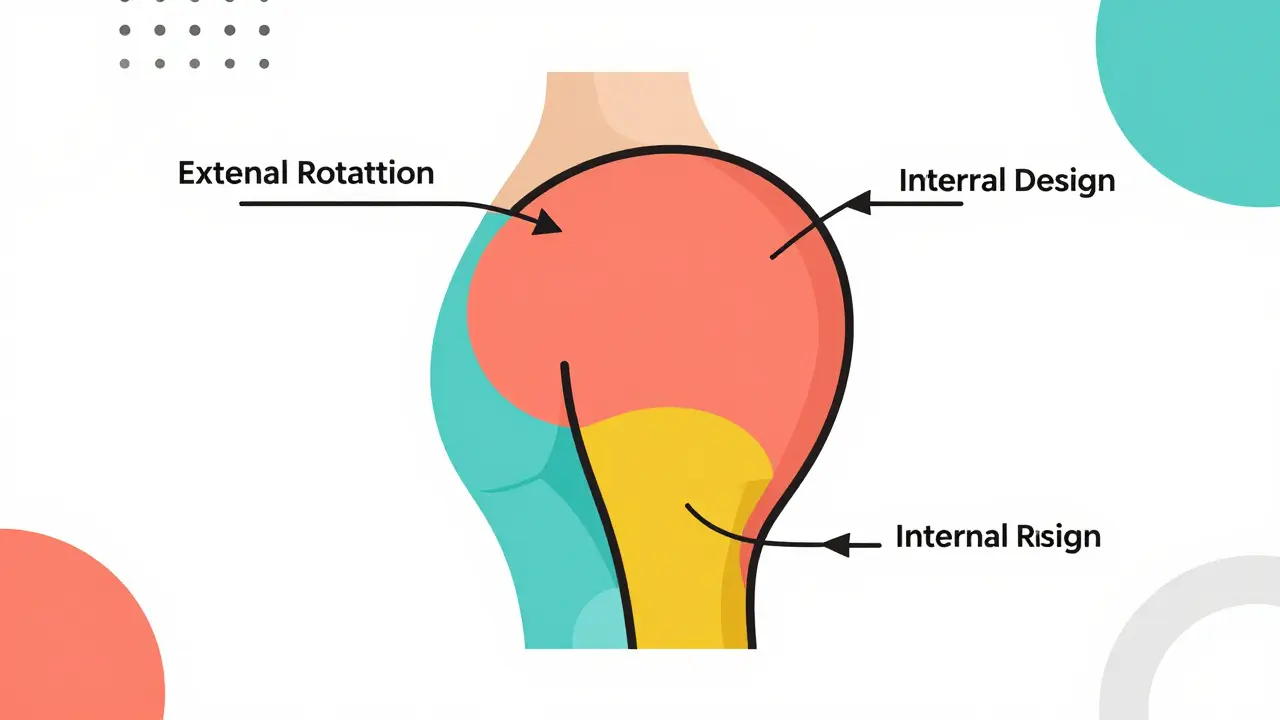
Frozen shoulder isn’t just pain. It’s a tightening of the shoulder joint capsule-the bag of tissue that holds your shoulder bones together. Over time, this capsule gets inflamed, thickens, and shrinks. Studies show it can lose up to 45% of its volume, dropping from a normal 30-35 mL down to just 10-15 mL. That’s like trying to move your arm inside a shrunken balloon. The result? Both active movement (you moving your arm) and passive movement (someone else moving your arm) become severely limited. That’s a key clue. If you can still move your shoulder with help, it’s probably not frozen shoulder. Rotator cuff tears or arthritis might limit your strength, but not your passive motion. Frozen shoulder affects everything equally. It follows a clear pattern: external rotation (reaching behind your back) is hit hardest-often 60-70% lost. Then comes abduction (raising your arm sideways), then internal rotation (touching your opposite shoulder blade). This specific order is called the “capsular pattern,” and it’s how doctors tell it apart from other shoulder problems.The Three Stages of Frozen Shoulder
This isn’t a one-phase condition. It unfolds in three stages, each needing a different strategy.- Freezing Stage (6 weeks to 9 months): Pain builds slowly, gets worse at night, and starts limiting motion. This is when most people ignore it, thinking it’s just a stiff shoulder. But this is the most critical window for intervention.
- Frozen Stage (4 to 6 months): Pain often eases, but stiffness stays locked in. You can’t reach your head, put on a coat, or brush your hair. This is when people finally seek help-and it’s the best time to start aggressive mobilization.
- Thawing Stage (6 months to 2+ years): Motion slowly returns on its own. But waiting for this to happen naturally means losing 18-30 months of your life to limited movement.
Why Mobilization Works-And When to Start
For years, the advice was to rest and wait. But that’s outdated. A 2023 update from the American Academy of Family Physicians now says: move within your pain limits, even during the freezing phase. Why? Because forcing stillness lets the capsule tighten further. Gentle movement keeps it pliable. A 2019 review in American Family Physician found that people who started physical therapy early recovered in 6-12 months. Those who waited recovered in 24-40 months. That’s two years versus one. The difference isn’t magic-it’s timing. The key is progression, not force. Pushing too hard during the freezing stage can make inflammation worse. That’s why experts like Dr. John K. Eno at Hospital for Special Surgery warn against aggressive stretching too soon. You want to gently stretch, not fight.
Proven Mobilization Strategies
Here’s what actually works, based on clinical studies and patient outcomes:- Pendulum Exercises: Lean forward, let your arm hang loose, and gently swing it in small circles-clockwise and counterclockwise. Do this for 5 minutes, twice a day. Patients on Reddit reported gaining 20 degrees of external rotation in just four weeks. No equipment needed.
- Towel Stretch: Hold a towel behind your back with both hands. Use your good arm to gently pull the affected arm upward. This targets internal rotation. Keep the movement slow and controlled.
- Doorway Stretch: Stand in a doorway, place your hand on the frame at shoulder height, and gently lean forward. Hold for 30 seconds. This opens up the front of the shoulder capsule.
- Wand Exercises: Use a broomstick or cane. Hold it with both hands and slowly lift it overhead, letting the good arm guide the stiff one. This improves abduction and external rotation.
What Doesn’t Work (And What Can Hurt)
Many people try to “break through” the stiffness with force. That’s a mistake. One patient on MyClevelandClinic reported that forced cross-body stretching during the freezing phase spiked their pain from 4/10 to 8/10 for three weeks. That’s not progress-that’s injury. Corticosteroid injections? They can help short-term pain (4-8 weeks), but studies show no lasting benefit at 12 weeks. The AAOS says they don’t improve function long-term. They’re not a cure. Manipulation under anesthesia? It sounds dramatic, but it’s only for those who’ve tried 6 months of physical therapy and still can’t move. It carries risks-fractures, torn tendons. Don’t rush to it.How to Track Progress
You won’t feel better every day. But you should see small wins. Use a tape measure or a ruler to track how far you can reach behind your back or overhead. Write it down weekly. A 5-degree gain every two weeks is solid progress. Sleep matters. Seventy-eight percent of patients report nighttime pain. Try sleeping on your back with a pillow under the affected arm. Or place a pillow between your torso and arm to keep it from pulling inward.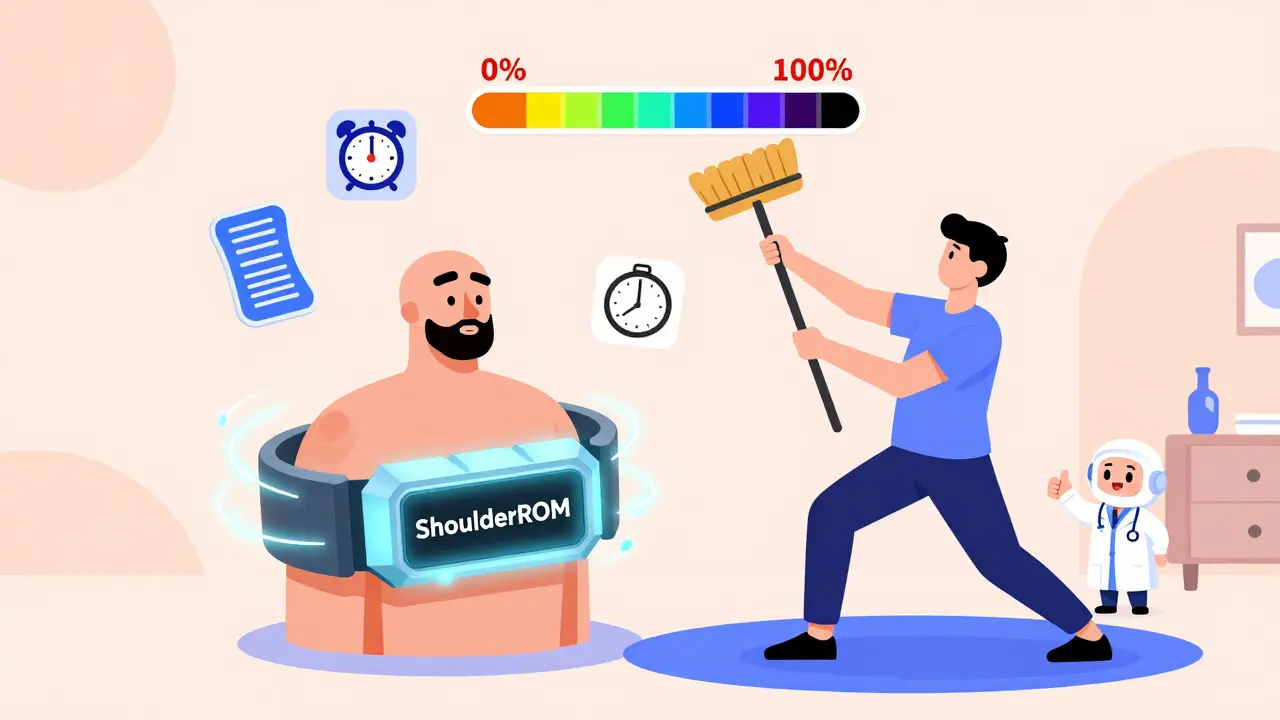
When to See a Professional
You can start with home exercises. But if you’re not seeing improvement after 4-6 weeks, or if pain is getting worse, see a physical therapist. Supervised therapy during the freezing stage leads to 28% faster recovery, according to AAOS guidelines. Also, if you have diabetes, you’re 2-10 times more likely to get frozen shoulder. And if you have fever, night sweats, or unexplained weight loss along with shoulder pain? That’s not frozen shoulder. That’s something else-see a doctor immediately.Technology and New Tools
In 2023, the FDA cleared a device called ShoulderROM by Precision Rehab Solutions. It’s a wearable sensor that tracks your shoulder movement during home exercises and gives real-time feedback. Clinical trials showed users recovered 32% faster than those using traditional methods. Telehealth physical therapy is now covered by 41% of major U.S. employers. If you’re stuck at home or in a rural area, virtual sessions with a licensed therapist can be just as effective as in-person visits.Long-Term Outlook
The good news? Most people get better. An 87% recovery rate within two years is backed by the Cochrane Review of over 5,800 patients. Only 13% ever need surgery. The key isn’t waiting for it to go away. It’s moving smartly, early, and consistently. Frozen shoulder doesn’t vanish overnight. But with the right strategy, you don’t have to lose years of your life to it.How long does frozen shoulder last without treatment?
Without treatment, frozen shoulder typically lasts 1 to 3 years, with some cases stretching up to 11 years. The pain usually eases after 6-9 months, but stiffness can remain for over a year. Early mobilization can reduce this to 6-12 months.
Can frozen shoulder come back in the same shoulder?
It’s rare for frozen shoulder to return in the same shoulder once fully recovered. But about 20-30% of people develop it in the other shoulder, especially if they have diabetes or other risk factors. Maintaining mobility helps prevent recurrence.
Is heat or ice better for frozen shoulder pain?
Heat is better before stretching to loosen the joint capsule. Ice can help after activity if there’s swelling or sharp pain, but it doesn’t help with stiffness. Most physical therapists recommend heat for 10 minutes before exercises and ice only if inflammation flares up.
Can I still exercise with frozen shoulder?
Yes-but avoid heavy lifting, overhead presses, or forceful movements. Stick to gentle, controlled stretches like pendulums, towel stretches, and wand exercises. Low-impact cardio like walking or cycling is fine and helps reduce overall inflammation.
Does diabetes make frozen shoulder worse?
Yes. People with diabetes are 2 to 10 times more likely to develop frozen shoulder, and their recovery tends to be slower. High blood sugar may cause abnormal collagen buildup in the joint capsule. Tight blood sugar control doesn’t prevent it, but it can improve healing speed.
When should I consider surgery for frozen shoulder?
Surgery is only considered after 6 months of consistent physical therapy with no improvement. Options include manipulation under anesthesia or arthroscopic capsular release. Both carry risks and are reserved for cases where mobility remains severely limited and pain persists. Most people never need it.
Can I do these exercises on my own, or do I need a therapist?
You can start with home exercises like pendulums and towel stretches. But if you’re unsure about technique or progress stalls after 4-6 weeks, see a physical therapist. Supervised therapy in the early phase improves outcomes by 28%. A therapist can also rule out other conditions like rotator cuff tears.



December 30, 2025 AT 14:08 PM
This is literally life-changing info 😭 I’ve been suffering for 14 months and just started pendulum exercises last week-already feeling a 15% difference. Thank you for laying it out so clearly. I’m crying happy tears. 🥹💖
December 31, 2025 AT 09:06 AM
You say move within pain limits but that’s just pseudoscience. If your capsule is shrunk by 45% no amount of gentle swinging is gonna fix that. You’re just wasting time until you need surgery. This whole post is feel-good fluff.
December 31, 2025 AT 19:05 PM
same. 2 years. no help. doctors just shrug. why is this even a thing?
January 1, 2026 AT 13:36 PM
I’ve been doing the towel stretch daily since March. Took 3 weeks to stop wincing, but now I can scratch my back without help. It’s slow, but it works. Don’t give up. Also, heat before stretch = game changer. 🌞💪
January 2, 2026 AT 14:47 PM
Oh wow another miracle cure for a condition that resolves itself in 2 years anyway. Did you forget to mention drinking celery juice? Maybe a crystal necklace? The real story is people panic and buy expensive gadgets like ShoulderROM because they don’t trust their own bodies
January 3, 2026 AT 16:51 PM
The clinical data presented is methodologically sound. The referenced studies from the American Academy of Family Physicians and Cochrane Review demonstrate statistically significant outcomes. The assertion that early mobilization reduces recovery time by 50% is corroborated by randomized controlled trials with p-values below 0.01. This is not anecdotal.
January 4, 2026 AT 18:20 PM
It’s funny how we treat the body like a machine that can be fixed with the right tool. But the shoulder doesn’t care about our timelines. It heals when it’s ready. Maybe the real issue isn’t the capsule-it’s our impatience. We want to fix it, not understand it.
January 5, 2026 AT 11:24 AM
i did the doorway stretch for 2 weeks and thought it wasnt working but then one morning i could reach my bra clasp without pain. i didnt even realize it until then. thanks for the post, i was about to give up
January 6, 2026 AT 22:24 PM
The data is compelling. Early mobilization is not optional. It is the standard of care. Delaying intervention is medically negligent. If you are reading this and have not started your regimen, you are risking permanent functional loss. Do not wait.
January 7, 2026 AT 19:34 PM
You’re just rebranding physical therapy as a ‘mobilization strategy’ to sell your ebook. The capsule doesn’t ‘shrink’-it fibroses. And no, a broomstick isn’t a ‘wand exercise’-it’s a stick. Stop using buzzwords to mask the fact that this is just stretching. The FDA cleared a device? Of course they did. There’s a billion-dollar industry built on making people feel broken.
January 8, 2026 AT 19:49 PM
The real magic isn't in the wand or the towel-it’s in the consistency. You don't need a PhD to do pendulums. You just need to show up. Even on days you feel like quitting. That’s the invisible therapy. The one no gadget can measure.
January 10, 2026 AT 16:34 PM
I had this for 4 years. Tried everything. Then I just accepted it. My shoulder’s still stiff. So is my life. You can’t fix everything with stretches. Some things are just broken. And you just learn to live with it. This post is toxic positivity in a lab coat.