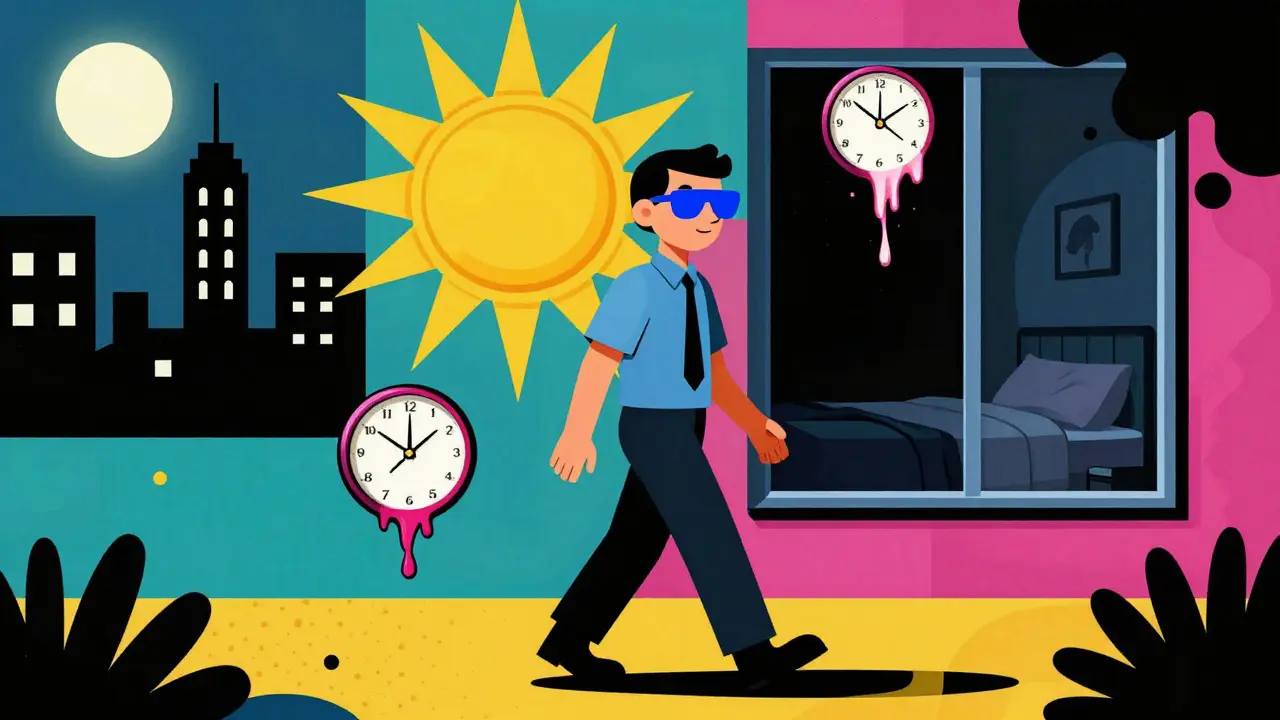
Working nights doesn’t just mean you’re awake when everyone else is sleeping-it means your body is fighting against its own biology. If you’ve ever tried to sleep during the day after a 12-hour shift, only to wake up exhausted, groggy, or wide awake at 3 p.m., you’re not lazy. You might have shift work sleep disorder (SWSD). This isn’t just bad sleep habits. It’s a medical condition recognized by the American Academy of Sleep Medicine and the World Health Organization, affecting millions of people who work outside normal daylight hours.
What Exactly Is Shift Work Sleep Disorder?
Shift Work Sleep Disorder happens when your work schedule clashes with your body’s natural sleep-wake cycle. Your brain is wired to sleep at night and be awake during the day. When you force yourself to be alert from midnight to 8 a.m., your body doesn’t adapt easily. Melatonin, the sleep hormone, keeps rising when you’re supposed to be working. Cortisol, the wake-up hormone, stays low when you need to be sharp. The result? You’re tired on the job and wide awake when you’re trying to rest.
It’s not just about feeling sleepy. People with SWSD often struggle with:
- Falling asleep or staying asleep during the day
- Excessive sleepiness during night shifts
- Difficulty concentrating or making mistakes at work
- Mood swings, irritability, or anxiety
- Headaches, digestive issues, or weakened immunity
Studies show that 29% of night shift workers and 24% of rotating shift workers have moderate to severe sleepiness during work hours-compared to just 8% of day workers. That’s not normal fatigue. That’s your body screaming for help.
Why Your Body Can’t Catch Up
Here’s the hard truth: your circadian rhythm doesn’t bend easily. Even after years of working nights, only 2-5% of people fully adapt. That’s not a failure on your part-it’s biology. The part of your brain that controls sleep (the suprachiasmatic nucleus) relies on light cues. When you’re exposed to sunlight on your way home from a night shift, your brain thinks it’s morning. But then you try to sleep in a bright, noisy house. Your body gets mixed signals.
One study found that artificial light at night can suppress melatonin production by up to 85%. That means if you’re using your phone, watching TV, or even turning on a light to get a glass of water at 3 a.m., you’re sabotaging your chances of sleeping later. And when you finally do sleep, you’re likely getting 1-4 hours less than you need. Over time, that adds up.
The consequences aren’t just about feeling tired. The International Agency for Research on Cancer classifies shift work as “probably carcinogenic” because of long-term disruption to sleep and hormone cycles. People with SWSD have higher risks of heart disease, diabetes, obesity, and even certain cancers. Fatigue also leads to accidents. One manufacturing plant in Ohio reported a $2.3 million equipment failure caused by a worker who nodded off during a critical operation. That’s not an isolated case.
Who’s Most at Risk?
SWSD doesn’t hit everyone the same way. Some people adapt better than others-and it’s not just about willpower.
- Age matters: Workers aged 50-64 are nearly twice as likely to develop SWSD as those aged 18-29. As we age, our bodies become less flexible in adjusting to new schedules.
- Gender plays a role: Women are 28% more likely than men to develop SWSD, possibly due to hormonal differences and caregiving responsibilities that make consistent sleep harder.
- Chronotype is key: If you’re naturally a “night owl,” you’re 37% more likely to handle night shifts than a “morning lark.” Your genes (like PER3 and CLOCK) determine how well your body adjusts.
- Job type affects severity: Healthcare workers, truck drivers, factory staff, and emergency responders are most affected. Nurses on rotating shifts report the highest rates of sleep complaints.
And here’s the kicker: most employers don’t help. Only 22% of shift workers have access to quiet, dark sleeping areas at work. Many workplaces still treat fatigue as a personal problem-not a safety issue.
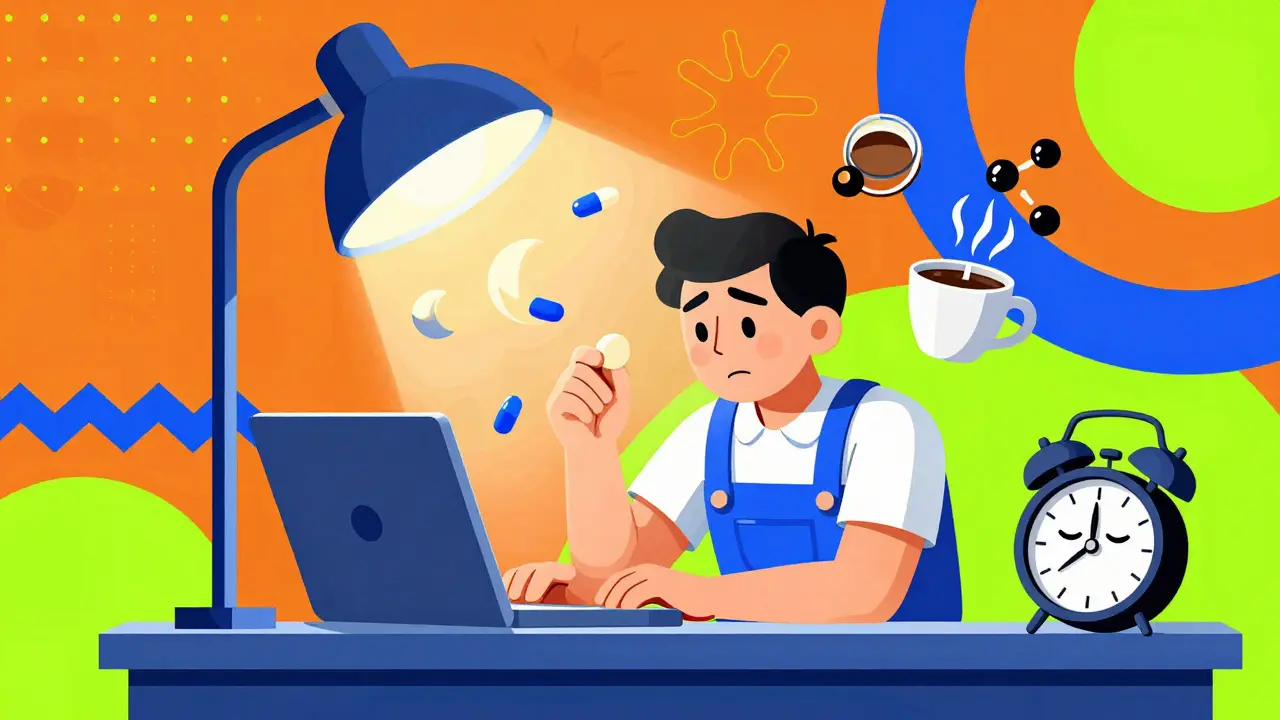
How to Fix It: Proven Strategies That Actually Work
You don’t have to quit your job. You don’t have to suffer silently. There are science-backed ways to manage SWSD-even if you’re stuck on nights.
1. Control Light Like Your Life Depends On It (Because It Does)
Light is your strongest tool. During your night shift, get bright light exposure. Use a 10,000-lux light box for 30-60 minutes every 2 hours. It tricks your brain into thinking it’s daytime. If you can’t get a light box, sit near a bright window or use LED work lights.
On your way home, wear blue-blocking sunglasses. Even a cheap pair from Amazon can cut melatonin suppression by 70%. Don’t skip this step. If you see sunlight on your commute, your body will think it’s morning-and you’ll struggle to sleep.
2. Time Your Caffeine Like a Pro
Caffeine helps-but only if you use it right. Drink your first cup at the start of your shift. Have a second if needed, but never after the halfway point. A 2022 Mayo Clinic study found that workers who limited caffeine to the first half of their shift were 40% less likely to crash later.
Avoid energy drinks. They spike your heart rate and make it harder to sleep later. Stick to coffee or tea. Maximum dose: 200 mg per serving (about one strong cup). More than that just makes you jittery and disrupts sleep even more.
3. Use Melatonin Wisely
Melatonin isn’t a sleeping pill. It’s a signal. Take 0.5-5 mg about 30 minutes before your daytime sleep. It tells your body, “It’s time to shut down.” Don’t take it during your shift-that’s when you need to be awake.
Start low. Many people overdose on melatonin thinking more is better. That just leads to grogginess. Stick to 1-2 mg unless your doctor says otherwise. It’s safe for long-term use and doesn’t cause dependence.
4. Create a Sleep Sanctuary
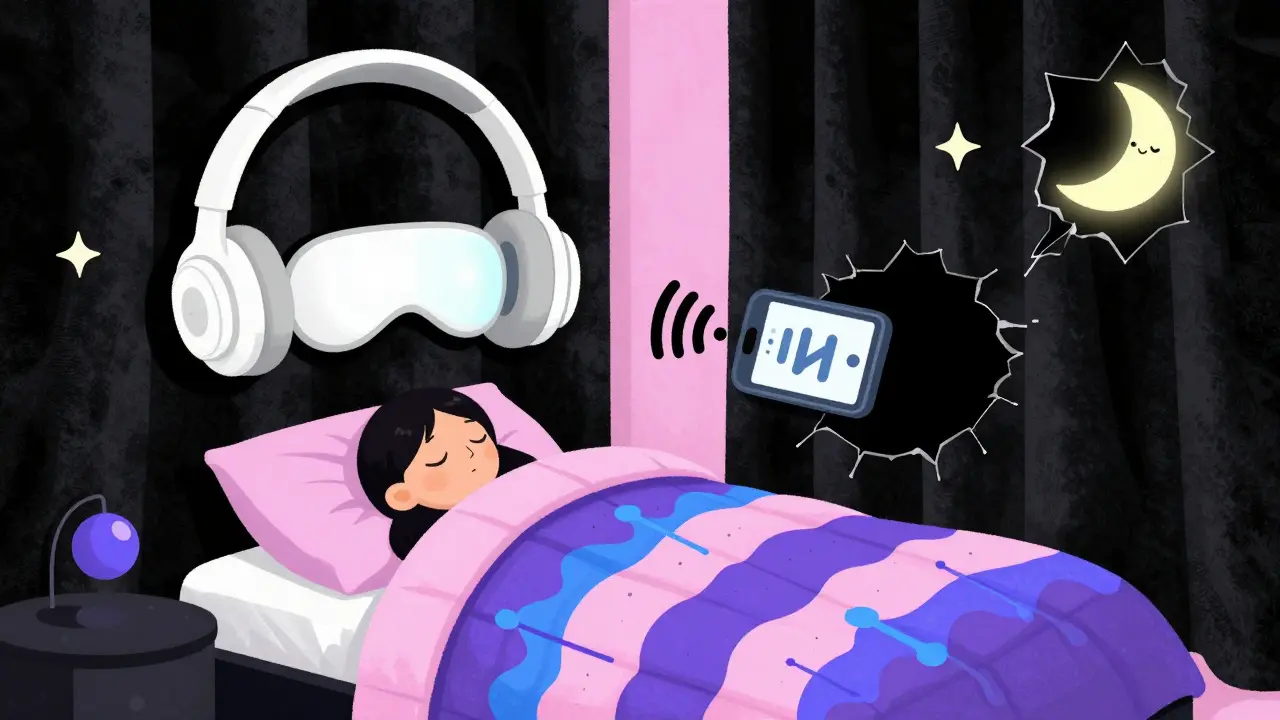
Your bedroom needs to be a cave. Use blackout curtains (not just shades). Add a white noise machine or earplugs. Turn off your phone and Wi-Fi router. Even the glow from a charger can interfere with sleep.
Some people use a sleep mask and earplugs together. It sounds extreme, but if you’re sleeping during the day, you’re fighting daylight, traffic, kids, and dogs barking. You need every advantage.
5. Nap Strategically
Before your shift, take a 20-30 minute nap. It boosts alertness without leaving you groggy. If your job allows, nap during your break. A 2021 study of nurses found that those who napped during shifts reported 68% better focus and fewer errors.
Don’t nap longer than 45 minutes-it can push you into deep sleep and make waking up harder.
What Doesn’t Work (And Why)
Some “solutions” you hear about just don’t hold up.
- Alcohol to help you sleep: It might knock you out, but it ruins sleep quality. You’ll wake up more tired.
- Sleeping pills: They don’t fix circadian misalignment. They just mask the problem-and can be addictive.
- Trying to sleep on your days off like a day worker: If you switch back to a day schedule on weekends, your body gets confused. Stay consistent. Even on days off, try to sleep at the same time.
- Waiting for your body to “get used to it”: Most people never fully adapt. Don’t wait for it to get easier. Act now.
When to See a Doctor
If you’ve tried these strategies for 2-4 weeks and still can’t sleep or stay awake during work, it’s time to see a sleep specialist. SWSD is diagnosable. You’ll likely need to keep a sleep log or wear an actigraphy device (a wrist monitor that tracks movement and light exposure) for at least 7 days.
Doctors can also prescribe FDA-approved medications like modafinil or armodafinil for excessive sleepiness. In May 2023, the FDA approved sodium oxybate specifically for SWSD-a big step forward. These aren’t quick fixes, but they can be life-changing when combined with behavioral changes.
Don’t wait until you make a mistake at work, get into a car accident, or get diagnosed with a chronic illness. Early intervention matters.
The Bigger Picture: Why This Matters Beyond You
SWSD isn’t just your problem. It’s a public health crisis. The National Safety Council estimates fatigue-related workplace accidents cost the U.S. $13 billion a year. Hospitals, factories, and delivery services are all at risk.
More companies are starting to wake up. The CDC’s NIOSH program is now used by 45% of Fortune 500 companies. Some hospitals have started offering light therapy stations in break rooms. Others are adjusting shift rotations to minimize rapid changes.
But change won’t come unless workers speak up. If your employer doesn’t offer dark rooms, light therapy, or flexible scheduling, ask. Cite the data. Show them the cost of mistakes. Show them the cost of turnover. Show them the cost of health claims.
You’re not asking for a favor. You’re asking for safety.
Final Thought: You’re Not Broken
If you’re working nights and struggling to sleep, you’re not lazy. You’re not weak. You’re not failing. Your body is doing exactly what it’s designed to do-it’s trying to protect you by telling you this schedule isn’t natural.
SWSD is real. It’s common. And it’s treatable. You don’t have to choose between your job and your health. With the right tools, you can manage it. You can sleep. You can be alert. You can stay healthy.
Start tonight. Put on those sunglasses. Block out the light. Take your melatonin. And give yourself permission to rest-because you deserve it.
Can shift work sleep disorder be cured?
SWSD can’t be permanently “cured” if you continue working nights, but it can be effectively managed. Most people who follow a consistent routine with light exposure, melatonin, naps, and sleep hygiene see major improvements in sleep quality and alertness within 2-4 weeks. The goal isn’t to eliminate the disorder-it’s to reduce symptoms enough to function safely and healthily.
How long does it take to adapt to night shifts?
Most people never fully adapt. Studies show only 2-5% of night shift workers achieve true circadian alignment, even after years. Your body can adjust partially-like shifting melatonin timing by a few hours-but full adaptation is rare. That’s why management strategies (light, melatonin, naps) are more important than waiting for your body to “get used to it.”
Is it better to work the same night shift every time or rotate?
Fixed night shifts are easier on your body than rotating ones. Rotating between days, nights, and evenings keeps your circadian rhythm confused. If you must rotate, follow a forward rotation (day → evening → night) and avoid going backward. Give yourself at least 2-3 days between major schedule changes to recover.
Can melatonin help me sleep during the day?
Yes, but timing matters. Take melatonin 30 minutes before your planned sleep time-whether that’s 8 a.m. or 2 p.m. It won’t work if you take it during your shift. Use 0.5-5 mg, starting low. Melatonin helps signal sleep time to your brain, but it doesn’t force sleep. Combine it with darkness and quiet for best results.
What if my employer won’t let me use a light box at work?
Try alternatives: sit near bright windows, use LED desk lamps (5000K or higher), or ask if you can take breaks outside during daylight hours. If your job is safety-sensitive, your employer may be legally required to accommodate fatigue-reduction strategies under OSHA guidelines. Bring data: studies show light therapy reduces errors by up to 30%. Frame it as a safety issue, not a personal preference.
Does SWSD increase the risk of cancer?
Yes. The International Agency for Research on Cancer (IARC) classifies shift work that involves circadian disruption as “probably carcinogenic to humans.” Long-term night work is linked to higher risks of breast, prostate, and colorectal cancers, likely due to suppressed melatonin (which has anti-cancer properties) and disrupted hormone cycles. Managing SWSD isn’t just about sleep-it’s about reducing long-term health risks.
Are there any new treatments for SWSD in 2026?
Yes. In May 2023, the FDA approved sodium oxybate for excessive sleepiness caused by SWSD. This joins modafinil and armodafinil, which have been used for years. New wearable devices that track circadian rhythms (like the Oura Ring or WHOOP) are now being used by hospitals to monitor employee sleep patterns. Personalized treatment based on your genes (PER3, CLOCK) is also entering clinical trials, with results expected by 2027.
Next Steps: What to Do Today
- Buy blue-blocking sunglasses for your commute home.
- Invest in blackout curtains or a sleep mask.
- Take melatonin 30 minutes before your next daytime sleep.
- Plan a 20-minute nap before your next night shift.
- Track your sleep for one week with a simple journal or app.
You don’t need to fix everything at once. Start with one change. Do it for a week. Then add another. Small steps, done consistently, lead to real results. Your body is trying to tell you something. Listen to it.


January 21, 2026 AT 14:10 PM
Just started night shifts last month. Bought the blue blockers. Slept like a rock last night. Game changer.
January 21, 2026 AT 21:56 PM
Let me be clear: if you’re struggling with shift work, it’s not because your body is ‘broken’-it’s because you’re surrounded by people who think sleep is a luxury, not a biological imperative. The fact that the FDA had to approve sodium oxybate for this in 2023 is a national disgrace. We treat burnout like a personality flaw instead of a systemic failure. Your employer doesn’t care about your circadian rhythm because they don’t have to. They’ll replace you in 48 hours. You’re not lazy. You’re being exploited. And you’re being lied to about how ‘normal’ this is.
January 23, 2026 AT 18:01 PM
Bro i just take 2 energy drinks and power through. Why are we making this so complicated. You want to be a nurse? Deal with it. My cousin worked nights for 15 years and never had a problem. Just stop whining.
January 24, 2026 AT 03:25 AM
Okay but have you considered that melatonin might be suppressing your natural cortisol rhythm even more? I read a paper in Chronobiology International that showed long-term melatonin use in shift workers led to phase delays of up to 90 minutes beyond baseline-meaning you’re not fixing the problem, you’re just adding another layer of dysregulation. Also, why are we ignoring the role of social jet lag? You’re not just fighting light-you’re fighting your kid’s soccer practice, your partner’s schedule, your dog’s barking at 6am. This isn’t just a biological issue. It’s a social one. And nobody talks about that.
January 25, 2026 AT 17:15 PM
Everyone here is acting like this is some groundbreaking revelation. I’ve been a night shift tech for 12 years. The only thing that works? Quit. Or get rich enough to fire your boss. Everything else is just placebo with a PubMed link. And no, your ‘light box’ won’t save you. You’re not a plant. You’re a human with a finite lifespan. Stop optimizing and start surviving.
January 27, 2026 AT 04:25 AM
The circadian misalignment metric (CMM) for rotating shifts is statistically significant at p<0.01 when compared to fixed night schedules. The suprachiasmatic nucleus exhibits reduced phase-shifting capacity after 3+ consecutive night shifts, with melatonin onset latency increasing by 1.8±0.4 hours. The 2-5% adaptation rate is corroborated by actigraphy studies from the Sleep Research Society (2021). The data is clear. The policy isn’t.
January 29, 2026 AT 02:29 AM
Big Pharma loves this. Melatonin? FDA-approved? Sodium oxybate? 😂 They’ve been poisoning our sleep cycles for decades and now they’re selling us the cure. Next they’ll patent ‘sunlight’ and charge you $200 a session. The real solution? Abolish night shifts. Let the machines do it. Humans were never meant to be on a 24/7 hamster wheel. Wake up.
January 29, 2026 AT 14:07 PM
Actually, the 29% statistic is misleading. That’s from a 2018 survey with self-reported sleepiness. Objective measures from polysomnography show only 12-15% have true SWSD. The rest are just tired from bad habits. And melatonin? Most people take 5mg when 0.3mg is sufficient. You’re not treating the disorder-you’re overdosing on a supplement. This post reads like a supplement ad with a PhD.
January 31, 2026 AT 12:44 PM
Why are we still talking about this? Just sleep when you can. No one’s forcing you to work nights. If you can’t handle it, quit. Simple.
February 1, 2026 AT 22:17 PM
im on nights too and i just drink coffee and chill. no light boxes no melatonin. just dont think about it. also why are we using big words for something so simple. just sleep when ur tired. duh.
February 2, 2026 AT 01:54 AM
Look, I’m American. I work 12-hour shifts at a warehouse. I don’t have time for all this science. I got three kids, a mortgage, and a dog that thinks I’m a robot. I take a nap before I go in. I wear sunglasses. I don’t care if it’s ‘scientific’-it works. And if you think I’m gonna pay $300 for a light box while my paycheck gets cut every year? Nah. You want change? Fight your union. Fight your boss. Don’t buy another gadget.
February 2, 2026 AT 07:58 AM
One must contemplate the existential implications of circadian dissonance in a post-industrial society that demands perpetual productivity. The human organism, evolved over millennia under the diurnal rhythm of celestial cycles, is now subjected to the arbitrary temporal tyranny of corporate logistics. To demand adaptation is to demand the erasure of biological identity. The true pathology lies not in the worker’s inability to sleep, but in the civilization’s refusal to honor the rhythms that birthed it. We have turned sleep into a commodity, and in doing so, we have commodified our very humanity.
February 3, 2026 AT 09:40 AM
Just wanted to say thank you for this. I’m a night shift nurse and I’ve been struggling for years. I tried the sunglasses and melatonin last week and actually slept 5 hours straight for the first time in 2 years. You’re not alone. We’re all out here trying to survive this. Keep going. 💪🌙
February 3, 2026 AT 22:22 PM
It is imperative to note that the efficacy of melatonin supplementation in shift work sleep disorder remains contingent upon adherence to strict temporal parameters, as delineated by the American Academy of Sleep Medicine Clinical Practice Guidelines (2022). Failure to observe these parameters may result in paradoxical arousal and further circadian disruption. Furthermore, the use of blue-blocking filters is not universally efficacious; individual photopic sensitivity varies significantly across the population. A personalized, evidence-based approach is required.
February 5, 2026 AT 01:04 AM
How quaint. We have peer-reviewed studies, clinical trials, and regulatory approvals-and yet, the discourse remains reduced to anecdotal advice and consumer-grade solutions. The real issue is not melatonin dosage or light exposure. It is the systemic devaluation of human biological integrity in the name of efficiency. This post reads like a pamphlet from a wellness influencer who has never set foot in a hospital ER at 3 a.m.
February 5, 2026 AT 14:09 PM
Man, I’ve been there. Night shifts, screaming kids, daylight bleeding through the curtains like a guilty secret. I used to think I was broken. Turns out, I was just living in a world that forgot how to rest. You’re not failing. You’re fighting a system that treats sleep like a glitch. Keep going. One pair of sunglasses, one dark room, one nap at a time. You’re doing better than you think.
February 6, 2026 AT 23:37 PM
As a night shift technician in Mumbai, I can confirm: the environment matters more than the science. In India, we don’t have blackout curtains. We have fans, mosquito nets, and neighbors who think 5 a.m. is perfect for a loud wedding procession. Melatonin helps-but so does silence. I started using earplugs and a ceiling fan to create white noise. It’s not perfect. But it’s mine. And I take it. One night at a time. 🌙❤️
February 7, 2026 AT 22:59 PM
Bro, I work nights in Delhi and I just chill with my chai and my phone. I use the blue light filter and play Bollywood songs. It’s not science, but it’s my rhythm. 🌙🎶
February 9, 2026 AT 21:40 PM
Let’s be honest: this entire framework is built on the assumption that shift work is an acceptable norm. It is not. The fact that we are discussing how to ‘manage’ a condition that should not exist in the first place speaks volumes about the moral bankruptcy of modern labor economics. The real solution is not melatonin, not light boxes, not even sodium oxybate. The real solution is abolishing mandatory night shifts for non-essential services. Everything else is just corporate damage control dressed up as self-help.
February 11, 2026 AT 09:23 AM
Hey, I’m a single mom working nights as a paramedic. I tried all this stuff. The sunglasses? Lifesaver. The melatonin? Took a week to work. The nap? Best 20 minutes of my life. But what really helped? Talking to other night shift moms on Reddit. We share tips, vent, and sometimes just say ‘I see you.’ You’re not alone. We’re all just trying to survive the daylight.