Imagine this: you are stuck in a shelter after a hurricane, your blood pressure is spiking, and the only pills left in your bag expired six months ago. Do you take them? This isn't just a hypothetical nightmare. With drug shortages affecting millions and disasters becoming more frequent, knowing how to talk about-and potentially use-expired medications is a critical survival skill. The short answer? It depends entirely on the drug, the condition, and the alternative.
The United States Food and Drug Administration (FDA) sets strict rules for expiration dates, but those rules were designed for stable shelves in air-conditioned pharmacies, not flood-damaged homes or hot cars. When supply chains break, the conversation shifts from "is it legal" to "is it safer than doing nothing." Here is how to navigate that difficult discussion with doctors, pharmacists, and family members during a crisis.
Understanding What Expiration Dates Actually Mean
First, we need to clear up a major misconception. An expiration date is not a cliff edge where a pill turns into poison overnight. According to FDA guidelines established in 1979 and updated in September 2023, an expiration date represents the final day a manufacturer guarantees 100% potency under specific storage conditions. It is a quality guarantee, not necessarily a safety deadline.
This distinction matters because of the Shelf Life Extension Program (SLEP). Launched in 1985 by the Department of Defense and the FDA, SLEP tested military stockpiles and found that 88% of 122 drug products maintained stability well beyond their labeled dates when stored in ideal conditions. However, "ideal" is the keyword here. Military warehouses are climate-controlled. Your bathroom cabinet or glove box is not.
If you are discussing expired meds with a healthcare provider, start by acknowledging this nuance. Most drugs do not become toxic immediately; they simply lose strength. For example, solid tablets often retain 90% of their power for one to five years past the date if kept dry and cool. But liquids? They degrade much faster. Liquid antibiotics can lose 30-50% of their effectiveness within six months of expiring. Always ask: "Is this a solid tablet or a liquid solution?" That question changes the risk profile entirely.
The Critical vs. Non-Critical Distinction
Not all medications are created equal when the clock runs out. You cannot treat an aspirin headache the same way you treat a heart attack. The American Pharmacists Association (APhA) divides these risks into categories based on what happens if the drug fails.
| Medication Type | Risk Level | Typical Degradation | Verdict in Crisis |
|---|---|---|---|
| Critical (Life-Sustaining) (Insulin, Epinephrine, Nitroglycerin) |
High | Fast & Unpredictable (e.g., Insulin loses ~10%/month at room temp) |
Avoid if possible. Failure can be fatal. |
| Essential (Chronic Management) (Blood Pressure, Cholesterol) |
Moderate | Moderate (Lisinopril may fail to control BP) |
Use as last resort. Monitor symptoms closely. |
| Non-Essential (Symptom Relief) (Ibuprofen, Acetaminophen, Antihistamines) |
Low | Slow (Acetaminophen retains 95% potency at 4 years) |
Safer to use. Better than no pain relief. |
Let’s look at the data. A 2021 stability report by Novo Nordisk showed insulin losing 40% of its potency just six months after expiration if stored at room temperature. Epinephrine auto-injectors degrade at 2-4% per month. If you rely on these for anaphylaxis or diabetic emergencies, an expired dose might not save your life. In contrast, a University of Utah study found that acetaminophen retains 95% of its potency even four years post-expiration. During the 2020 California wildfires, a UC San Francisco survey found that 89% of evacuees who used expired ibuprofen reported successful pain relief. The difference? One treats a symptom; the other sustains life.
Environmental Factors: The Hidden Killer
When discussing expired meds, people often focus on the calendar date. They should be focusing on the environment. Heat, humidity, and light accelerate chemical breakdown far faster than time alone. The FDA requires manufacturers to test stability at 25°C (77°F) with 60% relative humidity. But have you ever checked the temperature inside your car on a summer day? Or the humidity in a flooded basement?
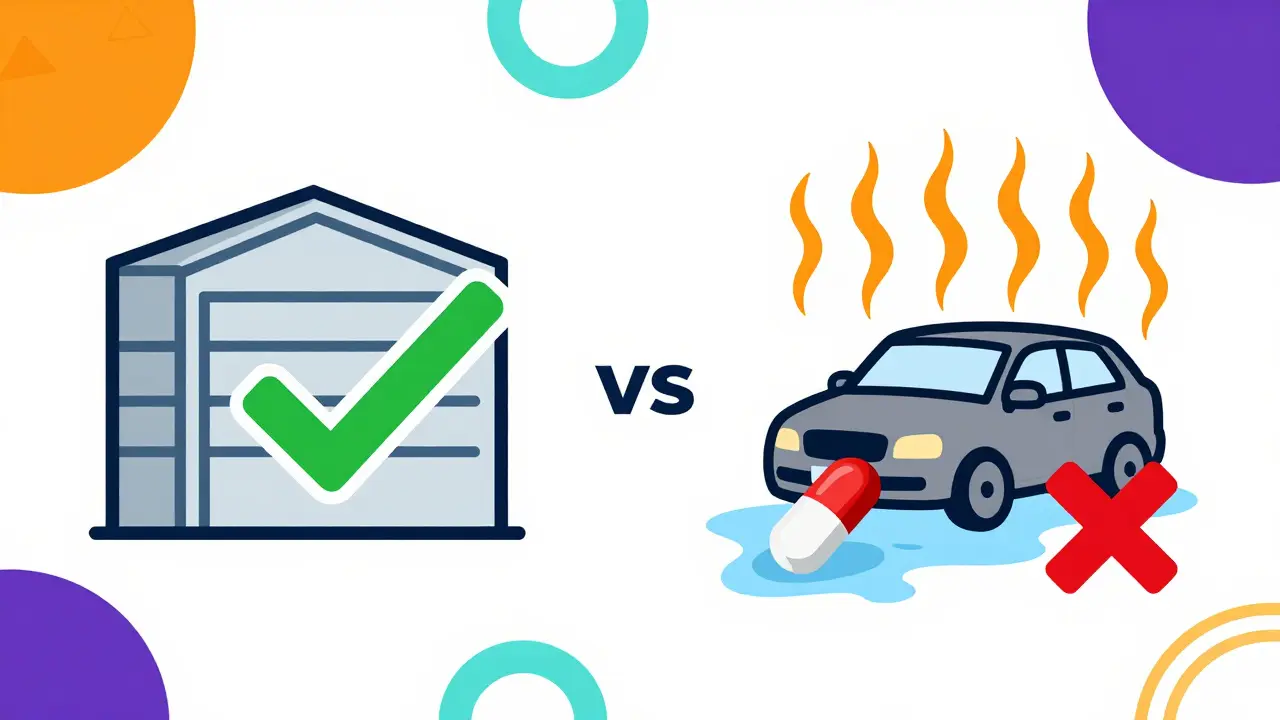
FDA disaster response data from 2022 reveals a stark reality: medications exposed to floodwater for just 24 hours show bacterial contamination in 92% of cases. Do not take these pills. Ever. Similarly, NIH-funded research shows that exposure to temperatures above 86°F (30°C) for 48 hours speeds up chemical breakdown by 15-25%. If your meds were in a house that lost power during a heatwave, the expiration date becomes irrelevant. The physical integrity of the drug has likely been compromised.
Here is a simple rule of thumb for your discussions: If the bottle looks cloudy, smells odd, crumbles easily, or was submerged in water, throw it out. The date doesn’t matter anymore. Physical degradation is a visual cue that the chemical structure has broken down.
The Toxic Exception: Tetracycline
There is one major exception to the "expired means weak, not toxic" rule. You must know this if you are prepping or managing a household pharmacy. Tetracycline, an older antibiotic, forms toxic degradation products when it expires. Specifically, it can cause Fanconi syndrome, a rare kidney disorder. The Institute for Safe Medication Practices (ISMP) documented 17 cases of this since 2000. If you find old tetracycline in your stash, discard it immediately. It is not worth the risk.
Practical Steps for Emergency Discussions
So, how do you actually handle this when the chips are down? The FDA’s 2023 'Safe Drug Use After Natural Disasters' guidelines offer a five-step assessment that you can use to guide conversations with telehealth doctors or local pharmacists.
- Verify Physical Condition: Is the pill discolored, crumbled, or sticky? If yes, discard it. About 73% of degraded medications show visible signs according to USP verification standards.
- Confirm Storage History: Was it exposed to heat (>86°F) or moisture for over 24-48 hours? If yes, assume significant potency loss.
- Determine Criticality: Is this for a life-threatening issue (asthma attack, severe infection) or a manageable one (headache, mild allergy)? Use the APhA criticality index to decide.
- Calculate Timeframe: How long past expiration are we talking? Solid OTC painkillers? Up to 2-4 years might be okay. Insulin? Even one month is risky.
- Consult Expertise: Call a pharmacist. In 48 states, pharmacists can legally provide emergency advice and sometimes dispense limited supplies without a doctor's direct order during declared emergencies. As of 2023, 92% of chain pharmacies participate in these programs.
Don't guess. Call. Even if the lines are busy, leave a message or check online chat services. Many health systems activated telehealth triage during the Maui wildfires in 2023, guiding 1,200 patients on using slightly expired antibiotics safely.
Navigating Legal and Ethical Gray Areas
You might worry about legality. Will you get in trouble for taking an expired pill? Generally, no. The law targets manufacturers and distributors, not consumers trying to survive. However, the ethical discussion is trickier. Dr. Sandra Kweder, Deputy Director of the FDA's Center for Drug Evaluation and Research, stated in a 2023 webinar that "in life-threatening situations with no alternatives, using certain expired medications may be preferable to receiving no treatment at all."
This is a last-resort decision. It is not a recommendation to hoard old meds instead of buying new ones. It is a harm-reduction strategy. If you have a choice between a fresh prescription and an expired backup, always choose the fresh one. Save the expired stockpile for true emergencies where access is impossible.
Also, consider the impact on resistance. A Johns Hopkins study found that 28% of disaster survivors using expired antibiotics developed resistant infections, compared to 8% with proper doses. Sub-therapeutic doses (because the drug is weaker) can breed superbugs. This is another reason to avoid using expired antibiotics unless absolutely necessary and ideally under medical supervision.
Preparing for the Next Shortage
The best way to discuss expired medication is to ensure you rarely have to use it. The pharmaceutical industry is aware of these gaps. Pfizer and other major players announced commitments in late 2023 to extend shelf lives through better packaging. Meanwhile, the NIH is funding $4.7 million in grants for rapid field-testing tools that could measure potency in minutes rather than weeks.
In the meantime, you can take control. Rotate your home medicine cabinet every six months. Check expiration dates when you buy. Store meds in a cool, dry place-not the bathroom. And keep a separate "emergency kit" with high-stability items like oral rehydration salts, basic pain relievers, and antihistamines, checking their dates annually. By staying proactive, you turn a scary conversation into a managed plan.
Is it safe to take expired ibuprofen or acetaminophen?
Generally, yes. Studies show that solid dosage forms like ibuprofen and acetaminophen retain most of their potency for several years after expiration if stored properly. They are considered low-risk for non-critical symptom relief during emergencies.
Can expired medication kill you?
In rare cases, yes. While most expired drugs just lose effectiveness, tetracycline can form toxic compounds that damage kidneys. Additionally, relying on expired life-saving drugs like insulin or epinephrine can lead to fatal outcomes due to treatment failure.
What should I do if my medication got wet in a flood?
Discard it immediately. Floodwater introduces bacteria and contaminants. FDA data indicates 92% of medications exposed to floodwater for 24 hours are contaminated. Do not attempt to dry them out.
Do pharmacists help with expired meds during disasters?
Yes. In many states, pharmacists have expanded authority during declared emergencies to provide guidance and limited emergency supplies. They can assess whether an expired med is safe to use based on its type and storage history.
How long does epinephrine last after expiration?
Epinephrine degrades relatively quickly, losing 2-4% of its potency per month after expiration. Using an expired auto-injector is risky and should only be done as an absolute last resort in anaphylaxis, preferably with a doubled dose if possible and under medical guidance.