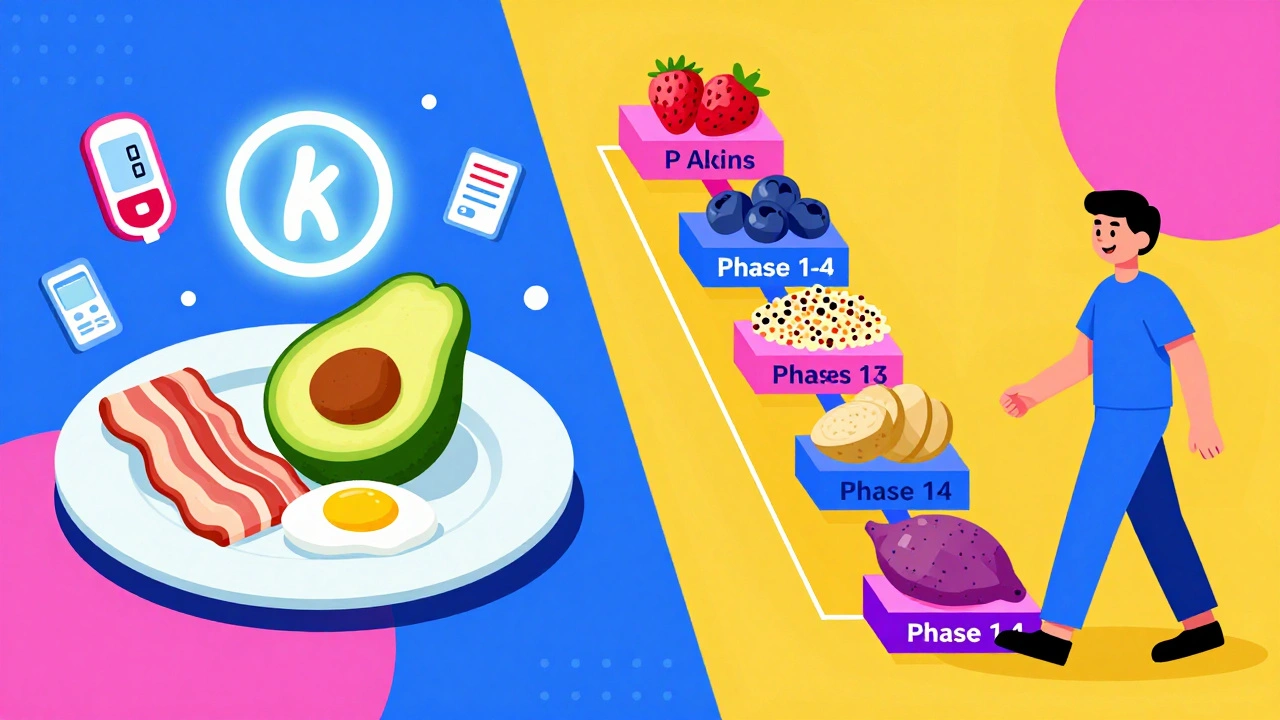
When you're trying to lose weight, not all low-carb diets are created equal. Two of the most popular options-keto and Atkins-sound similar, but they work in very different ways. One locks you into a strict fat-burning state. The other gives you room to grow into a sustainable eating pattern. So which one actually helps you lose weight and keep it off? The answer isn’t simple, but it’s clearer than most diet marketers want you to believe.
How Keto Turns Your Body Into a Fat-Burning Machine
The ketogenic diet isn’t just about cutting carbs-it’s about forcing your body to run on fat instead of sugar. To do that, you need to eat around 75-90% of your calories from fat, keep protein at 15-20%, and limit carbs to under 50 grams per day. That’s less than a banana. This forces your liver to make ketones, which your brain and muscles use for energy when glucose is gone. This shift doesn’t happen overnight. Most people go through a 2-4 week adaptation period called the “keto flu.” Symptoms like headaches, fatigue, brain fog, and irritability are common. Around 70-80% of new keto dieters experience this. It’s not dangerous, but it’s uncomfortable enough that many quit before their body adjusts. Once you’re past that, the results can be fast. A 2014 study showed people on a low-calorie keto diet lost an average of 44 pounds (20 kg) in 12 months-nearly three times more than those on a standard low-calorie diet. That’s because keto keeps your metabolism from slowing down during weight loss. Most diets cause your resting metabolic rate to drop, making it harder to keep losing weight. Keto doesn’t do that as much. But here’s the catch: you have to stay strict. Even one extra slice of bread or a handful of berries can kick you out of ketosis. That means constant tracking. Blood ketone meters cost $40-$60 a month. Apps like Carb Manager and KetoDiet help, but they add another layer of work. And while keto encourages whole foods like eggs, avocado, and fatty fish, many people turn to processed keto bars and snacks to make it easier. Those often come with hidden sugars and artificial ingredients.Atkins: A Phased Path to Weight Loss
The Atkins diet was built on flexibility. Created by Dr. Robert Atkins in 1972, it doesn’t ask you to stay in one mode forever. It has four clear phases:- Phase 1 (Induction): 20-25 grams of net carbs per day for at least two weeks. This is the closest to keto.
- Phase 2 (Ongoing Weight Loss): Add 5 grams of carbs per week until weight loss resumes.
- Phase 3 (Pre-Maintenance): When you’re within 10 pounds of your goal, you increase carbs to 50-80 grams daily.
- Phase 4 (Lifetime Maintenance): You find your personal carb threshold-up to 100 grams per day-where you don’t gain weight.
What the Science Really Says
Short-term? Both diets work. A 2013 study of 14 obese adults with type 2 diabetes on Atkins showed improved blood sugar and less need for medication. A 2014 keto study found massive weight loss with preserved muscle. But long-term? The story changes. A 2022 study in the American Journal of Clinical Nutrition tracked people for two years. At six months, keto lost 12.1 pounds more than a moderate-carb diet. At two years? The difference shrank to just 1.7 pounds. That’s not a win. It means your body eventually adapts, and calorie balance matters more than carb percentage. The Mayo Clinic says it plainly: over the long term, low-carb diets like Atkins aren’t more effective than any other weight-loss plan. Harvard nutrition experts agree. Dr. David Ludwig says keto delivers “impressive short-term weight loss,” but the extreme restriction makes it hard to keep up. Dr. Walter Willett points out that Atkins’ phased approach is more practical for most people. And then there’s the fat issue. Many keto meals rely on butter, bacon, and cheese. Dr. Neal Barnard from the Physicians Committee for Responsible Medicine warns this can raise LDL cholesterol and increase heart disease risk. Atkins isn’t immune-processed meats and full-fat dairy are still common. But because Atkins lets you add more vegetables, legumes, and whole grains over time, it naturally balances out.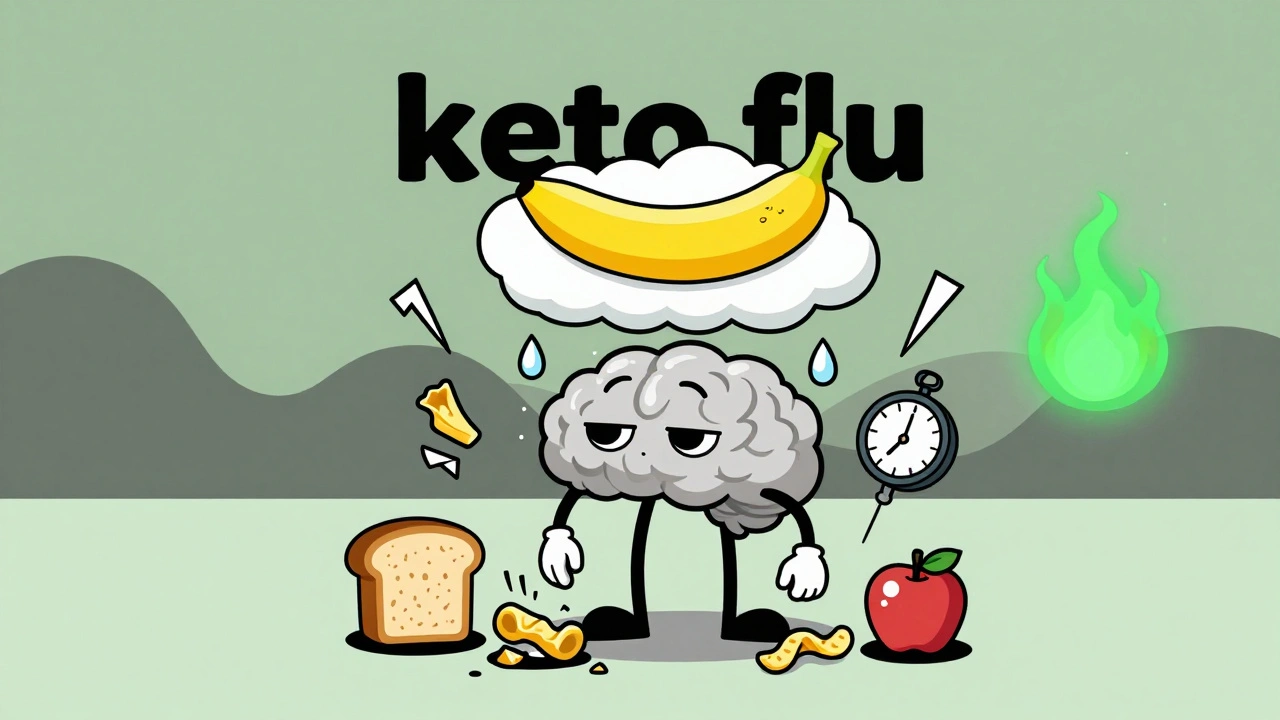
Who Should Pick Which Diet?
If you want fast results and don’t mind a strict, short-term challenge, keto might be your fit. You’re likely younger-18 to 34-and motivated by quick wins. You’re comfortable with tech: tracking macros, testing ketones, using apps. You’re okay with eating mostly animal fats and greens. But if you’re not ready to give up bread, fruit, or potatoes forever, you’ll burn out. If you want lasting change and don’t want to feel like you’re on a diet forever, Atkins is the smarter pick. You’re probably 35 or older. You’ve tried other diets that failed. You want structure, not punishment. You like the idea of slowly adding back foods you love-without regaining weight. You’re willing to read labels and adjust as you go. There’s also a third option: start with keto for 6-8 weeks to reset your cravings, then move into Atkins Phase 3 or 4. A 2023 study found that people who did a 6-month keto phase followed by a Mediterranean diet lost 10% of their body weight and kept it off for a full year. That’s not just weight loss-it’s metabolic retraining.Real People, Real Results
On Reddit, one user wrote: “I lost 50 pounds on keto in 6 months. My blood sugar went from prediabetic to normal.” Another said: “The keto flu nearly broke me. I quit after two weeks.” On the Atkins subreddit, someone shared: “Atkins 40 worked better than keto because I could eat berries and sweet potatoes and still lose weight.” Another admitted: “I hit a wall in Phase 3. I had to cut back on cheese and start walking daily.” The data backs this up. In 2022, 68% of keto dieters lost weight in the first 3 months. But only 35% stuck with it after a year. For Atkins, 62% lost weight early-and 48% stayed on it long-term. That’s the real difference. Keto gives you speed. Atkins gives you sustainability.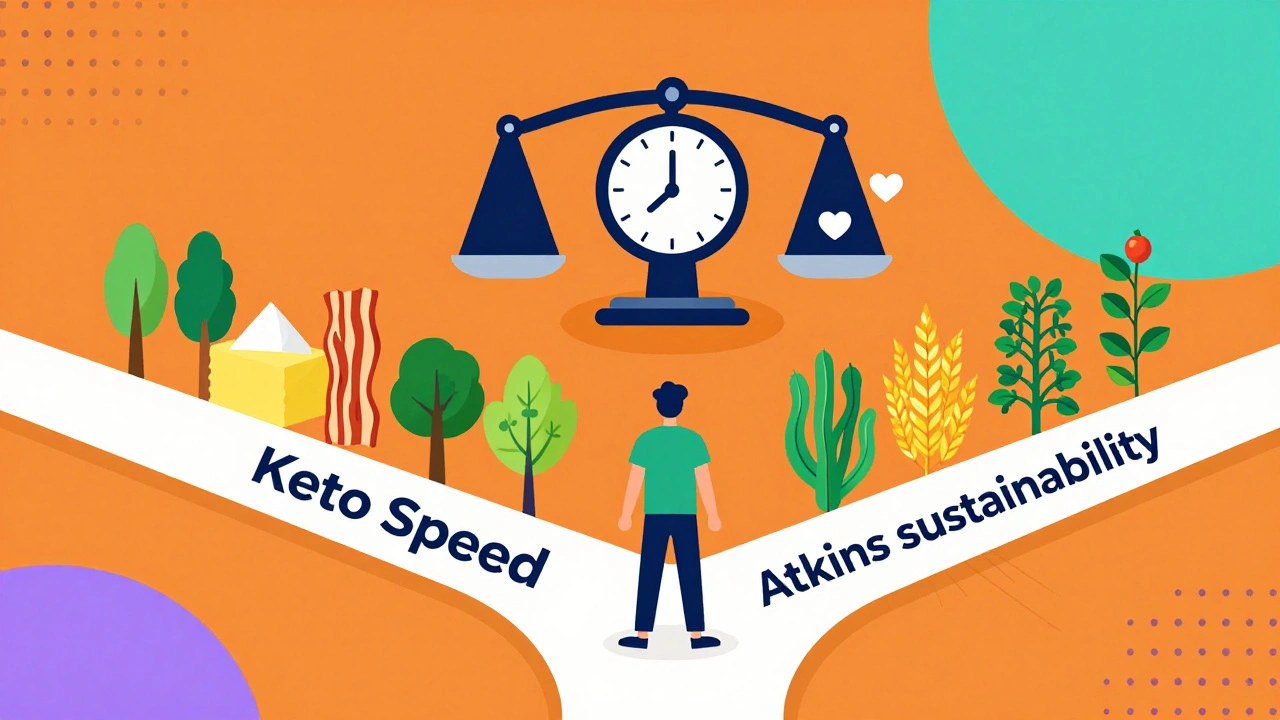
What You Should Do Next
If you’re new to low-carb eating, don’t jump straight into keto. Start with Atkins Phase 1 for two weeks. Cut out sugar, bread, pasta, and processed snacks. Eat eggs, meat, leafy greens, cheese, and healthy fats. See how your energy feels. If you feel great, stay there for another week or two. Then, slowly add back carbs-5 grams at a time. Try half an apple. A small serving of quinoa. A cup of berries. Track your weight and energy. If you start gaining, you’ve gone too far. If you keep losing, you’ve found your personal carb threshold. You don’t need expensive supplements. You don’t need ketone strips. You just need to listen to your body. The goal isn’t to be in ketosis forever. It’s to lose weight, feel better, and never go back to eating like you did before.Frequently Asked Questions
Can I do keto and Atkins together?
You can combine elements, but not the strictest versions. For example, start with keto-style eating for 4-6 weeks to reset your metabolism, then transition into Atkins Phase 3 or 4. This gives you the benefits of ketosis without the long-term rigidity. You’ll still avoid sugar and refined carbs, but you’ll have room for more vegetables, legumes, and even occasional whole grains.
Which diet is better for type 2 diabetes?
Both diets improve blood sugar control in the short term. A 2013 study showed Atkins helped people with type 2 diabetes reduce medication use. Keto does the same, often faster. But long-term, Atkins is easier to maintain because it gradually reintroduces healthy carbs like beans and fruit, which support gut health and insulin sensitivity. The American Diabetes Association says low-carb diets work well for short-term glycemic control, but long-term safety data is still limited.
Do I need to count calories on either diet?
Technically, no-but you still need to be mindful. Both diets reduce hunger by stabilizing blood sugar and increasing fat and protein intake. That naturally lowers calorie intake. But if you eat unlimited amounts of cheese, butter, or Atkins bars, you’ll still gain weight. The key is eating until you’re satisfied, not stuffed. Focus on whole foods, and don’t rely on processed low-carb products as your main meals.
Is keto safe for long-term use?
For some people, yes. For others, it’s risky. Long-term keto can lead to nutrient deficiencies if you don’t eat enough leafy greens, nuts, seeds, and organ meats. It may also raise LDL cholesterol in some individuals. Harvard’s nutrition experts warn that cutting out entire food groups like whole grains and legumes can reduce fiber intake and harm gut health over time. If you stay on keto long-term, get regular blood work and consider working with a dietitian.
What’s the easiest way to start?
Start with Atkins Phase 1: cut all sugar, bread, pasta, and processed snacks. Eat protein (meat, eggs, fish), healthy fats (avocado, olive oil, butter), and non-starchy vegetables (spinach, broccoli, zucchini). Drink plenty of water and add salt to your food to avoid keto flu symptoms. After two weeks, assess how you feel. If you’re losing weight and energized, keep going. If not, adjust your portions or try adding 5 grams of carbs from berries or sweet potatoes.


December 12, 2025 AT 22:57 PM
I tried keto for 3 weeks. Lost 8 pounds. Then I cried over a slice of pizza and quit. Now I eat avocado toast like a normal human. No regrets.
Also, why does everyone act like ketosis is some sacred state? It’s just chemistry. Your body’s not a spaceship.
December 13, 2025 AT 04:47 AM
ATKINS ALL THE WAY!!! 🇺🇸🔥 Keto is for people who think butter is a food group and carbs are a government conspiracy. I’ve been on Atkins for 5 years. Lost 92 lbs. Still eat sweet potatoes. Still have energy. Still don’t need a blood test to know I’m ‘in ketosis.’
Stop selling fear. Start eating real food. #MakeAmericaLoseWeightAgain
December 13, 2025 AT 13:43 PM
Let’s be honest - both diets are corporate shills disguised as health movements. The real agenda? Selling ketone strips, protein bars, and ‘Atkins-approved’ frozen dinners made in a lab by people who’ve never eaten a vegetable.
Meanwhile, the WHO quietly recommends whole grains, legumes, and seasonal produce. But who wants to hear that when you can buy a $12 ‘keto brownie’ that says ‘zero sugar’ but tastes like chalk and regret?
December 14, 2025 AT 10:11 AM
Hi everyone. I’m a nutrition educator with 18 years in clinical practice. I’ve seen hundreds of patients try keto and Atkins. The ones who succeed aren’t the ones who track macros - they’re the ones who learn to listen to hunger cues.
Start with removing ultra-processed foods. That’s the real win. Not ketosis. Not phases. Just… stop eating junk. Everything else follows.
You don’t need a diet. You need a reset.
December 15, 2025 AT 02:47 AM
OMG I DID KETO AND IT CHANGED MY LIFE!!! 🥑💪
Lost 40 lbs in 5 months, my brain fog lifted, I stopped craving sugar like it was my ex 😭
But the keto flu?? I cried in the shower for 3 days. Took electrolytes like candy. Now I’m in phase 2 of Atkins and eating blueberries like a queen 👑
PS: if you’re new, drink broth. It’s magic. I swear.
December 16, 2025 AT 01:58 AM
Weight loss is not about which diet you follow. It’s about whether you can live with it for the rest of your life.
Keto is a sprint. Atkins is a marathon. But the finish line isn’t a number on a scale - it’s feeling strong, clear-headed, and free from obsession.
Choose the path that lets you eat dinner with your family without guilt. That’s the real victory.
December 16, 2025 AT 08:21 AM
Y’all are overthinking this. Keto works. Atkins works. But the REAL problem? You’re all eating too much cheese and butter and calling it ‘healthy fat.’
STOP. Just STOP. Bacon isn’t medicine. Butter isn’t a vitamin. You’re not a caveman. You’re a human who needs fiber, veggies, and sleep.
Also, I typed this with one hand because my wrist hurts from scrolling through keto memes.
December 16, 2025 AT 19:31 PM
I used to think diets were about food. Then I realized they’re about control.
Keto gives you control over your body. Atkins gives you control over your life.
The most successful people aren’t the ones who stick to the rules - they’re the ones who stop fighting themselves.
Try both. See which one lets you breathe.
And if you’re still using keto bars? You’re not healing. You’re hiding.
December 17, 2025 AT 04:48 AM
Did you know the FDA doesn’t regulate keto claims? And Atkins? Their CEO used to work for a tobacco company.
They’re selling hope. And hope is profitable.
I lost weight on keto. But I gained anxiety. I started checking my ketones like a cult member. Now I eat rice. And I’m healthier than ever.
Question everything. Even this comment.
December 17, 2025 AT 21:55 PM
It is a well-established fact that low-carbohydrate diets are not superior to isocaloric diets with higher carbohydrate content for long-term weight management, as demonstrated by multiple meta-analyses published in peer-reviewed journals.
Furthermore, the notion of ‘ketosis’ as a metabolic panacea is a reductionist fallacy that ignores the complexity of human energy homeostasis.
One must consider evolutionary biology, gut microbiota, and epigenetic adaptation before embracing dietary extremism.
December 18, 2025 AT 19:43 PM
It’s not keto vs. Atkins - it’s surrender vs. evolution.
Keto is screaming into the void: ‘I won’t eat carbs!’
Atkins is whispering: ‘I’ll eat them… but only when my body says yes.’
I went from crying over a banana to dancing in the kitchen while making lentil curry. That’s not weight loss. That’s liberation.
And yes, I still eat bacon. But now I eat kale too. And I don’t need a meter to tell me I’m ‘doing it right.’
December 20, 2025 AT 12:35 PM
Start with Atkins 1. Two weeks. No sugar. No bread. Just meat, eggs, greens.
Then add back one fruit. See how you feel.
That’s it. No apps. No strips. No guilt.
Listen. Your body knows. You just forgot how to hear it.
December 21, 2025 AT 14:24 PM
I was skeptical. Then I tried the combo: 6 weeks keto, then Atkins 40.
Lost 50 lbs. Kept it off for 2 years.
But here’s what no one tells you - the real change wasn’t the food. It was the way I stopped punishing myself.
You don’t need perfection. You just need consistency.
And kindness. Always kindness.
December 23, 2025 AT 06:21 AM
For anyone considering either diet: prioritize protein, fiber, and whole foods. Avoid processed ‘low-carb’ products. Hydrate. Sleep. Move daily.
Both diets can work - but only if they’re tools, not cages.
And if you’re still using ketone strips after three months? You’re not optimizing your health. You’re optimizing your anxiety.