
More than half of people taking medication for mental health conditions stop taking them as prescribed. Not because they’re lazy or careless. Not because they don’t care about feeling better. But because the system isn’t built to help them stay on track. This isn’t a personal failure-it’s a systemic one. And the consequences are deadly. In the U.S. alone, non-adherence contributes to around 125,000 deaths every year. For people with schizophrenia, adherence rates hover around 50%. That means half the people trying to manage one of the most complex mental illnesses aren’t getting the full benefit of treatment. And it’s not just about symptoms getting worse-it’s about hospital visits, emergency rooms, and lost years of life.
Why Do People Stop Taking Their Medication?
It’s easy to assume people stop because they feel fine. But that’s only part of the story. The real reasons are messy, personal, and often hidden. One patient told me they stopped because the pills made them feel like a zombie. Another said they couldn’t afford the co-pay after their insurance changed. A third admitted they didn’t believe they were sick. These aren’t edge cases-they’re common.
Research shows the biggest barriers are:
- Side effects: Weight gain, drowsiness, shaking, or emotional numbness can feel worse than the original symptoms.
- Complex schedules: Taking three pills at three different times a day? It’s easy to forget-or to give up.
- Lack of insight: Some conditions, like psychosis or severe depression, make it hard to recognize you need help.
- Cost: A single antipsychotic can cost $300 a month without insurance. That’s more than some people earn in a week.
- Stigma: Fear of being seen as “crazy” or “weak” keeps people from filling prescriptions.
And it’s worse for people without stable housing. Among homeless individuals with serious mental illness, adherence drops to as low as 26%. That’s not because they don’t want to get better. It’s because they’re juggling survival-food, shelter, safety-while trying to remember to take a pill that makes them feel worse.
What Actually Improves Adherence? The Evidence
Not all interventions work. Many programs spend money on apps, reminders, or pamphlets-and see almost no change. But some approaches? They move the needle. Big time.
The strongest evidence points to one thing: pharmacist-led care. Not just handing out pills. Not just answering questions. But active, ongoing collaboration between pharmacists and psychiatrists, with the patient at the center.
A 2025 study in Frontiers in Psychiatry compared two groups: one got regular care. The other got a pharmacist working directly with their psychiatrist. The pharmacist reviewed every medication, checked for interactions, simplified dosing, and followed up weekly. After six months, the collaborative group improved adherence by 1.67 points on a standardized scale. The usual care group? Only 0.69. That’s a 142% greater improvement.
Why does this work? Because pharmacists are trained to spot what doctors miss. They notice when a patient is taking too many pills. They know which medications can be switched to once-daily versions. They can help patients navigate insurance denials. And they’re often more available than a psychiatrist, who might only see a patient every few months.
Kaiser Permanente saw this firsthand. After launching a pharmacist-led program for antipsychotic patients, adherence jumped 32.7% in just 90 days. Hospitalizations dropped by 18.3%. Their CMS Star Rating went from 3.8 to 4.3. This isn’t theory-it’s happening in real clinics.
Simplifying the Regimen Is a Game-Changer
Imagine you’re told to take a pill at 7 a.m., another at noon, and a third at 9 p.m. Now imagine you’re depressed, forgetful, and living in a shelter with no clock. You’re not going to stick to that.
One of the most powerful tools? Reducing dosing frequency. A NAMI survey found that 87% of patients stayed on track with once-daily meds. Only 52% did with multiple daily doses. Yet 73% of patients said their doctor never even asked if they could simplify their regimen.
Switching from three pills a day to one isn’t just convenient-it’s life-changing. Many antipsychotics now come in once-daily versions. Long-acting injectables (LAIs), given every two to four weeks, have shown 87% adherence rates-compared to 56% for oral pills. And they’re not just for schizophrenia. Some mood stabilizers and antidepressants now have extended-release options.
The catch? Many providers still default to old regimens. They don’t ask. They don’t explore alternatives. They assume patients will figure it out.
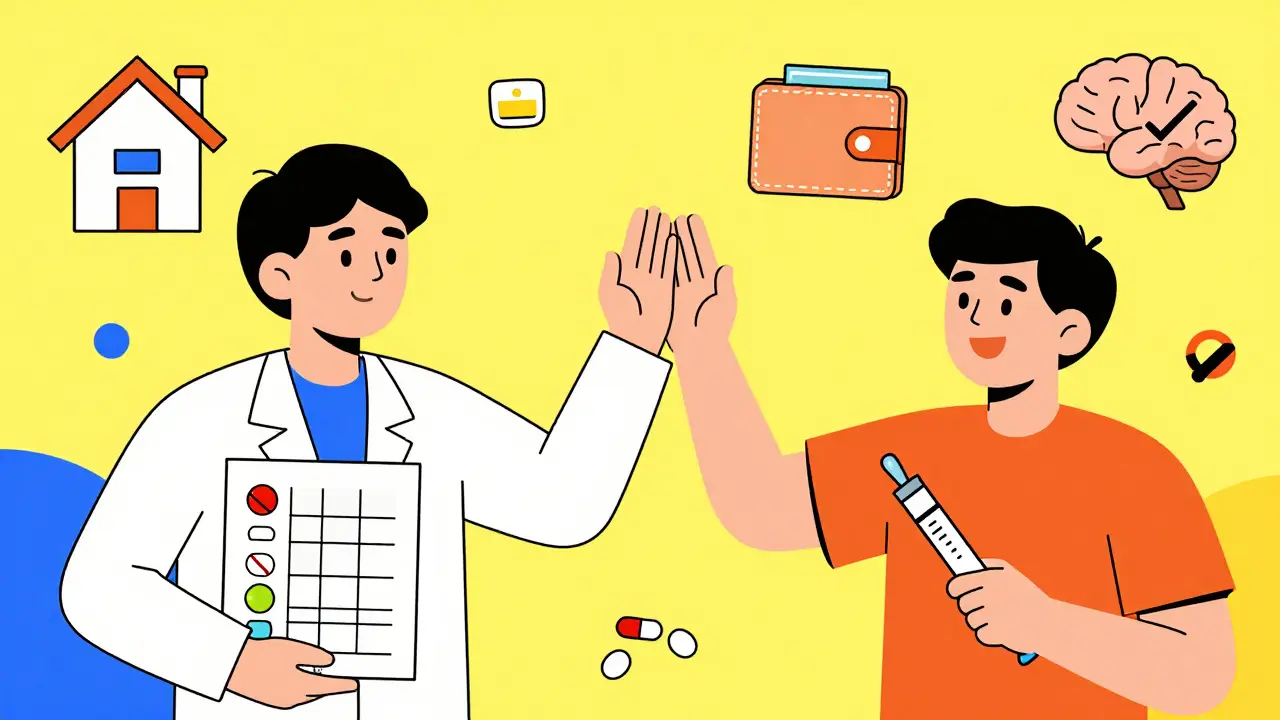
Cost Is the Silent Killer
Medication adherence isn’t just a medical issue. It’s an economic one. And it’s deeply tied to money.
A 2024 study found that patients who faced high out-of-pocket costs were twice as likely to skip doses or stop entirely. For some, choosing between rent and medication isn’t a metaphor-it’s reality.
But here’s the twist: when cost barriers are removed, adherence skyrockets. One program in Minnesota gave patients free access to antipsychotics through a pharmacy partnership. Within a year, adherence jumped from 41% to 78%. No counseling. No apps. Just affordable access.
Insurance companies are starting to notice. UnitedHealthcare now ties 12% of mental health providers’ pay to adherence rates. CMS penalizes Medicare Advantage plans if their patients aren’t taking meds as prescribed. And the FDA is pushing for more long-acting injectables, partly because they reduce overall costs-even if the upfront price is higher.
But here’s the problem: 64% of patients on Reddit’s mental health forum said they couldn’t access pharmacist-led care because their insurance wouldn’t cover it. The solution isn’t just better care-it’s better payment models.
Technology Helps-But Only If It’s Human-Centered
There are hundreds of apps promising to remind you to take your pills. Most fail. Why? Because they treat non-adherence like a memory problem. It’s not. It’s a meaning problem.
People don’t forget because they’re distracted. They forget because they don’t believe the pill matters. Or because it makes them feel worse. Or because they can’t afford it.
But some tech tools are making a difference. A 2025 study in Nature Mental Health used smartphone sensors to track movement, sleep, and voice patterns. The algorithm predicted when someone was likely to miss a dose-with 82.4% accuracy, 72 hours in advance. That’s not just a reminder. That’s a warning system for clinicians to reach out before a crisis.
And AI is coming. Epic Systems is building real-time adherence analytics into its electronic health records by 2026. But again-this only works if it’s paired with human action. A notification is useless if no one responds to it.
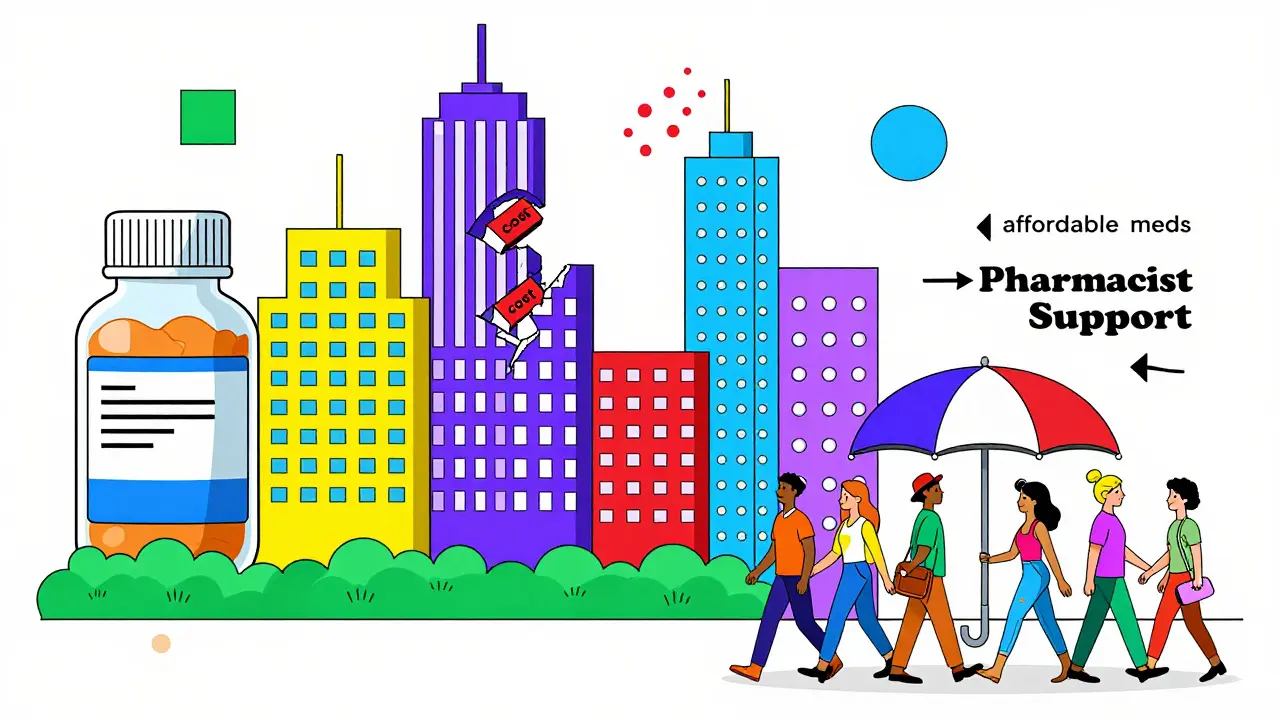
What Needs to Change?
Here’s the truth: we’re treating non-adherence like a patient problem. But it’s a system problem.
What works? Four things:
- Pharmacist integration-putting trained pharmacists on mental health teams, not just behind the counter.
- Regimen simplification-always asking: Can this be once daily? Can we switch to an injection?
- Cost transparency-knowing what a patient can afford before writing a prescription.
- Targeted support-not generic advice, but helping someone who feels worthless or suicidal stay on track.
And it’s not expensive. A medium-sized clinic can launch a full program for $150,000-$250,000. The savings? Up to $1,200 per patient per year in reduced hospitalizations. That’s a 5x return.
The bigger barrier? Culture. Most clinics still measure success by how many patients they see-not how many stay well. Until adherence is tied to provider pay, until pharmacists are seen as part of the care team, until cost is treated as a clinical factor-we’ll keep seeing the same numbers.
What Can You Do?
If you’re taking medication for a mental health condition:
- Ask: Can this be simplified? Can I switch to a once-daily version or injection?
- Ask: What’s the lowest cost option? Can my pharmacy help me find coupons or assistance programs?
- Ask: Can I talk to a pharmacist? Not just the one who fills the prescription-someone who understands mental health meds.
- Speak up if side effects are unbearable. There’s almost always another option.
If you’re a clinician:
- Don’t assume adherence. Ask directly: “How often do you miss your pills?”
- Work with your pharmacy team. Even a 10-minute consultation can make a difference.
- Know the cost of every medication you prescribe. If it’s over $100 a month, have a conversation about affordability.
- Track adherence like you track blood pressure. It’s just as important.
This isn’t about willpower. It’s about design. We can fix this. We already know how. The question is: are we ready to change the system-or keep blaming the people in it?
Why do people with mental illness stop taking their meds?
People stop for many reasons-side effects like weight gain or drowsiness, complex dosing schedules, cost, stigma, or not believing they need the medication. For some, the meds make them feel worse than their symptoms. Others can’t afford them. It’s rarely about laziness or lack of care.
What’s the most effective way to improve medication adherence?
The strongest evidence supports pharmacist-led collaborative care, where pharmacists work directly with psychiatrists to simplify regimens, manage side effects, and reduce costs. Studies show this approach improves adherence by up to 40%, far more than apps or reminders alone.
Can switching to a once-daily pill help?
Yes. One study found 87% of patients stayed on track with once-daily medications, compared to just 52% on multiple daily doses. Many antipsychotics and mood stabilizers now come in simplified forms. Always ask your provider if a simpler option exists.
Are long-acting injections better for adherence?
For many, yes. Long-acting injectables (LAIs), given every 2-4 weeks, have adherence rates of 87%, compared to 56% for daily pills. They’re especially helpful for people who struggle with daily routines or forgetfulness. They’re not for everyone, but they’re an underused tool.
Does insurance cover pharmacist-led adherence programs?
Often, no. Many insurance plans don’t reimburse for pharmacist mental health consultations, even though they save money long-term. Sixty-four percent of patients in one survey said they couldn’t access these services due to coverage limits. Advocacy and policy change are needed to make this standard care.
Is technology like apps and reminders helpful?
Most simple reminder apps have little impact. But advanced tools-like AI that predicts missed doses using smartphone data-show promise. The key is pairing tech with human support. A notification is useless if no one follows up.
How much does non-adherence cost the healthcare system?
Non-adherence contributes to up to 25% of all hospitalizations and costs between $100 billion and $300 billion annually in the U.S. Improving adherence could save billions and prevent tens of thousands of avoidable hospital stays and deaths each year.
What’s Next?
The tools exist. The data is clear. We know what works. Pharmacist collaboration. Simplified regimens. Cost transparency. Targeted support.
What’s missing is the will to scale it. Until adherence is treated as a core clinical outcome-not an afterthought-we’ll keep seeing the same stats: half the people with schizophrenia not taking their meds. A third of the elderly skipping antidepressants. People choosing between rent and treatment.
This isn’t just about pills. It’s about dignity. About being seen. About being supported. And it’s time the system caught up.

December 23, 2025 AT 08:58 AM
So let me get this straight-we spend billions on pills but won't pay a pharmacist $20/hour to actually talk to people? This isn't rocket science. It's basic human decency. Why are we still acting like this is a mystery?
December 23, 2025 AT 21:57 PM
I’ve been on meds for 8 years. The worst part isn’t the side effects-it’s how no one ever asks if you can afford them. They just write the script like it’s a grocery list. I had to choose between my rent and my antipsychotic last winter. No one talked to me about it. Just nodded and moved on.
December 25, 2025 AT 03:32 AM
This is why I love my pharmacist. She doesn’t just hand me pills. She asks how I’m sleeping, if I’ve been eating, if the cost is crushing me. She’s the only one who actually sees me. Doctors? They’re rushed. Pharmacists? They’re the real frontline. 🙌
December 25, 2025 AT 15:58 PM
I stopped taking mine because they made me feel like a ghost. Like I was watching my life through fogged glass. No one told me that was normal. No one asked if I wanted to try something else. I just felt broken for not being able to handle it.
December 25, 2025 AT 22:08 PM
The data is unambiguous. Pharmacist-led interventions yield a 142% improvement in adherence metrics versus standard care. The marginal cost of implementation is negligible compared to the $1,200 per patient annual savings in hospitalization avoidance. Institutional inertia is the only barrier.
December 26, 2025 AT 05:57 AM
In Nigeria, we don’t have this luxury. Many people don’t even get access to the meds at all. But when they do, the ones who stick with them are the ones who have someone-family, community, a local healer-who reminds them, who holds space. It’s not about systems. It’s about people showing up.
December 27, 2025 AT 12:04 PM
The fact that 73% of patients say their doctor never asked about simplifying their regimen is criminal. It’s not laziness-it’s systemic neglect. We treat mental health like a footnote. Fix the process, not the person.
December 27, 2025 AT 19:02 PM
We keep treating adherence like a moral failure. But if you’re choosing between food and your medication, that’s not a choice-it’s a sentence. The system isn’t broken. It was designed this way. We just never noticed because we weren’t the ones paying the price.
December 29, 2025 AT 16:40 PM
I'm from India. Here, people take meds for years but never see a psychiatrist. They go to the local chemist. The chemist gives them a bottle and says 'take one after breakfast.' No follow-up. No questions. No empathy. Just pills. We need pharmacists trained in mental health, not just inventory.
December 31, 2025 AT 06:26 AM
You know what’s really happening? Big Pharma doesn’t want you to take long-acting injections. They make more money off daily pills. They push the apps, the reminders, the fancy tech-but never the real solution. It’s all profit-driven. Wake up.
January 1, 2026 AT 08:24 AM
They say it’s about cost but I think it’s deeper. The government puts meds in the system so people don’t riot. They don’t care if you live or die. They just want you quiet. LAIs? Too expensive to monitor. So they keep you on daily pills so you’re always dependent. It’s control.
January 1, 2026 AT 08:53 AM
I used to think if I just tried harder, if I just remembered better, I could fix this myself. But after six months of missing doses, of feeling like a failure every time I didn’t take my pill, I realized-it wasn’t me. It was the system. The schedule was impossible. The cost was crushing. The side effects were soul-crushing. And no one ever asked me if I wanted to try something else. They just kept writing the same script. I finally switched to a monthly injection last year. For the first time in a decade, I feel like I’m not fighting just to survive.
January 1, 2026 AT 09:26 AM
You’re all naive. This isn’t about pharmacists or cost. It’s about the decline of Western civilization. People don’t take meds because they’ve lost their moral compass. They’ve been coddled into believing they’re victims instead of responsible adults. Take responsibility. Stop blaming the system. It’s character, not cash, that keeps you alive.
January 1, 2026 AT 09:41 AM
The data proves pharmacist integration works. The economics are clear. The human cost is undeniable. Yet we still treat mental health like a charity case. We don’t fund it. We don’t integrate it. We don’t value it. This isn’t policy failure. It’s moral failure.
January 2, 2026 AT 10:51 AM
I was hospitalized three times because I couldn’t afford my meds. Three times. And every time they discharged me, they handed me the same script. No one ever asked if I could pay. No one ever offered help. I stopped going back. Not because I didn’t care. Because I was tired of being treated like a problem to be managed, not a person to be healed.
January 3, 2026 AT 21:07 PM
I work in a clinic. We started asking patients: 'What’s the one thing making it hard to take your meds?' 90% said cost. 70% said side effects. 50% said they didn’t think it was working. We started talking to the pharmacist. Now we change meds before they even leave the office. Adherence went from 48% to 81% in 6 months. It’s not magic. It’s just listening.
January 5, 2026 AT 02:53 AM
Funny how we’ll spend $10,000 on a new MRI machine but won’t pay $50,000 to put a mental health pharmacist in the clinic. We’d rather diagnose problems than fix them. We’re brilliant at spotting symptoms. Terrible at healing people.
January 6, 2026 AT 00:52 AM
Just had my first LAI last week. Felt like I got my life back. No more daily panic about whether I remembered. No more shame when I missed one. Just a quick jab every month. I’m not 'non-adherent' anymore. I’m just... free. 🫶