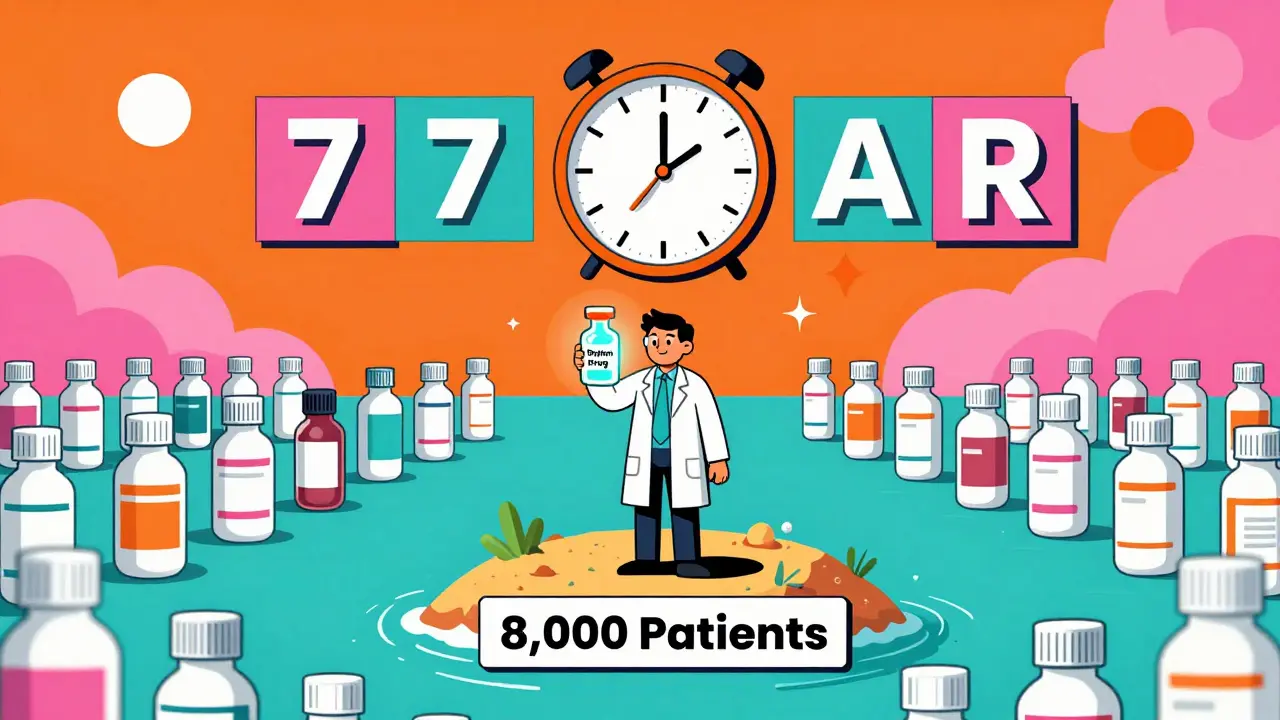
When a pharmaceutical company spends $150 million to develop a drug for a disease that affects only 8,000 people in the U.S., it’s not a charity case-it’s a calculated bet. And the only thing making that bet possible is orphan drug exclusivity. This isn’t just a loophole. It’s a legal lifeline designed to keep rare-disease medicines from disappearing before they ever reach patients.
Before 1983, there were barely any treatments for rare diseases. The FDA defines a rare disease as one affecting fewer than 200,000 Americans. For companies, that’s a financial dead end. Even if the drug works perfectly, there aren’t enough patients to recoup the cost of research, clinical trials, and manufacturing. So, most big drugmakers ignored these conditions entirely. That changed when Congress passed the Orphan Drug Act in January 1983. Signed by President Reagan, the law didn’t just encourage development-it created a real economic model for it.
How Orphan Drug Exclusivity Works
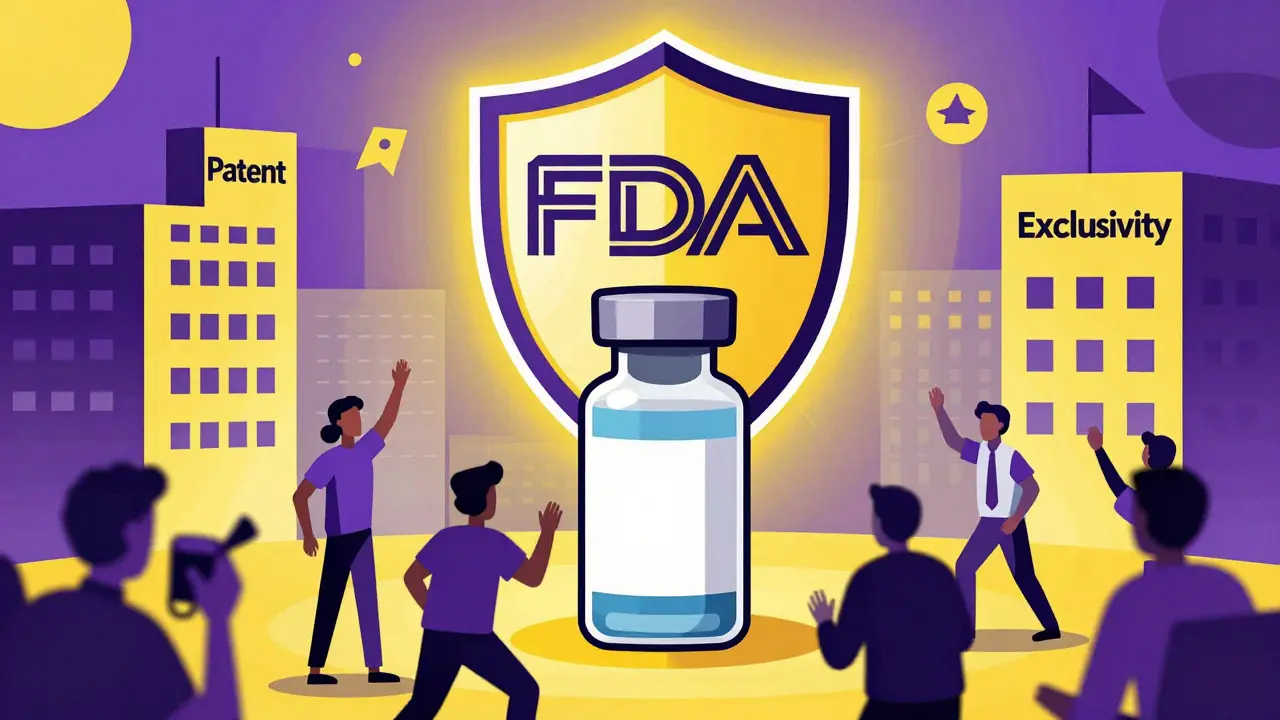
Orphan drug exclusivity gives a company seven years of market protection in the U.S. starting the day the FDA approves the drug for its rare disease use. During that time, no other company can get approval for the same drug to treat the same condition-unless they prove their version is clinically superior. That means better effectiveness, fewer side effects, or a safer way to take it. The bar is high. Since 1983, only three cases have met this standard.
Here’s the key detail: exclusivity isn’t tied to a patent. It’s tied to the specific drug and the specific disease. So if a company gets approval for using Drug X to treat Disease Y, no one else can get approval for Drug X for Disease Y-even if they develop it independently. That’s different from patents, which protect the chemical structure or how the drug is made. Patents can expire. Exclusivity doesn’t. It runs from approval date to seven years later, no matter what.
It’s not a monopoly on the drug itself. If the same drug is approved for another condition-say, a common form of diabetes-the company still has to compete with generics for that use. But for the orphan use? It’s theirs alone.
Why This System Exists
The numbers tell the story. In the decade before the Orphan Drug Act, only 38 drugs were developed for rare diseases. Since 1983? Over 500. That’s a 13-fold increase. The reason? Exclusivity turned a losing proposition into a viable business.
Think about it: a company might spend $200 million to bring a drug to market for a disease affecting 15,000 people. Without exclusivity, generics would enter as soon as the patent expired. But with exclusivity, they can’t touch it for seven years. That’s enough time to build a customer base, establish pricing, and recover costs-even if the price is high.
It’s not perfect. Some companies have used the system to extend protection for drugs already profitable in other markets. Humira, for example, received multiple orphan designations even though its main use is for common autoimmune diseases. Critics argue this stretches the intent of the law. But for most small biotech firms, this protection is the only reason they can exist.
How It Compares to Other Countries
The U.S. isn’t alone. The European Union gives orphan drugs ten years of exclusivity-three years longer than the U.S. But the EU also has more flexibility. If a company completes pediatric studies, they can get an extra two years. And under certain conditions, the exclusivity can be cut from ten to six years if the drug becomes too profitable. The U.S. doesn’t have those adjustments. It’s a fixed seven-year clock.
That difference matters. European regulators are now considering whether to lower the standard period to eight years, especially for drugs that end up selling well beyond the rare disease market. The U.S. hasn’t made any changes yet. For now, seven years remains the rule.
The Real-World Impact
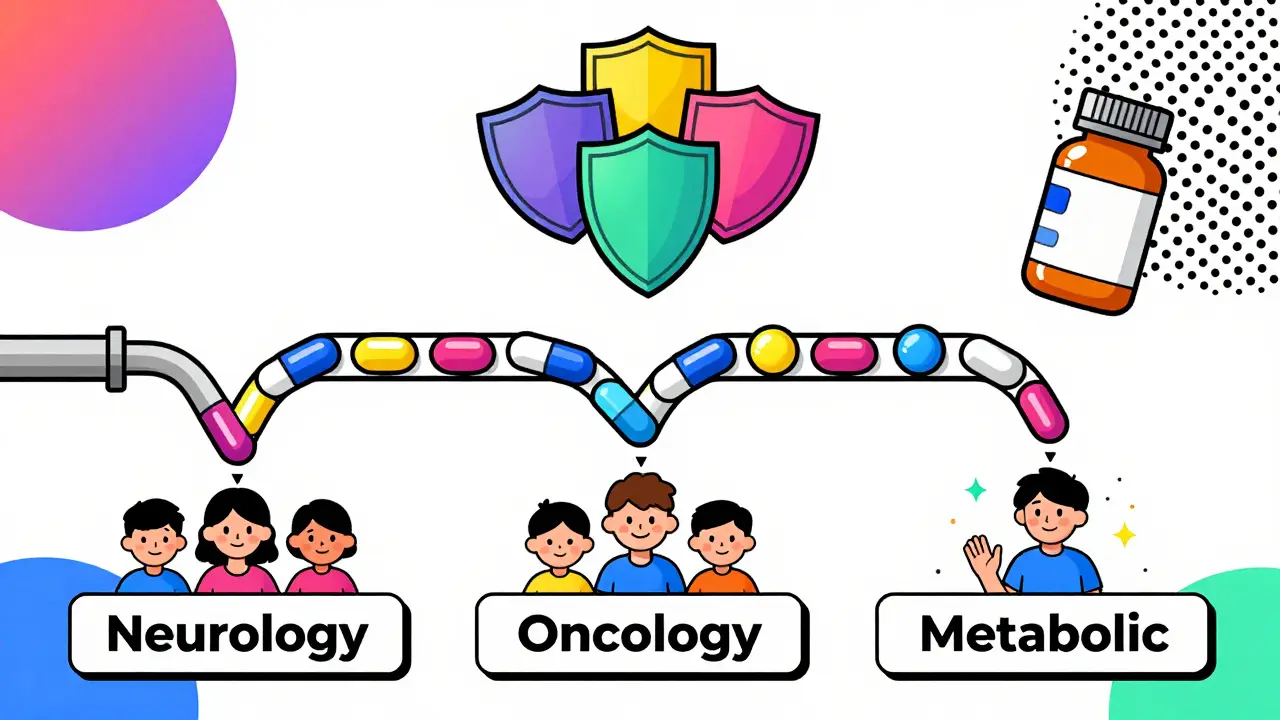
By 2022, orphan drugs made up 24.3% of global prescription sales-$217 billion. That’s up from 16.1% in 2018. Oncology leads the way, accounting for nearly half of all orphan approvals. But neurology, hematology, and metabolic disorders are growing fast. The top 10 orphan drugs brought in $95 billion in 2022. And 72% of new drugs approved by the FDA in 2023 had an orphan designation. That’s up from 51% in 2018.
For patients, this means more options. In 2023 alone, the FDA granted 434 orphan designations-the highest number ever. Conditions once considered untreatable now have drugs on the market. A child with a rare genetic disorder might now have a daily pill instead of lifelong hospital visits. That’s the goal.
But it’s not all progress. The same system that helps small companies also lets big ones game the system. Some companies file for multiple orphan designations for the same drug across different diseases-what experts call “salami slicing.” One drug might have five orphan labels, each giving seven years of protection. That’s not the intent, but it’s legal.
What Sponsors Need to Know
If you’re developing a drug for a rare disease, timing matters. Apply for orphan designation as early as possible-ideally during Phase 1 or early Phase 2 trials. The FDA reviews these applications in about 90 days and approves 95% of them if the disease meets the 200,000-person threshold. But you can’t wait until approval to apply. The clock on exclusivity starts at approval, not designation. So if you delay, you lose time.
You also need to prove the disease is rare. That means solid epidemiological data-not just estimates. The FDA requires population studies, medical records, and sometimes even global prevalence data. A weak case gets rejected. And if another company gets approval first? You lose the exclusivity. It’s a race. Many companies apply for the same indication. Only the first to market wins.
And don’t assume exclusivity protects everything. If your drug is approved for both an orphan and a common disease, generics can enter the market for the common use. You only get protection for the rare disease indication.
What’s Next?
There’s growing pressure to reform the system. In May 2023, the FDA released draft guidance to clarify what counts as the “same drug,” especially after controversial cases like Ruzurgi. The goal? Stop companies from using orphan status to block competition when the drug already has a big market.
Some lawmakers want to require proof of “unmet medical need”-not just low patient numbers. Others want to cap how many orphan designations one drug can get. But for now, the system stays. And it’s working. Nine out of ten biopharma companies say orphan exclusivity is critical to their rare disease pipelines.
The truth is simple: without this protection, most rare-disease drugs wouldn’t exist. Patients wouldn’t have treatments. Companies wouldn’t take the risk. It’s not a perfect system. But it’s the only one we have-and it’s saved lives.
How long does orphan drug exclusivity last in the U.S.?
In the United States, orphan drug exclusivity lasts seven years from the date the FDA approves the drug for its rare disease indication. This period begins at approval, not at the time of orphan designation, and it runs independently of patent protection.
Can another company make the same drug for the same rare disease?
No-not during the seven-year exclusivity period. The FDA will not approve another company’s application for the same drug to treat the same rare disease unless that company proves clinical superiority. That means showing their version offers a substantial therapeutic advantage, like better effectiveness, fewer side effects, or a safer delivery method. Only three cases have met this standard since 1983.
Does orphan exclusivity replace patent protection?
No. Orphan exclusivity and patent protection are separate. Patents protect the chemical compound or how the drug is made, while orphan exclusivity protects the drug for a specific rare disease use. Most drugs rely on patents for longer-term protection. In fact, orphan exclusivity was the main reason for delayed generic entry in only 12% of cases, according to IQVIA. Patents remain the dominant form of market protection.
Can a drug have multiple orphan designations?
Yes. A single drug can receive orphan designation for multiple rare diseases. Each designation comes with its own seven-year exclusivity period. For example, if a drug is approved for Disease A and later for Disease B, it gets seven years of protection for each condition. This practice, sometimes called "salami slicing," is legal but controversial.
What happens if a drug is approved for both an orphan and a common disease?
The orphan exclusivity only protects the rare disease use. For the common disease indication, other companies can still develop and sell generic versions once the patent expires. So a drug might have exclusive rights for treating a rare condition but face generic competition for its other uses.
How do companies apply for orphan drug designation?
Companies submit a request to the FDA’s Office of Orphan Products Development, typically during early clinical development. The application must prove the disease affects fewer than 200,000 people in the U.S. and that the drug shows promise for treating it. The FDA reviews applications in about 90 days and approves 95% of well-prepared submissions.


February 18, 2026 AT 09:39 AM
Wow, this is actually one of those rare topics that makes sense when you think about it. I mean, yeah, the prices are crazy high, but if you're a kid with a disease that no one else is even trying to fix, would you rather have a $500k drug or no drug at all? I'm from India, and we don't even have access to half these meds. So yeah, I'll take the high price over no hope.
February 20, 2026 AT 07:00 AM
Let me tell you something nobody else will: this whole orphan drug system is a corporate racket disguised as humanitarianism. Big Pharma doesn't care about rare diseases-they care about locking down markets. Look at Humira. They got orphan status for like five different conditions, all of which are basically the same disease with different names. It's not innovation-it's legal loophole exploitation. And don't even get me started on how they use the FDA's 95% approval rate to game the system. This isn't helping patients-it's creating monopolies. The fact that they can extend protection by filing for multiple indications? That's not innovation. That's greed with a medical license.
February 22, 2026 AT 02:38 AM
This is why I love healthcare innovation. Seriously. I used to work in a clinic where we had a 12-year-old girl with a metabolic disorder no one had ever seen before. Then this orphan drug came out-expensive, yeah, but it let her walk for the first time. I’ve seen families cry because they finally have a shot. Yeah, there are abuses, sure. But the alternative? Nothing. Zero. Nada. We need to fix the loopholes, not throw out the whole system. These drugs are saving lives. Every single one. Don’t let perfect be the enemy of life-saving.
February 23, 2026 AT 09:47 AM
So basically, if you're a small biotech startup, this is your only shot. Big pharma doesn't touch these diseases. So if you're trying to make a drug for 5,000 people, you need this 7-year window to even break even. It's not a handout-it's a survival tool. I'm not saying it's perfect, but without it? Most of these drugs wouldn't exist. And honestly? I'm okay with that trade-off.
February 23, 2026 AT 18:42 PM
The American system is a disgrace. Ten years in the EU, with reasonable caps on profitability? That’s governance. Here? Seven years, no limits, no oversight. It’s a free pass for pharmaceutical monopolies. Ireland has a public health system-we don’t let corporations turn rare diseases into profit engines. This isn't science. It's capitalism run amok.
February 24, 2026 AT 11:16 AM
It's fascinating how cultural attitudes toward healthcare innovation diverge so dramatically across borders. In the United States, we tend to view market exclusivity as a necessary incentive for high-risk R&D, whereas in many European nations, the emphasis is on equitable access and price regulation. The EU’s flexibility with pediatric incentives and profitability thresholds reflects a more nuanced, socially calibrated approach. Meanwhile, the U.S. system, while effective in driving innovation, lacks the structural safeguards to prevent exploitation. Perhaps a hybrid model-retaining exclusivity but introducing tiered pricing based on national income levels-could offer a more ethically sustainable path forward.
February 25, 2026 AT 16:45 PM
I’ve worked with families who’ve waited years for a diagnosis, let alone a treatment. When the first orphan drug finally arrives, it’s not just medicine-it’s hope. I understand the concerns about pricing and abuse. But the real tragedy isn’t the cost-it’s the silence. The silence of diseases that never got a drug because no one thought they were worth it. This system, flawed as it is, gave voice to thousands who were otherwise ignored. Let’s fix the abuses, not the intention.
February 26, 2026 AT 01:25 AM
And yet, the FDA approves 95% of orphan designation requests? That’s not oversight-that’s a rubber stamp. I’ve seen studies where companies submit the same drug for five different rare diseases with barely any clinical distinction. It’s not innovation. It’s legal fiction. And the fact that they can stack exclusivity periods like building blocks? That’s not a policy-it’s a loophole carnival. 🤡
February 27, 2026 AT 05:48 AM
Let me tell you about my cousin. She had a rare form of muscular dystrophy. The drug that saved her? $700,000 a year. Insurance covered it. But the company? They raised the price 300% after exclusivity kicked in. They didn’t improve the drug. They didn’t add anything. They just… waited. And then they went for the kill. This isn’t a lifeline. It’s a hostage situation. And the FDA? They’re the ones holding the keys.
February 28, 2026 AT 16:59 PM
I’m not against orphan drugs. I’m against the greed. I’ve seen families sell homes to pay for these meds. I’ve seen kids die because their insurance denied coverage. The exclusivity system works-but only if we stop letting companies turn compassion into a profit margin. Maybe we need a cap. Maybe we need transparency. Maybe we need to say: if you’re making $2 billion off a drug for 8,000 people, you’ve gone too far. We’re not talking about innovation anymore. We’re talking about exploitation.
February 28, 2026 AT 20:41 PM
Let’s be honest: this is just another example of Western medical imperialism. The U.S. system is built on the assumption that only American companies can innovate, and only American patients deserve breakthroughs. Meanwhile, in Nigeria, we have children dying from the same diseases-but no access, no research, no funding. This isn't about rare diseases-it's about who gets to be considered human enough to deserve a cure. And guess what? It's not us.
March 1, 2026 AT 11:51 AM
It’s funny how people romanticize this system. You think it’s about saving lives? Nah. It’s about control. The real power isn’t in the science-it’s in the patent office. Companies don’t want to cure diseases. They want to own the narrative. They want to be the only ones who can say, ‘We have the solution.’ And then they charge you for the privilege of breathing. This isn’t medicine. It’s a cult of exclusivity. And we’re all just worshippers.
March 3, 2026 AT 01:02 AM
Okay, I’ll play devil’s advocate: what if we replaced exclusivity with a prize system? Like, if you develop a drug for a rare disease, the government pays you $500 million upfront, and then the drug goes generic immediately. No monopoly. No price gouging. Just innovation rewarded without exploitation. Yeah, it’d cost more in taxes-but we’d save billions in long-term care costs. And patients wouldn’t be stuck in debt hell. It’s not perfect… but it’s worth thinking about. 🤔
March 4, 2026 AT 12:58 PM
My sister’s life was saved by an orphan drug. She was 3. The drug cost $1.2 million a year. We had to move states just to get coverage. I’ve sat in hospital rooms where parents were begging nurses to help them afford the next dose. I’ve watched kids with IVs in their arms cry because they couldn’t afford the pill that kept them alive. So yes, this system saves lives. But it also breaks families. And we’re pretending that’s okay because ‘it’s the only way.’ No. It’s not okay. It’s not enough. We can do better. We have to.
March 6, 2026 AT 04:50 AM
Interesting read. I didn’t realize orphan exclusivity wasn’t tied to patents. That’s a crucial distinction. Makes sense why generics can’t enter even if the patent expires. Still, the ‘salami slicing’ thing is wild. One drug, five orphan designations? That’s not innovation-that’s paperwork magic. I wonder how many of these are just minor variations of the same mechanism. Feels like the system’s too easy to game.
March 7, 2026 AT 15:14 PM
So we’re celebrating a system that lets companies charge $700,000 for a pill because 8,000 people need it? That’s not a lifeline. That’s a hostage crisis. And the fact that we call it ‘progress’ is the real tragedy. We’re not fixing healthcare. We’re just making it more expensive for the people who need it most. And we’re proud of it? Seriously?
March 8, 2026 AT 14:59 PM
It is worth noting that the Orphan Drug Act of 1983 emerged during a period of significant regulatory evolution in pharmaceutical policy, wherein the federal government recognized the market failure inherent in the development of therapeutics for low-prevalence conditions. The seven-year exclusivity provision was not conceived as a subsidy, but rather as a mechanism to recalibrate economic incentives in alignment with public health imperatives. While contemporary abuses are evident, the foundational logic remains defensible: without such protections, the development of disease-modifying agents for ultra-rare conditions would be economically irrational.
March 10, 2026 AT 03:31 AM
The U.S. orphan drug regime exhibits structural inefficiencies that undermine its ostensible public health mandate. The absence of profitability thresholds, combined with the non-transferable nature of exclusivity, incentivizes strategic designation stacking and therapeutic repositioning. Moreover, the FDA’s 95% approval rate for orphan designation applications suggests a permissive regulatory environment that lacks rigorous evidence-based scrutiny. In contrast, the EU’s regulatory framework incorporates dynamic recalibration based on market performance-a model that aligns innovation incentives with equitable access. The U.S. system, by contrast, functions as a de facto subsidy for pharmaceutical monopolies, with minimal accountability.
March 10, 2026 AT 14:58 PM
This system is a moral failure.