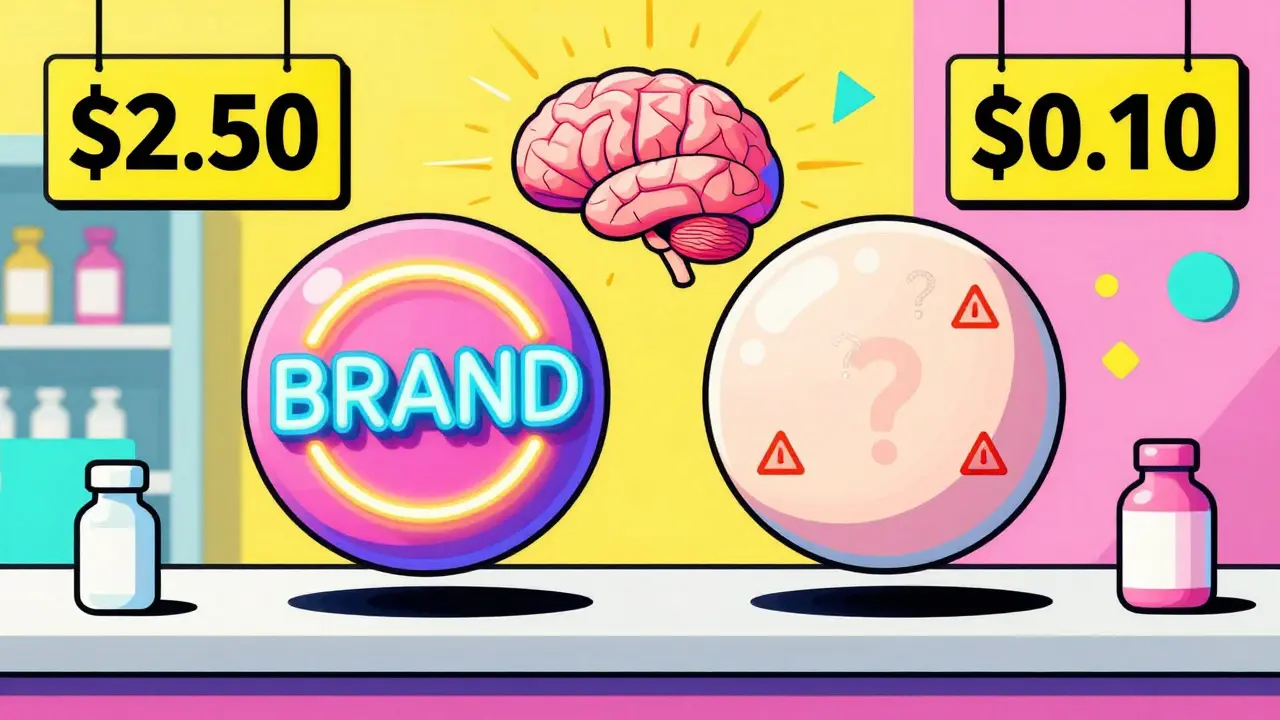
Switching from a brand-name drug to a generic might save you money, but it can also change how you feel the medicine works-even if the chemistry is exactly the same. This isn’t just in your head. It’s science. And it’s happening to millions of people every day.
Why Your Brain Believes Brand Names Work Better
In 2014, researchers at the University of Auckland ran a simple but powerful experiment. They gave people placebo pills-empty capsules with no active drug-but labeled them either as a well-known brand-name painkiller or as a generic version. The results? People who thought they were taking the brand-name pill reported the same level of pain relief as those who actually took ibuprofen. Those who thought they were taking the generic? Their pain relief dropped by nearly 40%. This isn’t magic. It’s the placebo effect in action. Your brain doesn’t just passively receive drugs-it actively predicts how they should work. When you see a familiar logo, a sleek package, or hear the name of a drug you’ve seen advertised, your brain kicks into gear. Brain scans show the dorsolateral prefrontal cortex, the area tied to expectation and belief, lights up 27% more when you think you’re taking a brand-name drug. That surge in brain activity literally changes how your body responds. The effect isn’t just for painkillers. In antidepressant trials, patients on identical sertraline pills reported higher dropout rates and worse symptoms when told they were taking the generic version. The chemical formula didn’t change. But their belief did. And that belief shaped their recovery.The Cost-Expectation Trap
Here’s the kicker: you’re more likely to believe a drug works if it costs more. In a 2008 study, healthy volunteers were given fake painkillers labeled at $2.50 per pill versus $0.10 per pill. The expensive ones? They cut pain by 64% more than the cheap ones-even though both were identical sugar pills. This is why so many people feel worse after switching to generics. They don’t realize the drug is chemically identical. They see the lower price and assume it’s lower quality. It’s a deep-rooted bias: expensive = better. And in medicine, that belief can have real consequences. In one case, a patient stopped taking generic escitalopram because she felt her anxiety had worsened. Blood tests confirmed her drug levels were exactly the same as when she took the brand-name version. Her brain didn’t believe the generic could work, so her body responded accordingly. This is called the nocebo effect-the opposite of placebo. It’s when negative expectations cause real side effects.Generics Aren’t Less Effective-But Your Mind Thinks They Are
The FDA requires generics to be bioequivalent to brand-name drugs. That means they must deliver 80% to 125% of the same amount of active ingredient into your bloodstream. In practical terms, they’re as close as two identical twins. The differences? Minor fillers, colors, or shapes. Nothing that changes how the drug works. But here’s the problem: when a generic pill looks different-say, it’s blue instead of yellow, or oval instead of round-it triggers confusion. Studies show that changing the appearance of a generic drug increases nocebo responses by 29%. People report side effects they never had before, even though the active ingredient hasn’t changed. This is why the FDA now requires generic manufacturers to keep pill appearance consistent. If your generic lisinopril used to be white and oval, it should stay that way. Even small changes can make you think something’s wrong.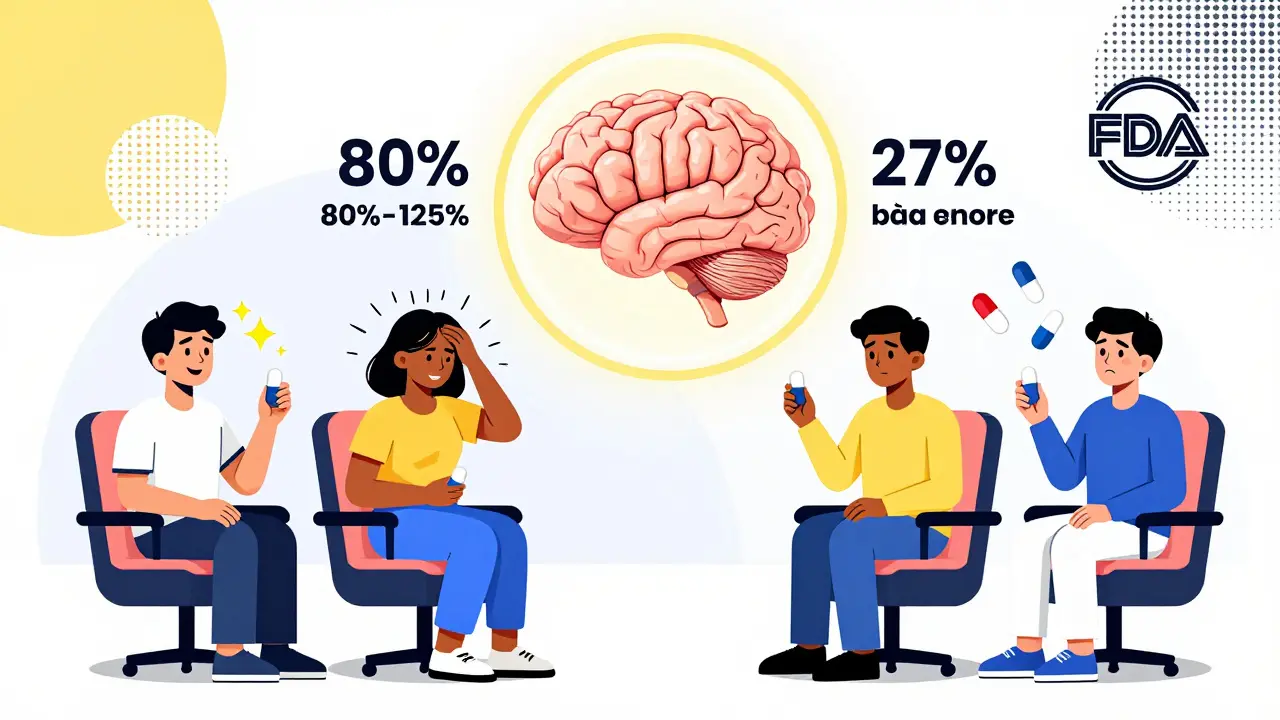
Who’s Most Affected?
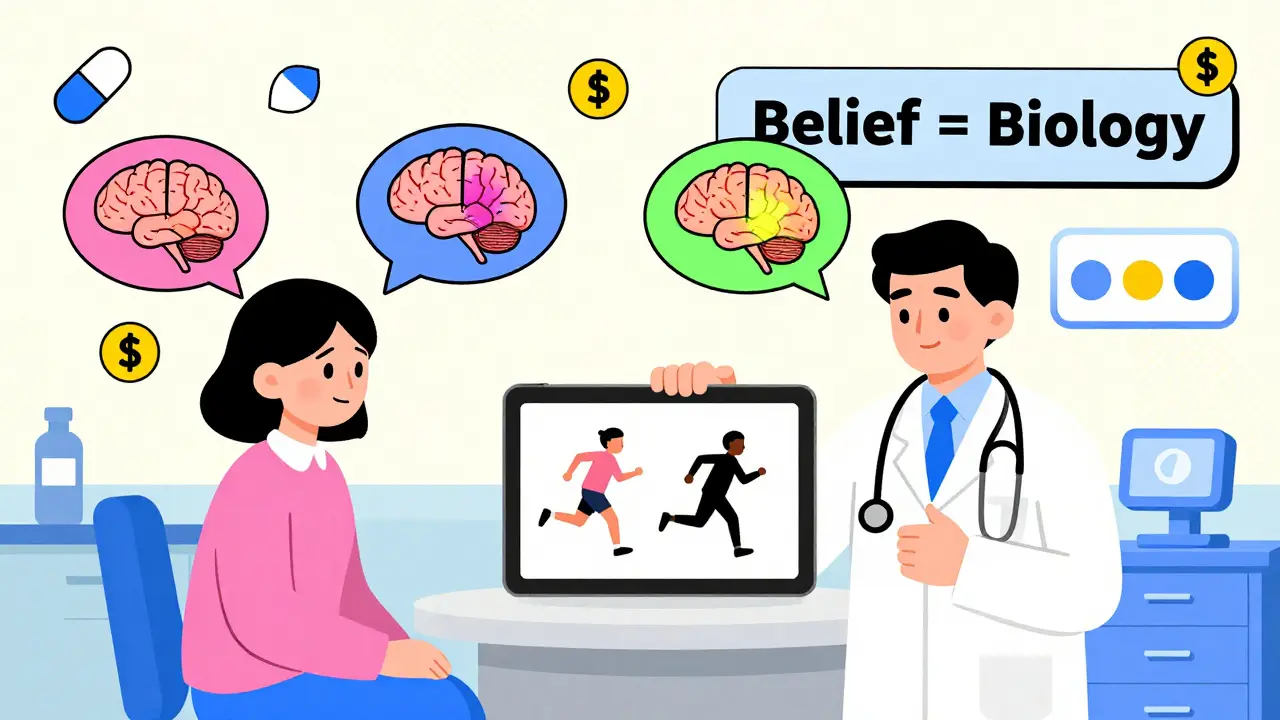
Not everyone experiences this effect equally. People with higher health literacy-those who understand how drugs are made and regulated-are less likely to fall for the brand-name illusion. They’ve read the facts. They know generics are tested just as rigorously. On the flip side, older adults over 65 show a 41% weaker placebo effect. Why? Their expectations are less tied to branding and more tied to past experience. If they’ve been on the same brand for 20 years, they’re more likely to stick with it-even if it costs 50 times more. Younger, more informed patients are more open to generics. But they still need clear information. A 2021 study found that a simple 3-minute conversation with a doctor cut nocebo responses by 47%. That’s not a small win. It’s a game-changer for adherence.How Doctors Can Help-Without Lying
The goal isn’t to trick people into thinking generics work better. It’s to help them understand why they might feel different. Here’s what works:- Explain bioequivalence. “The FDA requires generics to deliver the same amount of medicine into your body as the brand. The difference is less than what you’d see if you took the same pill at different times of day.”
- Acknowledge the feeling. “Some people notice a difference when they switch. That’s not because the drug is weaker-it’s because your brain is used to the old look, the old name. It takes time to adjust.”
- Give a transition window. “Give it two weeks. If you still feel off, we can talk about switching back. But let’s not assume it’s the drug before we’ve given it a fair shot.”
What Patients Can Do
If you’ve switched to a generic and feel something’s off:- Don’t stop cold. Give it two weeks. Your body and brain need time to recalibrate.
- Check the pill. Is it the same shape, color, and size as before? If not, ask your pharmacist. Changes in appearance can trigger nocebo effects.
- Ask your doctor: “Could this be psychological?” Not as a dismissal-but as a way to explore all possibilities.
- Use tools like GoodRx or Drugs.com. Read reviews from people who’ve made the same switch. You’re not alone.
The Bigger Picture
This isn’t just about individual pills. It’s about a $110 billion global market for generics. In the U.S., generics make up 90% of prescriptions-but only 23% of drug spending. Why? Because people keep asking for brand names. The psychological gap costs the healthcare system an estimated $1.4 billion a year in unnecessary brand-name prescriptions. Imagine if every patient who switched to generic metformin, atorvastatin, or sertraline stayed on it because they understood how it worked. The FDA is now testing a 12-minute digital tool called the “Expectation Modulation Protocol.” In trials, it reduced nocebo responses by 53%. It’s not a drug. It’s education. And it might be the most cost-effective treatment we have.Final Thought
A pill doesn’t care if it’s labeled “Lipitor” or “atorvastatin.” But your brain does. And your brain has real power over how you feel. The truth? Generics work just as well. The challenge isn’t science. It’s perception. And perception can be changed-with clear facts, honest conversations, and time.Are generic drugs really the same as brand-name drugs?
Yes. The FDA requires generics to have the same active ingredient, strength, dosage form, and route of administration as the brand-name version. They must also deliver the same amount of medicine into your bloodstream within a very tight range-80% to 125% of the brand. The only differences are inactive ingredients like color, shape, or fillers, which don’t affect how the drug works.
Why do some people feel worse after switching to generics?
It’s often not the drug-it’s the expectation. If you’ve been on a brand-name drug for years and suddenly get a pill that looks different or costs less, your brain may interpret that as a downgrade. This triggers the nocebo effect, where negative beliefs cause real symptoms like fatigue, headaches, or anxiety-even though the drug’s chemistry hasn’t changed.
Can the placebo effect make a generic drug work better?
Yes. Studies show that when identical placebos are labeled as brand-name drugs, patients report stronger pain relief and better outcomes. This isn’t deception-it’s how the brain works. Belief activates real biological pathways. So if you believe a generic works, it can work just as well as the brand.
Do pill color and shape affect how generics work?
Not pharmacologically-but psychologically. Changing the color or shape of a generic pill can increase reports of side effects by 29%. That’s why the FDA now requires manufacturers to keep pill appearance consistent after a switch. Familiarity reduces confusion and helps your brain accept the drug.
Should I avoid generics because of the placebo effect?
No. The placebo effect is a natural part of how medicine works for everyone. Avoiding generics because of it means paying 10 to 50 times more for the same drug. With the right information and support from your doctor, you can switch successfully-and save money without sacrificing effectiveness.
How can I talk to my doctor about switching to generics?
Say something like: “I’ve heard generics are the same, but I’m worried I might feel different. Can you explain how they’re tested? And if I switch, what should I expect?” Most doctors are happy to walk you through the science. A short conversation can make all the difference in your adherence and comfort.

February 28, 2026 AT 09:43 AM
I switched to generic lisinopril last year. At first I thought it wasn't working but I stuck with it. Turns out my blood pressure was more stable than when I was on the brand. Turns out my brain was just freaked out by the different color.
March 1, 2026 AT 08:59 AM
The pharmacokinetic bioequivalence parameters are non-inferior within the 80-125% AUC and Cmax confidence interval thresholds mandated by the FDA. The psychological modulation of therapeutic efficacy via expectational neurocircuitry is a well-documented phenomenon in clinical psychopharmacology.
March 3, 2026 AT 03:54 AM
Americans are too weak to handle a little savings. If you can't afford the brand, you shouldn't be taking the drug at all. This is why our healthcare is broken.
March 4, 2026 AT 18:10 PM
Look I get it, the science says it's the same. But let's be real here. When I was on the brand, I felt like I was taking something that was made with care. When I got the generic, it felt like I was taking a discount store version of my life. I didn't just feel worse physically, I felt like I was being told I wasn't worth the real thing. And honestly? That hurt more than any side effect.
March 5, 2026 AT 06:08 AM
Yesss this is so real!! I switched to generic sertraline and felt like I was falling apart. Then I read up on the nocebo effect and just told myself 'this is your brain playing tricks'. Now I'm doing amazing. You got this!! 💪
March 5, 2026 AT 06:20 AM
It is imperative to recognize that the placebo effect is not a mere psychological artifact but a demonstrable neurobiological phenomenon with clinical significance. The implications for public health policy are profound.
March 5, 2026 AT 09:18 AM
The bioequivalence standards are rigorously enforced. The difference in therapeutic outcomes between branded and generic medications is statistically insignificant. The perceived difference arises solely from cognitive bias and lack of patient education.
March 5, 2026 AT 18:29 PM
You guys are all missing the point. The FDA doesn't test generics for long-term effects. They just make sure the pill dissolves in water the same way. That's not science. That's paperwork. And the fact that people are dying from this is insane.
March 7, 2026 AT 17:42 PM
I used to be the person who demanded the brand name. Then I got a bill for $800 for a 30-day supply. Switched. Felt weird at first. Then realized I'd been paying $700 a month for a placebo with a logo. Now I save $600 and feel fine. Mindset shift is everything.
March 8, 2026 AT 08:57 AM
This is all a Big Pharma scam. The brand names are the real ones. The generics are made in China with cheap fillers that cause cancer. They just changed the label so you'd buy it. I'm not falling for it.
March 8, 2026 AT 17:38 PM
The notion that perception alters physiological response is not merely anecdotal-it is neurologically verifiable. The dorsolateral prefrontal cortex, as cited, modulates endogenous opioid release. This is not 'in your head.' It is your head, doing exactly what evolution designed it to do.
March 9, 2026 AT 03:39 AM
I think what's really interesting is how much of our health is tied to stories we tell ourselves. Like, if you believe a pill is powerful, your body listens. And if you believe it's cheap and therefore weak, your body believes that too. It's not about the chemistry. It's about the meaning we give to the pill. That's wild when you think about it.
March 10, 2026 AT 10:47 AM
The clinical evidence supporting the bioequivalence of generic medications is robust and well-established. Patient education remains the most effective intervention in mitigating nocebo responses and improving therapeutic adherence.
March 11, 2026 AT 22:44 PM
I used to be scared of generics too. Then my mom, who's 72, switched to generic metformin and said she felt better. I asked why. She said, 'Because I stopped worrying I was doing something wrong.' That hit me. Sometimes the medicine is in the peace of mind.
March 13, 2026 AT 15:18 PM
I'm from Ireland and we use generics all the time. No one here cares about the brand. The system just gives you the cheapest effective option. I think Americans are weirdly attached to pharmaceutical branding. It's like buying a car because it has a logo.
March 15, 2026 AT 15:13 PM
This whole thing is a psyop. They know people panic when the pill changes color. So they engineer the switch. They know you'll blame yourself. They know you'll stop taking it. And then they sell you the brand again next month. This isn't about health. It's about profit. And they're using your brain to do it.
March 16, 2026 AT 07:52 AM
You think the FDA is protecting you? They're owned by the same pharma companies that make the brands. The 'bioequivalence' standard? It's a joke. They don't test for long-term absorption. They don't test for interactions. They just check if it dissolves in a beaker. You're a lab rat.
March 18, 2026 AT 06:51 AM
I stopped taking my generic because I felt weird. Then I found out the pill changed shape. I asked for the old one. Got it. Felt fine. So yeah, it's all in your head. But your head is real. And your head matters.
March 19, 2026 AT 09:07 AM
This article reads like a pharmaceutical industry pamphlet. The placebo effect is real, but so is the fact that generics often have inconsistent bioavailability. Why are we ignoring the outliers? Why are we pathologizing patient concerns instead of improving quality control?
March 20, 2026 AT 06:55 AM
Generics are fine. But why do they always change the color? Why not just make them look exactly like the brand? Because they want you to feel like you're getting less. It's psychological warfare. And they win every time.