Finding out your prescription costs more than your weekly grocery bill is a gut-punch. For millions of people, especially those with high-deductible health plans (HDHPs), the gap between the "sticker price" of a drug and what they can actually afford is huge. This is where generic drug discount programs is a system of third-party services that negotiate lower rates with pharmacies to provide patients with reduced prices on medications comes into play. While they aren't insurance, they can be the difference between filling a script or skipping a dose.
How Prescription Discount Cards Actually Work
It is a common misconception that these cards are like coupons you'd find in a Sunday newspaper. In reality, they are more like a membership club. Companies like GoodRx, a digital healthcare platform founded in 2011 that aggregates prescription prices, or Blink Health, a pharmacy technology company that allows users to buy prescriptions at discounted rates, negotiate bulk pricing with manufacturers and pharmacies. When you show a card or a mobile app at the counter, the pharmacy charges a lower negotiated rate, and the discount provider takes a small fee for facilitating the transaction.
There are two main types of these programs you'll run into:
- Pharmacy-Specific Plans: These are run by the stores themselves. Think of the Walmart $4 generic drug program. They set a flat, low price for a specific list of common generics to draw people into their stores.
- Third-Party Discount Services: These are independent apps or websites. They don't own the pharmacy; they just provide the "deal" that you can take to thousands of different locations.
The Magic of Generics vs. The Brand-Name Trap
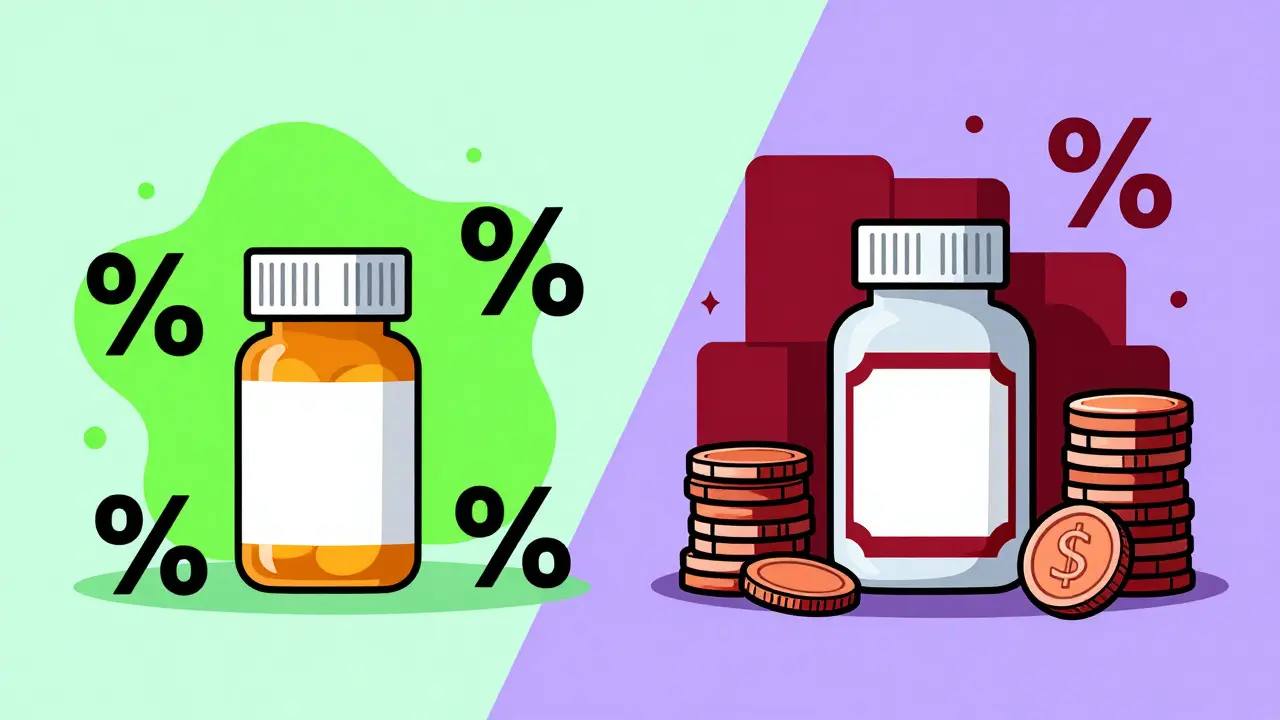
If you're using these cards, the biggest win is always with generic medications. A 2022 study published in Circulation: Cardiovascular Quality and Outcomes showed a staggering difference in results. For patients using a three-drug regimen for heart failure consisting only of generics, these programs brought monthly costs down to as little as $11. That is an average 65% discount compared to paying the cash price.
However, the math changes completely when you move to brand-name drugs. The same study found that when a brand-name SGLT2 inhibitor was added to that heart failure regimen, the monthly cost jumped to between $1,200 and $1,500. The discount on the brand-name portion was only about 10%. If your doctor prescribes a brand-name drug, you should always ask if a generic version exists, because that's where the real savings live.
| Medication Type | Average Discount Rate | Typical Monthly Cost Impact |
|---|---|---|
| Generic-Only Regimens | ~65% | Very Low (e.g., $11/mo for some heart meds) |
| Brand-Name Inclusive | ~10% | Very High (e.g., $1,200+ /mo) |
Who Benefits the Most?
These programs are a lifesaver for the uninsured and those in the "donut hole" of insurance coverage. With 43% of U.S. workers covered by high-deductible health plans as of 2022, many people are effectively paying cash for their meds until they hit a massive deductible. For these users, a discount card is often the only way to make a medication affordable.
But here is the catch: if you have great insurance with a low copay, a discount card might actually be *more* expensive than your insurance. The Ohio State University College of Pharmacy noted that these tools are most beneficial when you have no coverage or very high out-of-pocket requirements. Always check your insurance copay first before switching to a discount card.
The "Shopping Around" Struggle
Saving money this way isn't always as simple as clicking a button. It requires what some experts call "administrative burden." You might find that NeedyMeds, a non-profit providing patient assistance and discount programs, has a better price at one pharmacy, while GoodRx is cheaper at the one across the street. Prices can vary wildly even within the same zip code.
Real-world users often report a frustrating experience. On forums like Reddit, patients have mentioned the same drug costing $15 with one app but $42 with another at the exact same pharmacy. This inconsistency means you have to be proactive. If you're managing multiple chronic conditions, spending 15 minutes per prescription to compare prices can become a part-time job. In some cases, this "hunting" for the best price can even lead to medication delays if you can't find a price you can afford immediately.
New Trends: Integrated Discounting
The industry is moving toward making this easier. We are seeing the rise of "integrated discount card programs." Instead of you manually searching for a coupon, some Pharmacy Benefit Managers (PBMs) like Express Scripts or OptumRx are beginning to automatically apply the lowest available price-whether it's from your insurance or a discount card-at the point of sale. This removes the guesswork and the need to visit multiple pharmacies.
Additionally, some platforms are expanding into telehealth. This allows you to see a doctor and get a prescription that already has the discount applied, creating a more seamless path from diagnosis to medication. While this is convenient, it's still worth remembering that the most significant savings always come from the switch to a generic drug.
Pro Tips for Maximum Savings
To get the most out of these programs, follow these rules of thumb:
- Always Ask for the Generic: If the doctor wrote "Dispense as Written" (DAW), ask if you can switch to a generic. The discount cards work best here.
- Compare Three Sources: Check a pharmacy-specific plan (like Walmart), a major app (like GoodRx), and a non-profit (like NeedyMeds).
- Check Your Deductible: If it's January and you haven't met your deductible, the discount card is almost certainly cheaper.
- Use the Apps: Prices change frequently. Don't rely on a printed coupon from three months ago; check the app the day you go to the pharmacy.
Are prescription discount cards the same as insurance?
No. Insurance is a contract that covers a percentage of health costs. Discount cards are third-party negotiated rates. They do not count toward your insurance deductible and are not a replacement for health coverage.
Can I use a discount card and insurance at the same time?
Generally, no. You have to choose one or the other at the pharmacy counter. You cannot "stack" a discount card on top of an insurance copay.
Why are prices different at different pharmacies for the same card?
Pharmacies negotiate their own rates with the discount providers. Because each pharmacy has different overhead and profit margins, they may agree to different discounted prices for the same medication.
Do these cards work for brand-name drugs?
Yes, but the savings are usually much lower-often around 10%. The most substantial savings (sometimes over 60%) are exclusively found on generic medications.
Is there a cost to join these programs?
Most popular services like GoodRx and Blink Health are free to use. They make their money through fees paid by the pharmacies, not by charging the patients.

April 27, 2026 AT 03:14 AM
Just a heads up for everyone, if you're using these apps, always check if the pharmacy has a 'house' discount first. Sometimes the store's own generic list is actually cheaper than the GoodRx price, even if the app says it's the best deal in town. Also, don't forget that some pharmacies can actually transfer your script for free if you find a significantly cheaper price across the street, so don't be afraid to move your meds around to save a few bucks.
April 28, 2026 AT 13:48 PM
It's honestly wild how much of a difference a little bit of research makes in our healthcare system! ✨ Love seeing ways people can take back some control over their wallets. It really makes you think about the value of health versus the cost of the medicine. 🌈🙏
April 29, 2026 AT 16:17 PM
The absolute audacity of the pharmaceutical industry to treat basic survival like a luxury subscription service is just breathtaking. It's a parasitic circus where the clowns are the executives and the audience is paying for the privilege of being robbed. This whole "coupon" game is just a band-aid on a bullet wound, a pathetic attempt to make the systemic theft feel like a "discount" while the corporate ghouls keep sucking the marrow out of the middle class. It's a grotesque theater of the absurd where the only thing being "negotiated" is how much of your dignity you're willing to trade for a pill that should cost pennies. Truly a masterpiece of capitalist cruelty.
April 30, 2026 AT 15:03 PM
This is simply... inadequate!!! 🙄 Why are we acting like these apps are a solution when they are merely a symptom of a broken system??? 🧐 It is truly laughable to suggest that a "coupon" fixes the lack of basic regulation in the US market!!! 🤡
May 1, 2026 AT 07:10 AM
Interesting perspective. It's a strange paradox where the tools designed to help us save money actually add more labor to our lives. We've essentially turned healthcare into a side-hustle of price-matching.
May 1, 2026 AT 19:26 PM
I mostly just use the walmart list since it's easier then searching every app on my phone lol.
May 2, 2026 AT 07:04 AM
I really feel for everyone struggling with these costs, and I want you to know that it is okay to feel overwhelmed by the process of searching for the best price because it really is a lot of work to manage, but if you keep at it and just take it one step at a time, you can definitely find those savings that make a huge difference in your monthly budget, so please stay positive and keep advocating for yourself at the pharmacy counter because you deserve affordable care.
May 2, 2026 AT 10:39 AM
You're all missing the point here. The real issue is that some of you aren't disciplined enough to manage your health proactively, and then you complain about the price. It's all about the mindset.
May 3, 2026 AT 15:22 PM
The premise that these tertiary discount mechanisms constitute a viable healthcare strategy is fundamentally naive. One must acknowledge that the administrative burden mentioned is an inherent failure of the market's efficiency.
May 4, 2026 AT 05:20 AM
American system is a joke. Total failure.
May 4, 2026 AT 10:40 AM
The asymmetrical information gap between PBMs and the end-user creates a perverse incentive structure. This isn't a "discount," it's a marginal utility adjustment within a captured market. Purely transactional.
May 5, 2026 AT 11:56 AM
It's kind of a trip how we've accepted that we need a third-party app just to get a fair price on a generic. Like, why is the base price so high that a "discount" makes it reasonable?
May 6, 2026 AT 23:58 PM
I use the apps and they work well.
May 8, 2026 AT 23:02 PM
The pharmacological efficacy of generics is well-documented, yet the socioeconomic barriers to access persist due to these convoluted pricing tiers. It is a systemic inefficiency.
May 9, 2026 AT 02:39 AM
just go to costco they dont even need a member ship for pharmacy stuff usually!! way cheaper then those stupid apps anyway
May 11, 2026 AT 02:24 AM
People who don't use generics are basically just paying a 'brand name tax' because they're too lazy to ask their doctor for the cheaper version.
May 11, 2026 AT 14:25 PM
I tried using one of these last week and the pharmacist looked at me like I was crazy when the price changed by ten dollars. It's awkward.
May 11, 2026 AT 20:06 PM
Perhaps we should reflect on the ethics of a system where health is treated as a commodity to be negotiated. It is a profound tragedy that such tools are necessary for the basic maintenance of life.
May 12, 2026 AT 02:40 AM
USA healthcare is a disaster, but at least we have the freedom to choose which app we use to save a few cents!